

GRANTS, NM – Has the student in your family ever complained about not liking a particular class because they don’t see a future for it? “I’ll never use math!” Or, “I don’t like to read.” The Career and Technical Education (CTE) Program is the answer to those problems, “helping all students acquire challenging academic, technical, and employability skills to succeed in postsecondary education and in-demand careers.” (https://www,ed,gov) Jesse Rivera, Residential Construction instructor at Grants High School, is enthusiastic about his class, and looking at their projects, the students feel the same.
In the enormous workshop- classroom, there are three in-progress structures. One two-story small house, the frame of another with gingerbread trim, and a sophisticated chicken coop. Each project has a professional look, smooth, solid, and sturdy. The Residential Construction class is only one class that is contributing to the future of the students and the community as part of the CTE program.
Rivera has been the woodworking instructor for three years at GHS, teaching grades nine through twelve. The class gives young students the skills to build an actual house. That includes how to frame a building, how to figure the dimensions for a roof, the necessary tools, and the safety procedures.
Before graduating the four-year high school program, the students can also earn certification to make them employable upon graduation. While many students will be embarking on careers that require four to eight years of college, CTE grads can enter the workforce.
In this case, the Carpenter’s Union has certain certification requirements. One required certificate that the students can earn is the NCCER (National Center for Construction Education and Research) These certifications demonstrate up-todate knowledge of safety procedures and adherence to construction requirements, and employers use the NCCER registry to verify qualifications. (What Is NCCER Certification? Plus Benefits and How To Earn | Indeed.com) A certificate that attests to their knowledge of safety procedures, and is another industry requirement is the OSHA 30 Safety Certification. Along with the certification they can earn, the students also will have credit towards their degree at the next level.
The good news is that “they should be able to go right into the industry and get a job. They will know how to use all the tools. They will know how to do all the math, and they will know all the safety precautions that are necessary to be safe.” Encouraging words from Rivera.
“Most adults don't even understand how to read a tape measure,” a surprising remark. “I want them to learn and use every single tool. I like for them to touch it, I like them to use it. I like for them to just get the whole concept that they can use any tool that's put in front of them. So they learn to use all the tools that they will need to use in the industry. For the most part, every tool that is in this shop they could build a house with.”
Are there any girls in the program? “I don't want to say it's half-and-half, but it'd be pretty close.”
There is also a portion of the curriculum that addresses business, for those who might be interested in becoming an entrepreneur. For example, Rivera pointed out the projects in the room, “There's two starters back there, and then there's this redwood that's a chicken coop.” Build the coop for farmers, or raise your own chickens.
The bellringer for the day was still on the whiteboard - What makes a bad boss? They write the question down and then they have about a five-minute conversation on that topic of the day.
“This was actually a three-part question. What makes a good boss, what makes a bad boss, and what do they have in common. This is a question that I’ve used three years in a row. They’ll come to find that communication is a word that comes up, and an answer that comes up, in all three of those questions,” said River.
“They start to grasp the concept of communication with the people that you work with and your bosses, and how that’s a big point of working. That question improved their performance in the class. I would say 100% have improved the way they work in the shop, because it gives us all a chance to be able to communicate with each other, to have a discussion with each other, to feel comfortable with each other. And it lets them know that I’m not here just to give them a grade and throw them out into the shop. It kind of brings it together, we become more personal.”
To answer our original question about our students appreciating the basics, Rivera is very aware of the benefits imbedded in the CTE program.
“One of the projects that we do, a winter project, is the project that we’re working on now, where they get to pick a project. I get to approve it, and they get to build whatever they want. In order for them to be able to do that, they have to draw a blueprint, they have to write a description of exactly, step-by-step, how they’re going to put it together. It has to have all the measurements. It has to have all blueprint symbols on it, and they find out quickly that if their math isn’t good, it’s not going to translate here. Also, they find out if they can’t write very well.
“I like to tell them, this is just like when you guys were in fifth grade and you had to write -how to make a peanut butter and jelly sandwich, step-by-step. We just need to be very detailed with how we’re describing. You’re telling a story to somebody, and you may not be there to explain yourself, so they have to be very, very descriptive.
“They come to find that even though this is an elective class, it’s very involved with English, math, and science, so that’s wonderful.”
What are some of the occupations that they will be qualified for after this class? General contracting operation, for one option. Of course, they would start at the bottom, but they would have the knowledge they’ll need when they start working.
Because not all of them will go to college. And that’s what CTE is really about. It’s really about focusing on those individuals where college may not be something that they want to pursue. Maybe they want to start working and making money right away. This is going to help them be a lot more successful because they’re going to be ready for it.”
Could this course that concentrates on construction skills also lead to a career in architecture?
“I have some students who have drawn blueprints that I have told, “You need to go into architecture. You’re above and beyond what I’m capable of doing. I’ve had at least two every year.
“Some of their drawings are just phenomenal, and they never even thought about it. Then I told them, take a look at this, you know, you could be an architect. That’s one thing about this class I like to tell them, yes, it is residential construction, but it’s a lot more than that.
This class in the CTE program teaches communication as well as skills. The students not only become the designers and the craftsmen but also the managers who can communicate with their crew.
In the fourth and final year of Residential Construction, the students are learning electrical and plumbing, additional skills that they can be certified in.
“They’re just gaining some basic knowledge,” added Rivera, “and to see if maybe it’s something that they would like to pursue. Then they would have to go to CNN or even the branch here.”
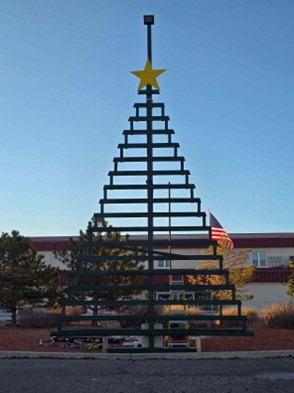
The 305-foot tree on display at the school’s entryway took all seven classes about 11 days to construct. Each class worked on it for about 50 minutes, or a full class period.
The tree was the request of Ms. Stevy Elkins’, GHS Principal. “She asked if we could build a Christmas tree for outside.”
“My hall pass is actually a Christmas tree.” He pointed to an approximately 4-foot replica of the Christmas tree.
“She saw them carrying it around, and said ‘I’d like to get a couple of those for the front of the school.’ I introduced the idea to the kids, and all the students said, yeah, let’s do it!”
“We were about halfway through with the first design, and we realized that it wasn’t quite going to work the way I wanted it to. On the first attempt of moving it, it started moving and wobbling in places I didn’t really want it to. So, I told them we have to take it apart. They were a little devastated. They had just worked probably about six days on it.
“So we took it apart, redesigned it, put it back together, and we went out and started putting it up.”
Following his own advise, Rivera expressed gratitude for the help and encouragement frothe community and the administration. Mag Electric allowed Rivera’s classes to use their boom truck to raise its three sections.
“Three 10-foot sections that we picked up and put on top of each other. There’s brackets holding it to the metal pole that the welding program built for us. And then our media department got time-lapse video of us putting it together here in the classroom.
“We had it actually right here. We didn’t have desks in here because this was the biggest spot we had. Sso we moved all the desks to the side and they did a timelapse video of all the kids working on it, every class.”
“Our administration here at Grant High School is amazing. They’re super supportive. They just embraced letting the kids do something like that.”
Rivera also praised his classes. They hadn’t been confident they could make such a structure, but he had confidence in them.
Young students do not need to wait until high school if they are interested to learn new skills. CTE starts in the middle school.
“A lot of our CTE programs have a pathway that takes them from middle school all the way until they graduate. The middle school portion is for them to see if that’s something they’re interested in,” said Rivera.
Students can start to focus on a career pathway in middle school. When they get to high school they can on the career pathway that they’ve become interested in.
In its inception, the CTE program had been affected by COVID. Professionals began to notice that there were a lot of people who weren’t in the industry anymore. They had left, retired, or suffered from COVID. There was nobody to fill their places, and the workforce was suffering from a lack of skilled workers and knowledgeable trainers. The CTE program, which today is nationwide, is filling that need.
Does Rivera think that the CTE program has affected the dropout rate? He believes it has made a positive difference.
“If I can get a student, who wants to be in my class but has to be here for the rest of the day just to be in this class, then I think that everybody benefits. My students love being in my class, they love coming to class, they love working with the tools. So, my opinion is that it’s definitely going to help. We are going in the right direction.”