

“History is written by the victors,”-Sir Winston Churchill, British statesman.
This month’s quote emphasizes the power of the “winners” to shape the historical record to glorify their actions.
I chose this book because it is a timely followup to my July 2 column, the proposed Equal Rights Amendment to the U.S. Constitution.
Agitating for the right to vote and the success of those efforts in the early years of the twentieth century in Europe and America changed the status of women. The right to vote meant they were no longer hampered by the cultural standards which defined acceptable behaviors, social roles, and the belief that “a woman’s place was in the home, not the workplace.”
In contrast, Indigenous communities have traditionally held women in high regard because of their knowledgeandskillsascuranderas, shamans, and healers.
European women were solely responsible for the household gardens which provided food for the family and included numerous medicinal plants for healing injuries and combating illnesses, according to literature from the early medieval era.
Distinguished author Dr. Susan Groag Bell, 1926-2015, was a Czech-American pioneer in Women's Studies at a time when there were no academic courses nor textbooks offered in women's history. Her research included compiling images from artworks to highlight the role of women in society from the Middle Ages through the Victorian Era.
Dr. Bell began presenting lectures in 1971 that focused on female roles from cultures around the world. She wrote a short outline in 1976 that emphasized “women’s place in [horticultural] history and how it had largely been written out because male historians saw no reason to include anything about women and their contributions. The men in charge did not see them [women] as fully adult.”
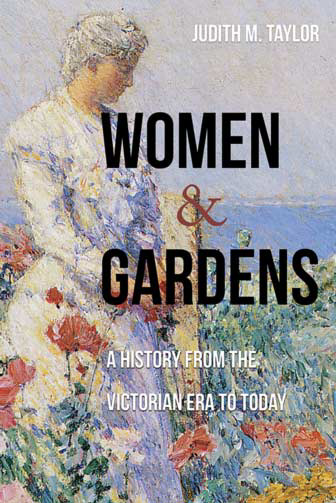
Bell’s outline became the framework for Judith M. Taylor’s latest book, “Women & Gardens, A History From The Victorian- Era to Today.” Taylor wrote seven chapters to flesh out Bell’s outline. The introduction emphasizes the rules that for centuries have defined the social status of European women. These “norms” have consistently hindered women’s efforts to gain knowledge in any field of human endeavor.
Taylor explores the opportunities available to female gardeners in the Eighteenth Century, the advent of horticultural colleges and landscape design, plant breeding, and the symbolism created by women gardeners. The author highlights women’s contributions from cultures around the world. Many of these gardeners have attained international acclaim.
She provides in-depth knowledge of modern day female gardeners in the final section. These are women who have contributed to the advancement of horticultural science and landscape design. Some of the more renowned include a British landscape artist, an American landscaper, a French horticulturist, and New Zealand rose breeder.
British landscaper Gertrude Jekyll, 18431932, revolutionized gardening design in England and the United States. She emphasized the importance of linking the house and garden as a single unit. Jekyll is recognized for her significant contributions in utilizing color to create harmonious outdoor spaces.
Beatrix Jones Farrand, 1872-1959, is known for designing the grounds of Dumbarton Oaks, Washington, D. C., her landscaping at Princeton, New Jersey, and at the English boarding school, Dartington Hall, in South Devon, England. She was born into New York high society which is commonly known as the famous Four Hundred (a list of New York City's elite socialites that was compiled in the late 19th century during the Gilded Age). American author Edith Wharton (18621937) who was Ferrand’s aunt has described this elitist group in her novels.
Marie Louise (nee Paulino) Meilland, 19201987, created 120 rose cultivars. The Peace Rose was developed by her husband, Francis. The seedlings were successfully smuggled out just as the Germans were advancing into France during WWII. The Peace Rose was released for commercial sales in the U.S. after 1945.
Nola Gordon, 19302011, introduced the first brown floribunda rose, Hot Chocolate, to the commercial markets in 1978. Gordon served in all the offices of New Zealand rose organizations and was awarded a Lifetime Achievement Award by the Royal National Rose Society of the
United Kingdom.
Judith M. Taylor has written several books about the history of gardening.
She has been internationally acclaimed as today’s foremost horticultural historian. “Women & Gardens” is especially timely because it highlights the long-term gender bias in all fields of endeavor. This mind set is being challenged throughout the Western world today, according to the past president of the Royal New Zealand Institute of Horticulture.
SIDEBAR
Judith M. Taylor (1934 - ) is the author of five books about horticultural history: 'The Olive in California: history of an immigrant tree” (2000), 'Tangible Memories: Californians and their gardens: 1800-1950” (2003), 'The Global Migrations of Ornamental Plants: how the world got into your garden” (2009), 'Visions of Loveliness: the work of forgotten flower breeders' (2010), and most recently “Women & Gardens, A History From The Victorian- Era to Today” (2025).
The author, a retired Oxford educated physician, was born in London, England. She has been a resident of California since 1994.
Title: “Women & Gardens, A History From The Victorian-Era to Today” Author: Judith M. Taylor Publisher: University of New Mexico Press, unmpress.com Published: 2025 Paperback: 218 pages, includes numerous black-and-white photographs