
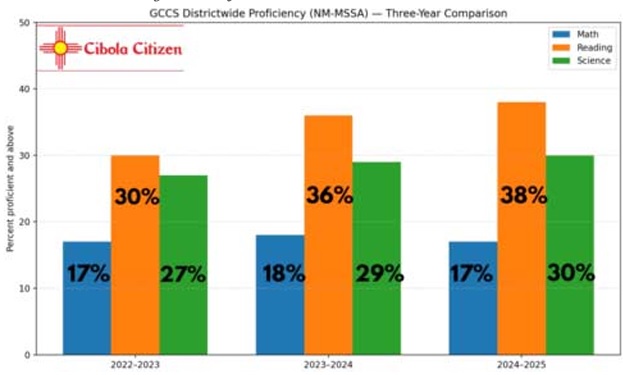

GRANTS, N.M. – Updated student testing results released through the New Mexico Public Education Department’s NMVistas report cards show Grants-Cibola County Schools continuing to show low proficiency rates overall, with a clear three-year trend of improvement in reading and science but little movement in math.
The most recent results reflect the results of the statewide test, NM-MSSA, that New Mexico students take at the end of each school year.
NMVistas publishes school and district “report cards” based on end-of-year statewide assessments (NM-MSSA) that measure how many students score “proficient and above” in math, reading, and science.
In Grants-Cibola County Schools, districtwide proficiency increased in reading from 30 percent in 2022–2023 to 36 percent in 2023–2024 and 38 percent in 2024–2025; while science rose from 27 percent to 29 percent to 30 percent over the same period. Math, however, remained essentially flat at 17 percent in 2022–2023, 18 percent in 2023–2024, and 17 percent in 2024–2025.
Widner, Executive Director for Teaching and Learning Jennifer Griego, and District Test Coordinator Marisa Corley sat down with the Cibola Citizen earlier this week to discuss the results. After some research, district leaders found the math trend reflects foundational skill gaps, inconsistent instruction across sites, and lost instructional time tied to student absenteeism and mobility. The school district is focusing on strengthening core instruction and embedded supports to push results upward and improve the issues they found.
GCCS Districtwide Results NMVistas’ district snapshot for Grants-Cibola County Schools shows that, at the end of the 2024–2025 school year, 17 percent of students scored proficient and above in math, 38 percent in reading, and 30 percent in science on the state’s end-of-year assessments (NMMSSA).
The same NMVistas report card lists district growth at the 46th percentile in math and the 42nd percentile in reading, along with a district graduation metric of 1.6 percent.
Looking across three years of NMVistas district report cards, reading and science have moved upward, while math has remained flat overall:
• Math: 17 percent (2022–2023) → 18 percent (2023–2024) → 17 percent (2024–2025)
• Reading: 30 percent → 36 percent → 38 percent
• Science: 27 percent → 29 percent → 30 percent In a Jan. 5 interview, Superintendent Lane Widner, Executive Director for Teaching and Learning Jennifer Griego, and District Test Coordinator Marisa Corley said the math trend signals foundational skill gaps that persist across grade levels, and they pointed to two structural challenges they believe affect outcomes districtwide: student mobility between schools and lost instructional time due to absenteeism.
Widner said mobility can be especially disruptive when students move between schools that are using different approaches or pacing, and they said absenteeism reduces the amount of “seat time” students have with grade-level instruction. District leaders said their response is focused on strengthening what happens daily in classrooms, they described this as “improving Tier 1 (core) instruction” – while also building embedded intervention time within core subjects so supports can happen during the school day.
They said GCCS adopted the Marzano “Art and Science of Teaching” platform last spring to standardize instructional strategies and support teachers, while still allowing educators flexibility in how they deliver lessons.
Griego then explained that the school district is not just focusing on those students who are not reaching proficiency, but said GCCS is focusing on supports for those students who reach proficiency and exceed it so they still have a place in the classroom.
Widner also said the district is working through a strategic plan update and is aiming for realistic yearahead improvements. With math currently at 17 percent, he said moving to around 20 percent would represent a meaningful gain, and that “a few percentage points” of improvement in each tested subject would be a significant step forward.
Cibola Student Proficiency Rates
NMVistas data show that student proficiency varies widely across the Grants-Cibola County Schools district depending on the school, grade span, and – especially in smaller communities – cohort size.
Before looking at individual schools, NMVistas includes several privacy protections that affect how results are displayed to the public. In the Jan. 5 interview, district officials said NMVistas will mask certain data points to protect student privacy when the tested group is very small. NMVistas may also display results as ranges, such as “≤20 percent” or “<5 percent”, rather than an exact percentage, which officials said is also tied to state reporting rules designed to prevent individual students from being identified in small groups.
Those privacy rules are most visible in small schools, where year-to-year shifts in a grade-level cohort can produce noticeable movement in the reported percentages.
District officials explained that masked results should not be interpreted as a lack of instruction or focus, and said the district still uses its internal data to guide instruction and interventions at each site.
With that context, NMVistas school report cards provide a three-year look at proficiency in math, reading, and science across GCCS schools.
The results below follow the district’s grade progression – high school first, then middle school, then elementary school, data all coming from NMVistas proficiency rates for 2022– 2023, 2023–2024, and 2024–2025.
High School Results
NMVistas report cards for GCCS’ three high school programs – Grants High, Laguna- Acoma High, and GCCS Early College High School – show sharply different proficiency patterns across the last three years, with science emerging as a relative strength at two sites while math remains a persistent challenge at the district’s largest high school.
Grants High School
At Grants High School, NMVistas shows reading and science improving steadily over three years, while math remains very low. Proficiency rates for Grants High are:
• 2022–2023: 7 percent math / 22 percent reading / 37 percent science
• 2023–2024: 10 percent math / 28 percent reading / 44 percent science
• 2024–2025: 9 percent math / 34 percent reading / 51 percent science In the Jan. 5 interview, district officials said the math results reflect foundational gaps that start earlier and compound over time, and they emphasized the need for more consistent math instruction across sites and classrooms.
“High school math reflects cumulative gaps from earlier grades,” the district wrote in a response to the Cibola Citizen’s questions. “We are increasing targeted interventions, monitoring progress earlier, and strengthening instructional supports.”
Widner said the district is working to “change the narrative” around math, arguing students should see themselves as capable in math and science, and officials described a broader focus on strengthening core instruction and providing embedded supports during the school day.
While math has struggled, over three-years reading and science proficiency rates have increased, Griego credited targeted instruction and supports.
Laguna-Acoma High School NMVistas shows persistently low proficiency at Laguna-Acoma High School across the three tested areas, with results reported as exact percentages in some years and as ranges in others due to NMVistas reporting rules:
• 2022–2023: ≤10 percent math / 11 percent reading / 25 percent science
• 2023–2024: <5 percent math / 15 percent reading / 23 percent science
• 2024–2025: ≤20 percent math / 13 percent reading / 20 percent science During the interview, district leaders discussed the district’s ongoing obligations and programming work connected to the Yazzie/Martinez education lawsuit, noting that students across GCCS fall into groups addressed in the case, including Native American students, English learners, and students from low-income backgrounds. Widner said the district is working through tutoring, summer programming, partnerships with tribal education departments, and targeted supports, and officials said the school’s new administrator has identified literacy needs and is exploring additional literacy programming and professional development support.
District officials also said they are interested in expanding AVID – a college- and career-readiness program currently at Grants High – to Laguna-Acoma High as part of strengthening student skills and ownership.
In support of cultural education application, Widner said GCCS is currently seeking a Navajo language teacher.
GCCS Early College High School
NMVistas data for GCCS Early College High School are largely masked due to the school’s small enrollment, but NMVistas reports a notable 75 percent science proficiency for 2024–2025:
• 2022–2023: Masked / Masked / Masked • 2023–2024: Masked / Masked / Masked • 2024–2025: Masked / Masked / 75 percent Widner described Early College as an applicationbased program located on the NMSU-Grants campus, designed for students who want a more academically focused pathway that includes dual credit coursework and the opportunity to graduate with an associate degree.
Widner said he would like to increase enrollment at ECHS, describing a goal of growing the program to roughly 100 students over time.
Widner also attributed the program’s academic rigor to its structure and the expectations placed on students taking college-level coursework. He said to encourage students every teacher at ECHS holds a PhD, while noting that the published NMVistas results reflect a small cohort at the school.
Middle School Results
NMVistas results for GCCS’ two middle schools Los Alamitos Middle and Laguna-Acoma Middle – show improving reading proficiency at both sites over the last three years, alongside continued challenges in math and mixed results in science.
Los Alamitos Middle School
At Los Alamitos Middle School, NMVistas shows a strong three-year rise in reading proficiency, while math improved between 2022–2023 and 2023–2024 and then held steady. Science was essentially flat over the period, with a small dip this year: • 2022–2023: 8 percent math / 23 percent reading / 22 percent science
• 2023–2024: 12 percent math / 36 percent reading / 24 percent science
• 2024–2025: 12 percent math / 38 percent reading / 22 percent science In the Jan. 5 interview, district leaders pointed to the role of middle school programming that connects academics to career exploration and hands-on learning, including expanded career and technical education (CTE) opportunities.
Widner said CTE coursework can reinforce core skills in a cross-curricular way, he described examples such as measurement and applied math, as well as science concepts that help keep students engaged.
“The next lift is supporting math and science instruction,” the district wrote.
Laguna-Acoma Middle School
At Laguna-Acoma Middle School, NMVistas shows a gradual rise in reading proficiency across three years, while math and science results are affected by NMVistas reporting rules and masking:
• 2022–2023: 10 percent math / 21 percent reading / 31 percent science
• 2023–2024: 6 percent math / 22 percent reading / 20 percent science
• 2024–2025: ≤20 percent math / 24 percent reading / Masked science District officials said year-to-year shifts in small cohorts can drive noticeable changes in reported results, and emphasized that masked results are a privacy measure, not an indication that science instruction is absent.
Griego said the district is working to strengthen readiness for high school by improving core instruction and using short-cycle assessments to identify gaps and guide interventions earlier in the year.
Elementary School Results NMVistas data show a mixed set of trends across GCCS elementary schools, with some sites posting strong gains in one subject while declining in another, and smaller rural schools showing greater year-to-year volatility due to cohort size and masking.
Widner and Griego explained that NMVistas results can shift noticeably at small schools because a handful of students can move the percentage up or down, but said GCCS is focused on strengthening core classroom instruction and using data to target supports early.
Milan Elementary School
NMVistas shows Milan Elementary improving across all three tested subjects over the last three years, including a sizable jump in reading proficiency in 2024–2025:
• 2022–2023: 16 percent math / 33 percent reading / 19 percent science
• 2023–2024: 14 percent math / 33 percent reading / 18 percent science
• 2024–2025: 17 percent math / 42 percent reading / 22 percent science In the Jan. 5 interview, Griego credited Milan’s results to instructional consistency and stable staffing, along with a strong use of data in professional learning communities (PLCs) to drive instructional decisions and professional development.
Mesa View Elementary School
At Mesa View, NMVistas shows gains from 2022– 2023 to 2023–2024 followed by declines in 2024–2025 across all three subjects:
• 2022–2023: 21 percent math / 32 percent reading / 19 percent science
• 2023–2024: 23 percent math / 44 percent reading / 31 percent science
• 2024–2025: 18 percent math / 39 percent reading / 20 percent science District officials cited student mobility and cohort changes as a major factor this year, and said construction at the Mesa View campus contributed to families shifting students to other sites.
Officials also referenced leadership changes and said the district is working on instructional systems aimed at keeping gains from slipping year-to-year.
Widner said construction on the new Mesa View building is expected to be finished in May, with the goal of opening the new school for the start of the next school year. Once the new building is complete, Widner expects consistency to return to the school and students.
Mount Taylor Elementary School
NMVistas shows reading increasing at Mount Taylor, while math and science declined in 2024–2025 after higher results in 2023–2024:
• 2022–2023: 23 percent math / 32 percent reading / 19 percent science
• 2023–2024: 30 percent math / 39 percent reading / 30 percent science
• 2024–2025: 21 percent math / 43 percent reading / 18 percent science On the split between readings increase and the decline in math and science, the district wrote, “The split reflects stronger literacy practices and the need to better align math and science instruction. Our response is increased coaching and instructional support in those content areas.”
Widner said science has historically received less attention statewide than reading and math, and they are working to strengthen science instruction through adoption of a new science curriculum and more handson STEM learning supports.
Bluewater Elementary School
Bluewater, historically one of the district’s highestperforming schools, shows lower reported proficiency this year in math and reading compared to 2023–2024. Science is masked in 2024– 2025 after being reported in 2023–2024:
• 2022–2023: 56 percent math / 71 percent reading / Masked science
• 2023–2024: 60 percent math / 80 percent reading / 57 percent science
• 2024–2025: 46 percent math / 64 percent reading / Masked science District officials said Bluewater’s shifts are influenced by cohort changes and small group sizes, which can produce noticeable year-toyear movement.
Griego emphasized that science masking reflects privacy requirements, not a lack of instruction, and noted the district’s adoption of new science curriculum materials to ensure consistency in instruction.
Cubero Elementary School
NMVistas shows Cubero holding steady in math and reading across three years, while science has declined:
• 2022–2023: 37 percent math / 38 percent reading / 41 percent science
• 2023–2024: 37 percent math / 42 percent reading / 31 percent science
• 2024–2025: 37 percent math / 42 percent reading / 27 percent science Widner and Griego said they are working to strengthen science proficiency through closer alignment to standards and by integrating literacy strategies into science content to support comprehension and application.
“We are strengthening Science instruction by aligning lessons more closely to standards and integrating literacy into science content to support comprehension and application,” Widner and staff wrote.
San Rafael Elementary School
NMVistas shows San Rafael’s reading proficiency trending downward over the three-year period, while math and science results are affected by masking in 2024–2025:
• 2022–2023: 31 percent math / 45 percent reading / Masked science
• 2023–2024: 35 percent math / 30 percent reading / Masked science
• 2024–2025: Masked math / 23 percent reading / Masked science District officials said San Rafael’s small enrollment and continued declines in enrollment can affect reported results, and they described the school as having consistent staffing and a school leader focused on positioning the site for improvement.
“We are closely monitoring progress using local data,” the district wrote.
Seboyeta Elementary School
At Seboyeta, NMVistas shows results reported as ranges or masked due to very small cohorts. Reading dropped between 2022– 2023 and 2023–2024, and all categories are masked in 2024–2025:
• 2022–2023: ≤20 percent math / 33 percent reading / Masked science
• 2023–2024: ≤20 percent math / 9 percent reading / Masked science
• 2024–2025: Masked math / Masked reading / Masked science District officials described Seboyeta as a very small site and said strengthening literacy is a priority, while emphasizing that small cohort sizes can significantly affect publicly reported results from year to year.
“At very small sites, results can change significantly year to year. Our focus is ensuring students receive strong instruction to support regardless of how results are reported publicly,” the district wrote.
Improving the Scores
District leaders said GCCS is approaching the next school year with a focus on steady, realistic gains rather than dramatic promises.
Superintendent Lane Widner said the district’s school board is revisiting its strategic plan and that prior targets were “very lofty.” Moving forward, Widner said the district is looking for progress measured in a few percentage points in each subject area.
With district math proficiency at 17 percent in 2024–2025, Widner said reaching around 20 percent would be a meaningful win.
Widner, Griego, and Corley said the district’s instructional response centers on strengthening Tier 1 (core) instruction and building embedded intervention time within core classes so students can receive targeted support during the school day. Officials said GCCS adopted the Marzano “Art and Science of Teaching” platform last spring to strengthen instructional practices and provide teachers with a consistent set of strategies while maintaining classroom autonomy.
They also described the district’s use of short-cycle assessments – such as iMSSA and STAR – to check progress at the beginning and middle of the year and to guide interventions and reteaching where students show gaps. These tests scores are more internal, and are not the same as the end of year NM-MSSA test, but are designed to help prepare students for the end of year test.
Officials said improved math outcomes will require a sustained approach to addressing foundational gaps, increasing consistency across schools and classrooms, and reducing lost instructional time tied to absenteeism and mobility. Widner said “seat time” remains critical, and district leaders emphasized the importance of students being present and engaged each day. GCCS officials said the district’s calendar includes 180 instructional days this year.
On facilities, Widner said construction on the new Mesa View Elementary building is expected to be finished in May, with the district’s goal to open the new campus at the start of the next school year.
While GCCS’ NMVistas proficiency rates remain below where educators and families want them to be, district leaders said they are betting on consistent systems – stronger core instruction, targeted supports, and coherent approaches across sites – to build on the threeyear upward trend in reading and science and to begin pushing math proficiency upward in the years ahead.