
Councilman George Garcia Recounts Military Life, Instructing GHS MCJROTC
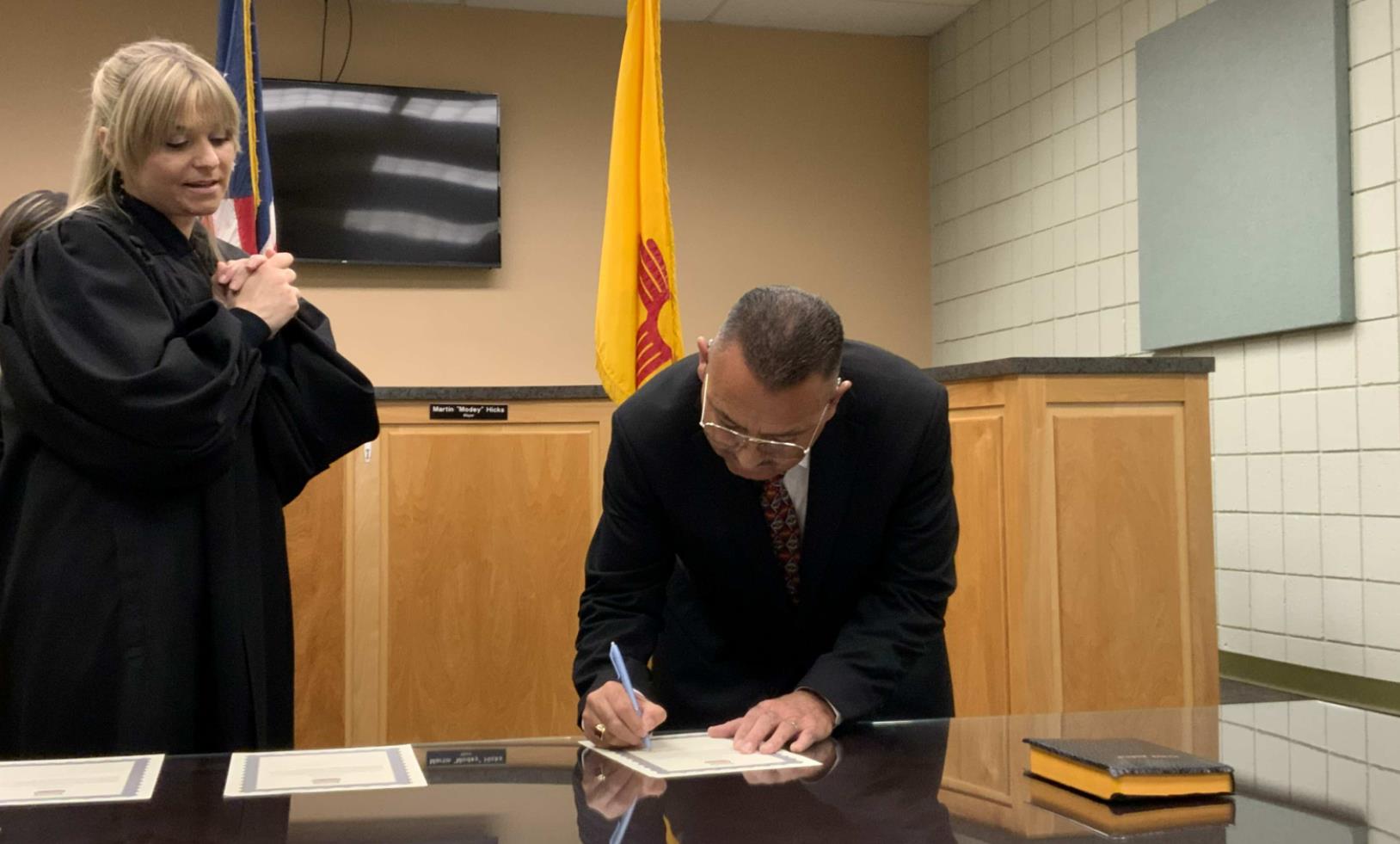
GRANTS, N.M. – George Garcia is an iconic member of the Cibola community. His work with the Grants High School Marine Corps JROTC program brought national acclaim to Grants, New Mexico, a huge spotlight for the high school. Today, Garcia is a sitting Grants City Councilor, he saw a vacuum of leadership and ran to fill it, earning high praise from members of the community who are grateful for his work in the council chambers.
Before becoming the community champion he is today, Garcia was a hero. Serving in the United States Marine Corps since leaving high school, Garcia learned a lot about honor and valor. He married and started a family while in the Marine Corps and had the opportunity to travel the world.
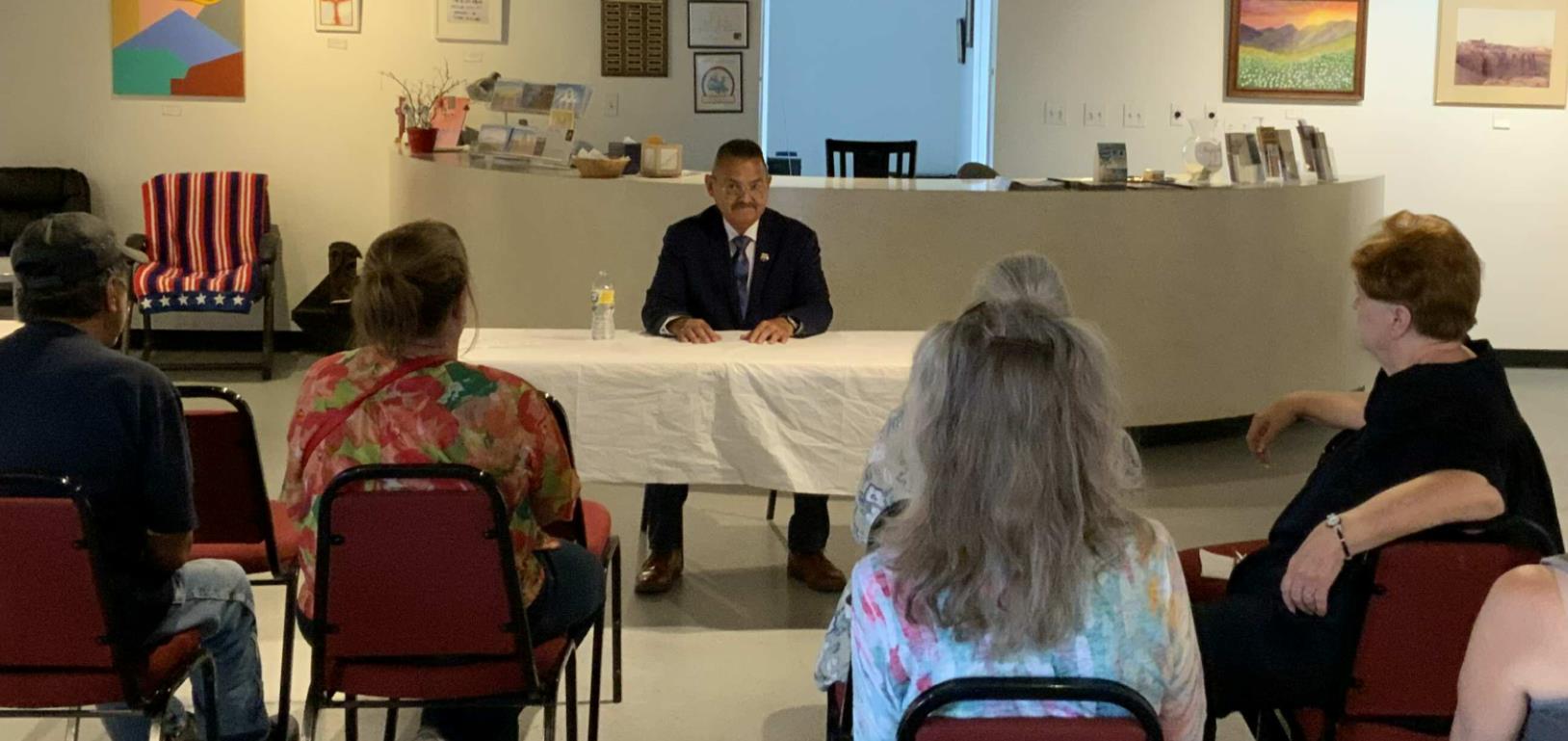
On Saturday, July 9, Garcia spoke to a crowd of community members about his dedication to Grants, his life as a Marine, and his experience instructing students at GHS.
Before beginning his speech, event coordinator C.L. Peterson rose and spoke highly about Garcia, the two had previously worked together at Grants High School. “This man has worked magic among the students,” she said of Garcia.
Early Life
The month Garcia’s family moved to Grants, New Mexico, was the very month he was born, it was July, 1960. Garcia spoke of growing up in Grants, he recalled going to elementary school with former City Manager Laura Jaramillo, and fondly spoke about the community.
“We grew up with simplicity,” Garcia said. “Through high school, Vietnam was going on, I remember seeing a lot of folks coming back. The only reason I was interested the military was because of the JROTC program.”
Grants High School’s proud legacy of Marine Corps Junior ROTC began in 1973, and is one of the first JROTC programs in the state. Garcia said the program left a mark on him, if the program had been Navy, he would have joined the Navy, if it would have been the Army, he would have joined the Army, that’s how influential the program was.
It was in the ROTC program that he met the love of his life, Vicki Martinez, who was on the color guard.
When he turned 17, Garcia grabbed the necessary paperwork and went to his mom for her signature, allowing him to become a member of the military. He had to wait until he graduated, but Garcia was dedicated to joining the Marine Corps.
Martinez, his girlfriend at the time, who would later become his wife, told him, “I know that’s your dream. I don’t want to hold you back. So, if you go and come back, that’s good; if you don’t, have a nice life.”
“If you know my wife, you know how outspoken she is,” Garcia said, “but she was super supportive and helpful in my decision to join the Marine Corps.”
Being a small-town boy from Grants, his family never had much of an opportunity to travel. His first time on an airplane was when he loaded up to leave for bootcamp in San Diego, California. Garcia would become an ammunition technician.
Life in the Marines
Garcia recalled the mental toll of bootcamp.
“I have to say the [ROTC] program prepared me. I was ready for the mental aspect of it. But, after a few weeks I was crying writing home, ‘Vicki, don’t forget me; Pray for me.’ she was a great support,” Garcia said.
Overall, Garcia said bootcamp was a good experience that tested his physical abilities. Right out of bootcamp, Garcia began education and training for his work as an ammunition technician. Many of his trainers had previously served in Vietnam.
“I ended up in the Cold War era, which was unique in itself because we were always preparing for something, but we didn’t know what,” Garcia said.
Garcia had been living in the barracks, crammed in a small room with around 70 other men. He recalled picking up the phone and calling his girlfriend, saying “We have got to get married.”
Garcia had a vision of coming home and marrying Martinez and getting stationed in Yuma, Arizona. This did not work out because Garcia was ordered to South Carolina.
It was February 14, 1979. Garcia and Martinez drove to the Village of Milan, grabbed the Justice of the Peace and married each other. The plan wasn’t romantic, “but it turned out that way,” Garcia joked.
“We were 18 years old, we were in a ‘79 Malibu,” he said.
When they arrived in South Carolina, Garcia was sure the Marines would have a house the new family could live in. He learned that houses were reserved for higher ranked personnel. With assistance from a female corporal on base, the Garcias were able to find a trailer, “We were free and living the dream.”
On November 4, 1979, the Iranian Hostage Crisis began. “We were ramping up and preparing to go,” Garcia said. When this crisis finally came to an end, things began to settle down.
He decided to apply for a promotion, and to become a drill instructor. Garcia was promoted and his family could now live on base. By this point, Garcia had two young children. Then, he was ordered to Japan – alone. Garcia was worried about his family, but knew he had a duty to his country and was going to fulfill it. During this time, Garcia was able to see parts of Asia.
“I call that, an American appreciation course,” Garcia said. Before this point he had never experienced a true division of wealth classes, he had never seen the level of hardship and suffering that the people of Korea and The Philippines had to go through.
Garcia spoke fondly of his memories in Asia, especially about the cultural experience he was able to absorb while in the area. For the most part, while in Asia, he focused on his job.
His time in Asia gave Garcia a great appreciation of the United States, and an even greater appreciation for other people’s experiences and cultures.
Garcia’s enlistment ended, and he decided not to reenlist. He returned to Grants as the mines were failing and the economy was struggling. Here, Garcia was working mine security as his family expanded by one. With economic struggles for the whole community, Garcia decided to reenlist.
Not only did he get to keep his rank, but Garcia was promoted upon his reenlistment, and was finally given the position he wanted for years – drill instructor.
The work was strenuous, at one point it kept Garcia at work for 36 hours straight. He said he loved the challenges, especially working with younger soldiers, but that he understands why the positions are typically left for younger people. Being an instructor was the most rewarding time he had while serving in the Marine Corps.
Eventually, Garcia was ordered to Hawaii. His daughter graduated high school from the schools there. He and his wife even considered retiring in Hawaii, there was a little taste of home when they found a small rural area with cowboys riding bulls.
When the desert storm operations were undergoing, Garcia was attached to nuclear and chemical operations, his team was kept in the background but he was involved in these dangerous missions.
When the operations concluded, Garcia decided it was time to hang up the helmet and retire.
GHS MCJROTC
Garcia had returned home to Grants. He decided to go looking around for a job and applied to be the MCJROTC instructor at Grants High School. He recalled interviewing with Rick Horacek, and using Bob Horacek as a reference.
His very first day of work with the school district was September 11, 2001. He recalled his wife calling him and talking about the plane crashes. The first call, he said, they assumed was just an accident. With the second plane crash, Garcia thought to himself, “I’m going back.”
Garcia looked at potentially rejoining the service, but the only position they offered him was for “Casualty Assistance,” where he would be alerting families to their lost loved ones. After speaking with his wife, they decided Garcia was right where he needed to be, and that God had brought them back to Grants for a reason.
Garcia said he is glad that he stayed. Over the years he turned students at Grants High School into national champions. He influenced generations of students and developed close bonds with his students and their families.
He recalled a time when one of his cadets, Nicole Lopez, took herself off the drill team because, as commander, she couldn’t get one of her cadets to follow commands. Garcia said that he called her father, who quickly came down to the school and convinced her to rejoin the team. Garcia said it was a great help when families joined in and were engaged.
There were many instances when students had very little family support to draw on, but he offered that for every student he could.
Garcia’s legacy is undeniable, and Cibola looks forward to seeing what comes next as Garcia settles into his role as Grants City Councilor.