
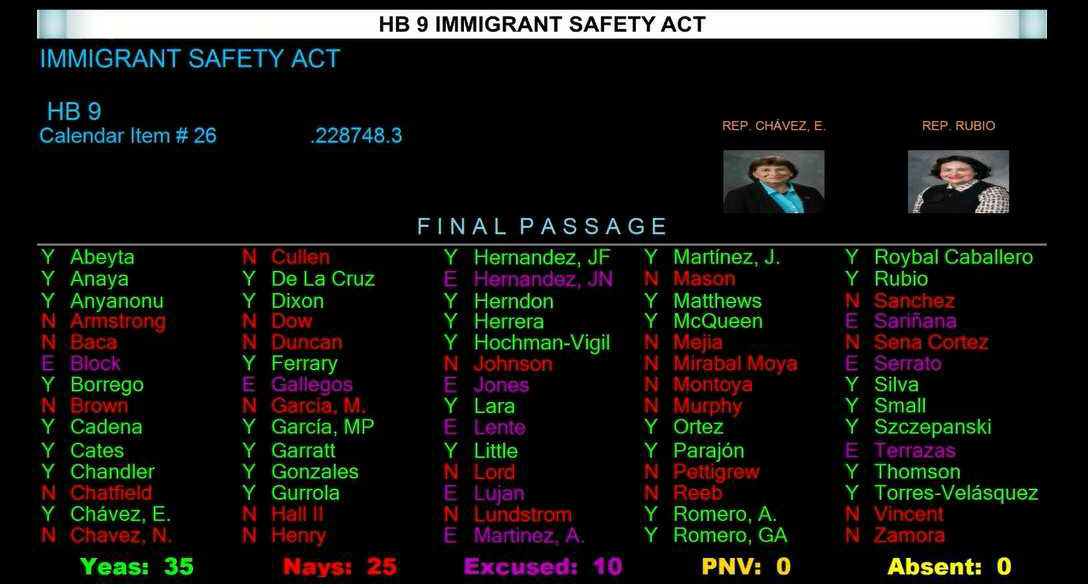
SANTA FE — A bill that passed the New Mexico House of Representatives 35-25 last Friday has the ability to cancel Cibola County’s contract with ICE to allow illegal immigrants to be detained at the Cibola County Correctional Center.
After hours of heated debate, the New Mexico House of Representatives passed House Bill 9, the Immigrant Safety Act, on March 7, 2025, with a final vote tally of 35-25.
House Bill 9, if passed, will prohibit local governments from entering into agreements to detain individuals for federal civil immigration violations, now moves to the Senate for consideration.
However, the bill’s passage has sparked serious concerns about economic repercussions in Cibola County, where the Cibola County Correctional Center (CCCC) in Milan relies on an ICE detention contract that could be eliminated under the new law. The debate in the House exposed deep divisions between lawmakers over immigration enforcement, local government autonomy, and economic security.
Heated Debate Over HB 9’s Impact
During the House floor debate, lawmakers clashed over the financial consequences of ending ICE detention agreements.
Representative Patricia Lundstrom (D-McKinley County) voiced strong concerns, arguing that Cibola is one of the poorest counties in the state and that losing detention contracts could devastate local jobs and revenue. Lundstrom also challenged the accuracy of financial reports regarding detention facilities, signaling that lawmakers lack a full picture of the economic fallout.
Representative Andrea Romero (D-Santa Fe) countered that ICE contracts create a “bad feedback loop” between local governments and federal immigration enforcement. She originally claimed that CCCC only had 350 beds, suggesting the facility’s economic importance was overstated. However, this claim was later disproven when Cibola County Manager Kate Fletcher confirmed that CCCC has 1,300 beds, with 148 occupied by ICE detainees, she said the ICE contract generates significant revenue.
Representative Stefani Lord (R-Sandia Park) pressed lawmakers on what counties like Otero—which hold bond debt tied to their ICE detention facilities—would do if forced to cancel contracts. With financial obligations still outstanding, the state’s intervention could leave counties in economic turmoil.
Neither of the representatives for Cibola County in the state House spoke during this floor debate.
Cibola County’s Stake in the Bill
The Cibola County Correctional Center (CCCC) in Milan is a privately-run facility operated by CoreCivic.
CCCC has 1,300 beds, of which only 100 are contracted for county inmates. The bulk of beds in CCCC are taken up by US Marshal Service de- tainees, and as of the last count the newspaper was able to get ahold of, the facility was housing 148 ICE detainees.
Although ICE detainees make up only 12 percent of the facility’s population, County Manager Kate Fletcher emphasized that the ICE contract is one of the most financially valuable for the facility. CCCC also contributes an estimated $610,000 in annual property tax revenue, meaning its role in Cibola’s economy is significant.
Fletcher’s biggest concern? Job losses. She warned that if HB 9 forces ICE contracts to be terminated, corrections jobs, administrative roles, and local business contracts could be at risk.
Cibola’s lawmakers who live in the county took opposing stances on the bill.
Representative Martha Garcia (D-Pine Hill, Fence Lake, Zuni, Milan), who recently secured her seat after the House District 6 seat was left vacant for most of this legislative session, voted against HB 9. Garcia is a former Cibola County commissioner, whose district includes the Village of Milan, where CCCC is housed.
Representative Michelle Pauline Abeyta (D-Grants, To’hajiilee, Laguna, Acoma), who represents House District 69, a seat formerly held in Grants by former Representative Harry Garcia, voted in favor of HB 9.
On February 26, CCCC Manager of Public Affairs Brian Todd wrote in an email, “Our immigration facilities provide a safe, humane and appropriate environment for the individuals in our care. We operate with a significant amount of oversight and accountability, adhere to all U.S. Immigration and Customs Enforcement (ICE) standards, and are monitored by ICE officials on a daily basis. Our immigration facilities are also audited regularly and without notice several times a year, and we’re routinely visited by elected officials, attorneys, families and volunteers.”
Gustin finished, “House Bill 9 and other similar legislative efforts are unfortunately often based on false and misleading information provided by groups and individuals that do not have direct knowledge of the facts surrounding our company, the facilities we operate, or our dedicated employees. The legislation also doesn't appear to consider the potential impact and unintended consequences to the local communities.”
House Bill 9 will now head to the Senate and Public Affairs Committee where it is not scheduled to be heard as of press time. If approved, the bill will move to the Senate Judiciary Committee for approval before seeing a final floor vote.