
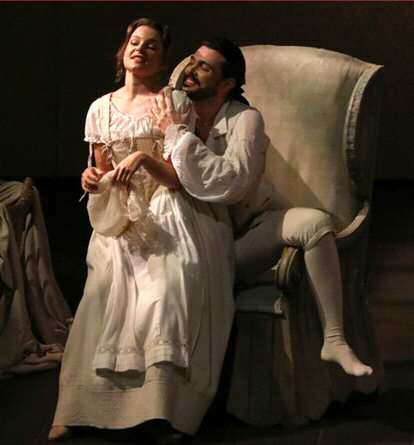
GRANTS, NM -- The Marriage of Figaro is a comic opera written by Wolfgang Amadeus Mozart, an ambitious newcomer to the opera and music scene in 18th-century Vienna.
The four-act play is based on its counterpart play, “The Barber of Seville” by Pierre-Augustin Caron de Beaumarchais which tells the story before “The Marriage of Figaro” about how the Count met his Countess though the opera was written after Mozart’s “Figaro”. The opera premiered in 1786 at Vienna’s Burgtheater (the Imperial theatre) under the direction of Count Orsini-Rosenberg. Both operas are enjoyable for the novice opera lover because they are, what is called “operabuffa”, or funny opera.
Themes of love, betrayal, and forgiveness are portrayed by the play’s main characters: Count Almaviva, his wife, Countess Rosina, Figaro, the count’s valet, and Susanna, the countess’ maid and Figaro’s fiancé.
Cibola Arts Council presented the October 2022 Teatro Alla Scala production of “Le Nozze de Figaro” On Saturday, October 11, at its West Santa Fe Avenue location.
The main cast members were: Ildebrando D’Arcangelo as Count Almaviva (bass), Countess Almaviva - Olga Bezsmertna (soprano) and later Elsa Dreisig, Susanna-Benedetta Torre (soprano), Figaro Luca Micheletti (bass), and Cherubino - Svetlina Stoyanova (soprano).
Elegant staging by Giorgio Strehler and costumes by Franca Scarciapino contribute to the story’s interest. Strehler, at first, ignored his family’s connections with opera and music until, by chance, he viewed Una delle ultime sere di Carnevale. He decided his opinion that opera was shallow compared to films was wrong and attended the theater school Accademia dei Filodrammatici to learn his craft. Scarciapino is an Italian costume designer for major theatres and opera houses. She won an Academy Award in 1990 for her costumes for the film “Cyrano de Bergerac.”
Here is a brief introduction. The story is involved and can never be told as it deserves in this brief article. Hopefully your curiosity will be gripped and you may follow the links at the end to learn more about this opera that has become a favorite of classical enthusiasts.
ACT I
Opens with a duet: Figaro and his love, Susanna are viewing the room given to the soon-to-be newlyweds by Figaro’s master. Which quickly turns into a lover’s quarrel of suspicions.
Figaro now believes there is a secret plot and that his master is planning to steal away Susanna, his love.
Enter, another servant, Sybil, who wants to foil the Count’s plot and somehow have Figaro for herself. She also has an admirer, Bartolo, who becomes her coconspirator, vowing to create confusion.
Cherbino – buffoon; has a crush on the Countess, Susanna’s mistress, and every woman he sees. He is young, inexperienced, and impressionable.
The Count enters. He professes his love for Susanna.
Susanna is beginning to fear for her reputation in the face of all the rumors that are coming to her attention. The rumors seem to be true.
Cherbino is hiding and hears the Count. He is discovered and banished to the military.
ACT II
Takes place in the Countess’ room. She is singing mournfully of losing “her treasure”, the Count’s love.
Cherbino, still hiding, is given women’s clothing as a disguise.
The Count is at her door, and once again, Cherbino must hide. Making a noise in the closet, the Count now thinks his wife has a lover. She has told him it is Susanna in the closet, but Susanna is behind the bed.
As you can so far see, this is a farcical romcom. You need to pay close attention to the action which progresses quickly, but it is worth it to keep up with this brilliant work by newcomer Mozart.