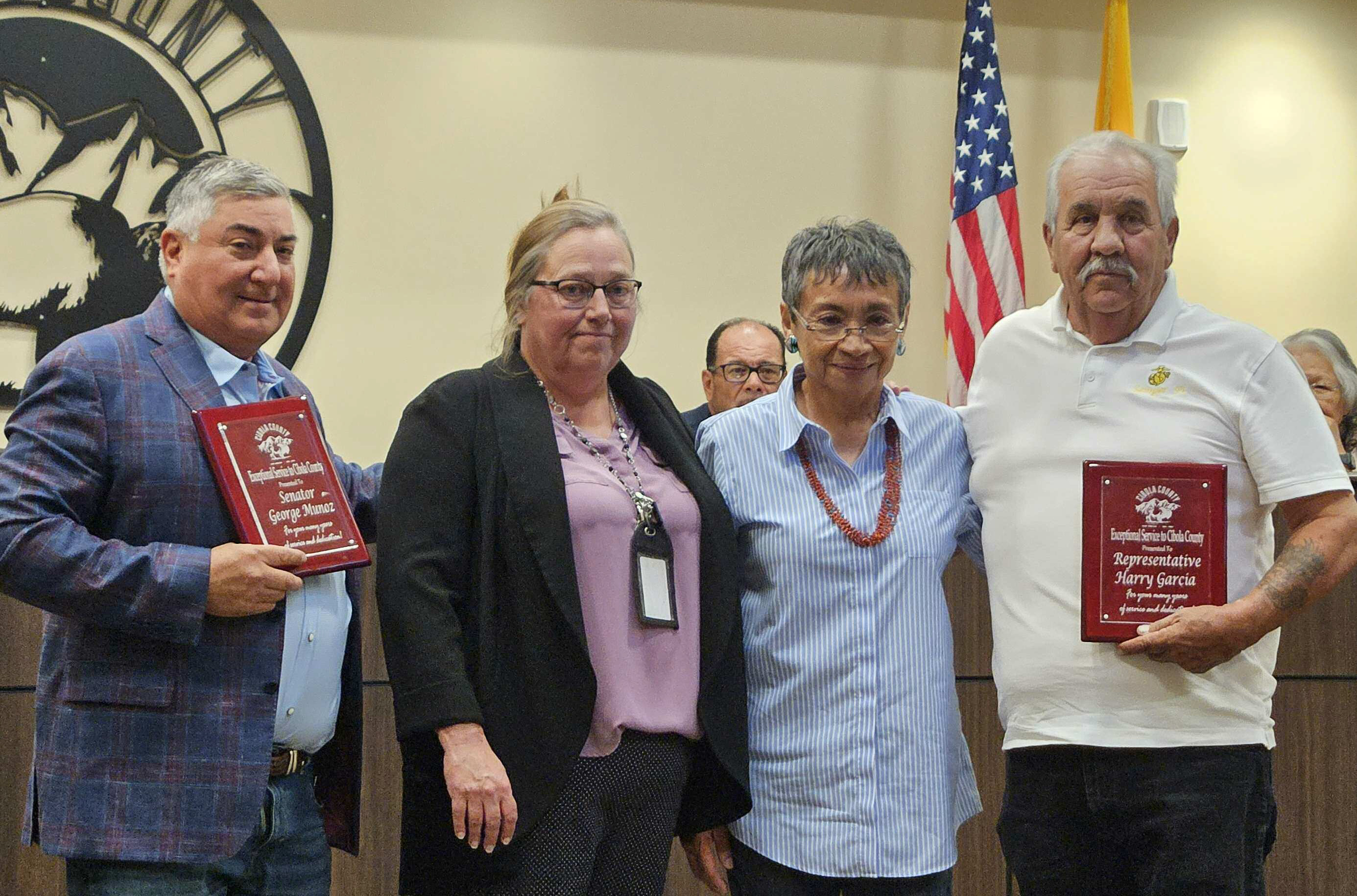
GRANTS, NM – The county commission went over their interim budget and ICIP for the 2025 Fiscal Year, the commission also acknowledged and honored Representative Harry Garcia, Senator George Munoz and Senator Joshua Sanchez for their work in preventing the passing of Senate Bill 145.
County Manager Kate Fletcher and Finance Director Paul Ludi gave the monthly budget and finance report as of April 30, 202. The county is reconciled through April 30, 2024 for the Main Operating Account and the Treasurer’s office is reconciled through April 30, 2024 for the Tax operating account. A public hearing workshop for the final budget will be held soon, the county will announce when the date is. The purpose of the workshop is for the public to come and understand what is entailed in the budget and give their thoughts and requests to the governing
body.
Cibola County has earned the Government Finance Officers Association (GFOA) Distinguished Budget Presentation Award for the fourth year in a row. For the month of May the county has received $633,656 in GRT. Currently the county has collected $2,622,246 in property taxes and $544,108 in delinquent taxes. The commission also approved the interim budget for FY24-25, the ending cash and investments for the interim budget is $13,819,474.85 with the revenues projected to be $26,383,842.26 and expenditures being $40,054,907.08.
There was a presentation held to acknowledge and honor Representative Harry Garcia, Senator George Munoz, and Senator Joshua Sanchez for Exceptional Service to Cibola County. Attorney Dave Pato gave some background information on the reasoning behind the presentation. In 2023 Senate Bill 145 was in consideration by the New Mexico Legislature. The act states, “No public body or entity or individual acting on behalf of or within the scope of the authority of a public body may enter into or renew any contract, intergovernmental service agreement, memorandum of understanding or any other agreement to detain individuals for federal civil immigration violations.” If this bill would have passed this would have forced the county to discontinue the contract between themselves and CoreCivic, a private prison who houses U.S. Immigration and Customs Enforcement (ICE) prisoners. According to Pato this would have caused the shut down of Core-Civic and the loss of about 300 jobs. Pato said, “According to the department of workforce solutions, as of September 2022, we had the second highest unemployment rate in New Mexico. Prohibition against private detention contracts would leave those 300 employees and their families without an income source.” The county wished to honor Representative Garcia, Senator Munoz, and Senator Sanchez for their work in voting against Senate Bill 145 and working on the Senate floor to make sure the bill did not pass. The bill died in the New Mexico Senate in a 21-18 vote. Representative Eliseo Alcon was left out of this acknowledgement, and currently Commissioner Torrez is running against him for New Mexico Representative of District 6. Senator Sanchez was also absent from the commission meeting.
A resolution was approved by the commission to recognize the Cibola County Health Council as the official health council for the purposes outlined in the County and Tribal Health Councils Act. The resolution states, “in 2019, the New Mexico Legislature repealed the Maternal and Child Health Plan Act and enacted the County and Tribal Health Councils Act… the Act requires the Board of County Commissioners of a county or leadership of a tribe to recognize only a single health council for its jurisdiction.” The Cibola County Health Council provided an overview of the health council and data for Cibola County. According to the CCHC they have operated since the early 1990s in Cibola County and their successes so far include: they reviewed community data, they have developed and implemented a community health improvement plan, they have strengthened community partnerships, and they have leveraged over $3 million since 2001. Currently the two main focuses of the CCHC are behavioral health and substance abuse.
A presentation was held regarding the infrastructure capital improvements plan, the presentation went over why an ICIP is done, the priorities of ICIP projects, and increased funding opportunities. The ICIP for the next fiscal year includes many different projects, for 2026 the projects in order of priority include, county road eight, a digital radio system for public safety, sheriff and first responder vehicles and equipment, county road 34, county road one, an emergency generator for the county building and county road five. For 2027 the projects in order of priority include, above ground field tanks, a public safety multi-purpose training facility, a transitional housing center, a substance abuse center, a women’s shelter facility, and street lighting within unincorporated areas of the county. For 2028 the projects in order of priority include, county road 24, a health trail, broadband infrastructure, and improvements to La Mosca Road. For 2029 the projects in order of priority include, Zuni Mountain trains-Quartz Hill, heavy road maintenance and equipment. For 2030 the projects in order of priority are county road 42, Zuni Mountain Trails Project Bluewater Trail, and Zuni Mountain Trails Ojo Redondo Trail.
The meeting ended with a few announcements, a Special Canvassing Commission Meeting will be held on Thursday, June 13, 2024, at 2:00 p.m., the next Regular Commission Meeting will be held on Thursday, June 27, 2024, at 5:00 p.m.