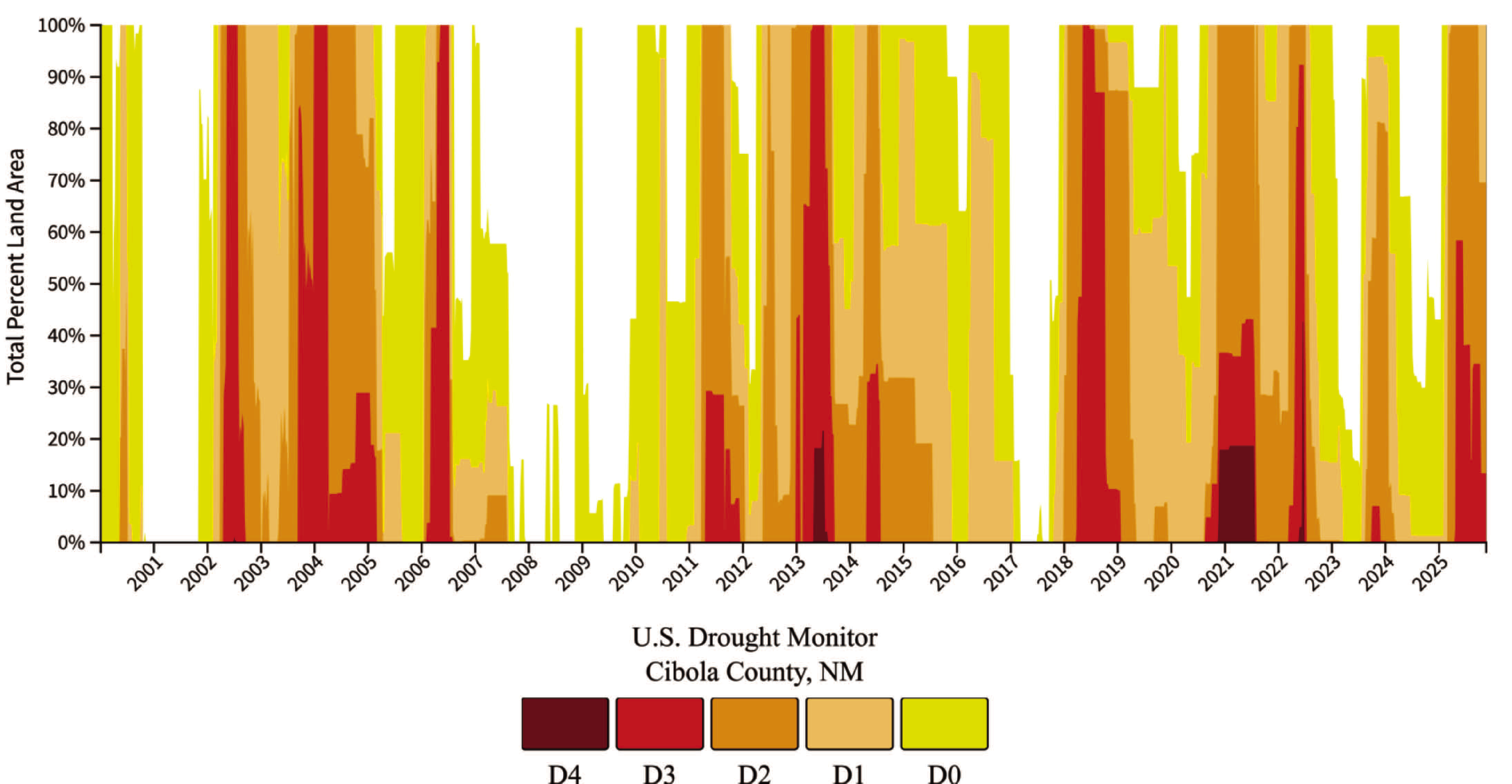
CIBOLA COUNTY, N.M. — As Thanksgiving nears, drought conditions across Cibola County remain unchanged, marking yet another week where 100 percent of the population — all 27,213 residents — remain affected by drought, according to the latest federal data released November 25 which included data unreleased due to the government shutdown.
This pattern of drought comes on top of a difficult year for local water supplies, agriculture, and fire risk. 2025 continues to trend among the driest on record for the region.
August 2025 was the 35th driest August in 131 years of recordkeeping, with rainfall falling 0.76 inches below average. The year-to-date total from January through August places 2025 as the 13th driest in that same 131-year span, running 3.13 inches below normal precipitation.
Thanksgiving Drought Conditions
According to the latest U.S. Drought Monitor report issued November 18, the entirety of Cibola County remains firmly entrenched in drought, with no areas classified as abnormally dry or droughtfree. The drought’s severity has held steady for weeks now, with nearly one-third of the county – 30.44 percent – experiencing Moderate Drought conditions, while over half – 56.19 percent – continues to endure Severe Drought.
The most intense category present in Cibola is Extreme Drought, which still covers approximately 13.37 percent of the county.
This exact breakdown has persisted for seven consecutive weeks, part of a longer 14-week stretch in which the entire county has remained in drought. While not yet reaching the catastrophic D4 “Exceptional Drought” threshold, the cumulative impact of prolonged dryness has created significant strain across the region.
Agricultural assessments from the U.S. Department of Agriculture estimate that approximately 448 acres of hay and 30 acres of haylage within Cibola County are currently growing — or struggling to grow — under drought stress. The dry conditions aren’t just affecting crops. An estimated 10,281 head of cattle and 3,026 sheep are also being raised on land categorized in the D1–D3 range. These conditions limit forage availability, strain water supplies for livestock, and add cost pressures to feed and operations at a time when margins are already tight for many local ranchers.
Water Supply Still Receding Cibola’s two major hydrological indicators — Bluewater Lake and the Rio San José continue to mirror the county’s broader drought profile.
As of November 25, Bluewater Lake had fallen to 4,695 acre-feet of stored water, down from 4,711 acre-feet just two days earlier. The reservoir, which began 2025 with nearly 12,000 acre-feet, has steadily declined throughout the year with few interruptions.
The Rio San José, meanwhile, has remained nearly static since September, holding at 1.91 feet through November. While its flow is consistent, it remains well below historical averages, this offers little relief to downstream users.
Drought Response and Wildfire Preparedness
Though no federal aid has yet been triggered specifically for drought in Cibola County, state officials are leaning into longterm strategies.
The New Mexico Energy, Minerals and Natural Resources Department (EMNRD) is requesting $49.3 million in general funds for fiscal year 2027 — a 9.1 percent increase — largely aimed at boosting wildfire prevention and drought resilience.
“Wildfire protection is no longer a seasonal concern,” said EMNRD Secretary Melanie Kenderdine in a recent release. “This budget reflects the growing need to protect New Mexico’s communities from the potential dangers of wildfires that are resulting from drought and warmer temperatures we are experiencing due to climate change.”
Among the proposed allocations are a $50 million for Wildfire Prepared Program grants and contracts, newly enacted under Senate Bill 33; $2 million to fund an AI-enabled wildfire detection camera network; $800,000 to hire dedicated Wildfire Prepared Program staff; and $200,000 to certify forest timber for structural use — an effort tied to forest thinning and fuels management.
While the budget is aimed at the fiscal year beginning in mid-2026, state leaders said prevention efforts must begin now and remain active even in winter, when fire risk may seem dormant.
The Future of Drought in Cibola
The absence of meaningful rainfall in recent months has extended drought impacts into every sector of life in Cibola County — from ranching and water security to fire management and natural habitat preservation. With no major winter precipitation event forecasted yet, the outlook for early 2026 hinges on snowpack levels in surrounding highlands and continued monitoring of key data systems.
Understanding the trajectory of drought in Cibola requires a close watch on several critical tools.
Among the most visible is the U.S. Drought Monitor, which synthesizes climate data, soil moisture, satellite observations, and field reports to generate weekly maps of drought conditions. This system helps local officials assess risk, inform resource planning, and advocate for aid when necessary.
In addition, the United States Geological Survey has stream gauges along the Rio San José and reservoir monitors at Bluewater Lake provide real-time insights into surface water levels — a vital benchmark for both municipal and agricultural use. These gauges have shown consistent low flow and declining reservoir storage since mid-summer, reinforcing the need for careful water management.
On the agricultural front, the USDA’s drought impact estimates help quantify how many acres of crops and how many livestock are affected each week. These numbers not only give a snapshot of economic vulnerability but also play a role in disaster assistance eligibility and federal support programs.
Beyond the technical instruments, on-the-ground efforts from ranchers, fire crews, forest managers, and residents will continue to shape Cibola’s drought resilience.