CIBOLA COUNTY, N.M. – As 2025 draws to a close, Cibola County remains firmly gripped by drought, with no measurable relief in sight. Persistent dryness, shrinking reservoir levels, and a lack of significant snowfall have set the tone for an uncertain start to the new year.
According to the latest data released December 30, 100 percent of the county’s population – all 27,213 residents – remains affected by drought. This caps a difficult stretch that now ranks 2025 as the 19th driest year-todate in the county’s 131-year climate record.
Drought severity has held steady since midsummer.
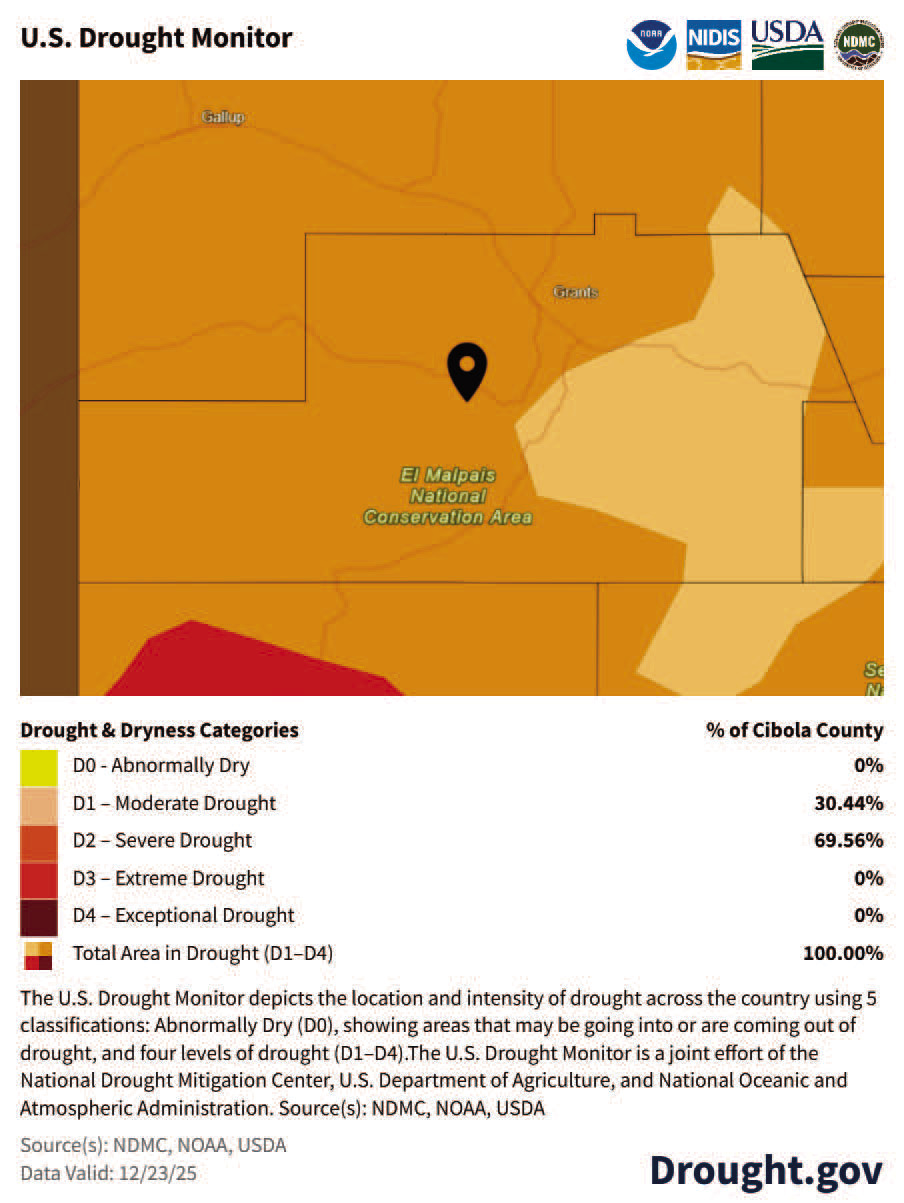
The U.S. Drought Monitor continues to classify all of Cibola County as in drought, with no areas even falling into the “Abnormally Dry” category.
The latest breakdown shows 30.44 percent of the county in Moderate Drought (D1) and 69.56 percent in Severe Drought (D2). No areas currently meet the thresholds for Extreme (D3) or Exceptional Drought (D4).
This unchanged distribution marks more than five months of persistent dryness across the county.
A Year Defined by Drought
What began as a dry winter deepened into a summer of concern and closed with a stubborn drought pattern that refused to budge.
January and February brought little relief from the dryness that lingered after 2024’s already below-average monsoon season.
Snowpack in the Zuni and San Mateo Mountains was limited, with no major winter storms to recharge local watersheds.
By March, Bluewater Lake had risen slightly due to seasonal meltwater but remained well below historical averages.
Spring 2025 failed to deliver the rain many had hoped for.
The U.S. Drought Monitor reported fluctuating drought intensity in the early months, but by June, the situation had stabilized in the wrong direction: nearly the entire county was classified under Moderate or Severe Drought. Conditions remained dry across ranchlands, riverbeds, and high-desert forest zones. Grasses browned early, and spring winds only accelerated evaporation.
The drought led to conditions dangerous enough to create conditions where fire can spread rapidly.
One of the most destructive consequences of Cibola County’s 2025 drought emerged in mid-June, when the Alamo Fire tore through a residential neighborhood in east Grants, destroying six homes and damaging several others.
Sparked in a field of dry grass near the intersection of Nimitz Drive and Alamo Street, the blaze quickly escalated, fueled by brittle vegetation, high temperatures, and strong winds. Within minutes, flames reached fences, sheds, and rooftops, overwhelming the first structures in its path.
Fire crews from Grants, Milan, San Rafael, and Mt. Taylor raced to contain the fast-moving fire, ultimately holding it to roughly eight acres, but not before it left a permanent scar on the community.
Officials said the blaze was made worse by overgrown lots and droughtstressed brush, explaining the elevated wildfire risk that has accompanied this year’s prolonged dry conditions.
By July, the U.S. Department of Agriculture estimated over 10,000 head of cattle and 3,000 sheep were being raised in drought-affected zones, with hundreds of acres of hay and haylage struggling under the stress of limited moisture. Ranchers faced increasing feed costs and diminished forage, while agricultural resources strained.
August 2025 was especially revealing. With precipitation falling 0.76 inches below average, it became the 35th driest August in 131 years of local data. By this point, 100 percent of Cibola County was in drought, an unfortunate milestone that would hold unbroken through the remainder of the year.
September and October brought brief flashes of hope thanks to heavy bouts of rainfall afternoon thunderstorms occasionally passed over the mesas and canyons, and some residents reported light rainfall. But the impacts were limited.
Despite these isolated storms, October ranked only the 26th wettest in recorded history, just 0.58 inches above normal. Hardly enough to dent the year’s cumulative deficit.
By November, the yearto- date shortfall in precipitation reached 3.06 inches below average, securing 2025’s place as the 19th driest year on record for Cibola County. While November’s moisture came close to average, the gains were marginal, and they did little to reverse broader trends. The U.S. Drought Monitor continued to show no areas drought-free, and no movement in severity categories.
December, typically a quiet month for precipitation, remained consistent with this year’s pattern: no new storms of significance and no deviation in the drought classifications. The month closed with zero percent of the county in even the least-severe category of “Abnormally Dry.”
All told, 2025 was marked by long stretches of flatlined drought data — periods where neither worsening nor improvement occurred, simply stagnation in a dry state. This consistency made for easier mapping but harder living, especially for those working the land or depending on natural water systems for grazing, irrigation, or recreation.
Bluewater Lake and the Rio San José Spent 2025 in Decline
Water levels across Cibola County told a consistent story in 2025: slow decline, brief interruption, and a prolonged struggle against drought.
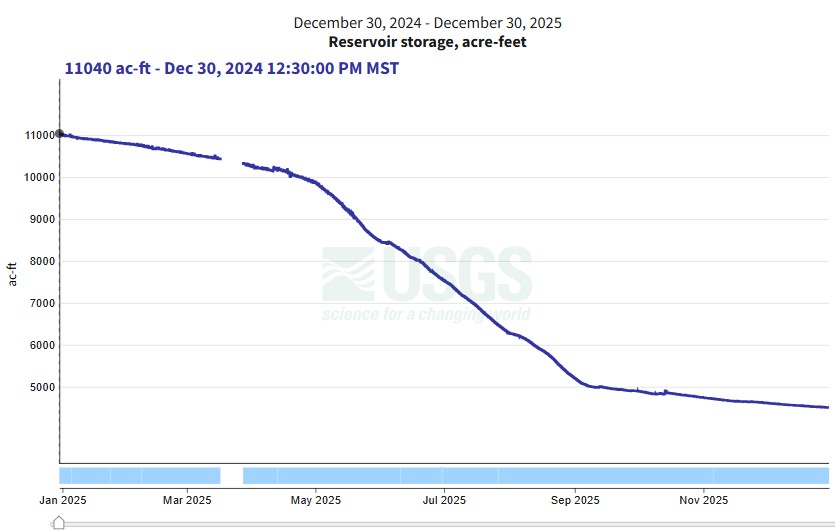
Bluewater Lake, one of the county’s primary water storage sites, entered the year holding over 11,000 acre-feet of water. But as the months progressed, the reservoir steadily lost volume. By late May, the drop accelerated, and from there, the lake declined sharply throughout the summer and fall.
The final U.S. Geological Survey reading of the year was taken on December 30 and recorded just 4,504 acre-feet remaining. That marks a 60 percent loss over the course of the year.
With no major refilling event and few significant inflows, the lake was unable to recover, even after October brought above-average rain. This steep decline reflected the broader hydrologic stress on the region, where evaporation, limited snowpack runoff, and reduced stream contributions combined to deplete water reserves.
Meanwhile, the Rio San José exhibited a different but equally telling pattern.
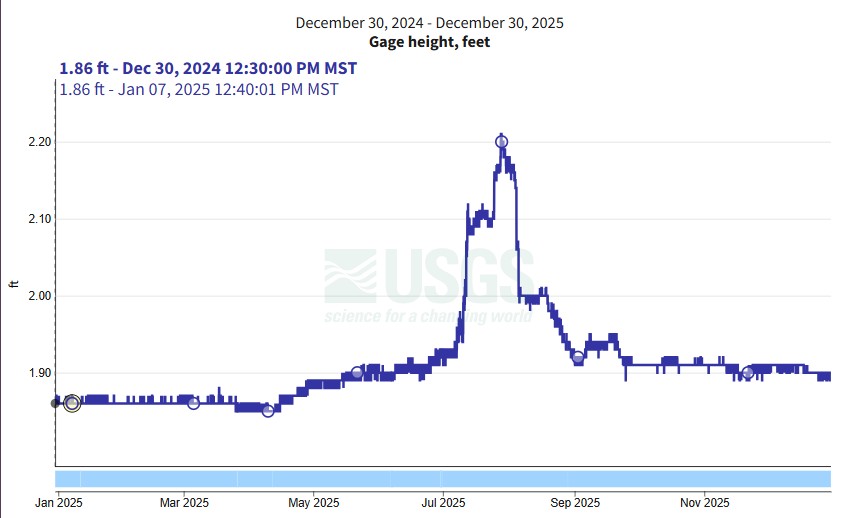
From January through mid-June, the river held relatively flat, hovering just under 1.90 feet—already a low baseline by historical standards. Then, a surge of summer precipitation in July and early August caused the river to spike dramatically, peaking above 2.20 feet in late July. This rise, while notable, proved to be shortlived.
By September, the river had returned to its subdued state, once again holding a narrow band around 1.90 feet through the fall and into early winter.
A 21st Century Drought Timeline
The story of drought in Cibola County is not a brief chapter, it’s the defining theme of the 21st century.
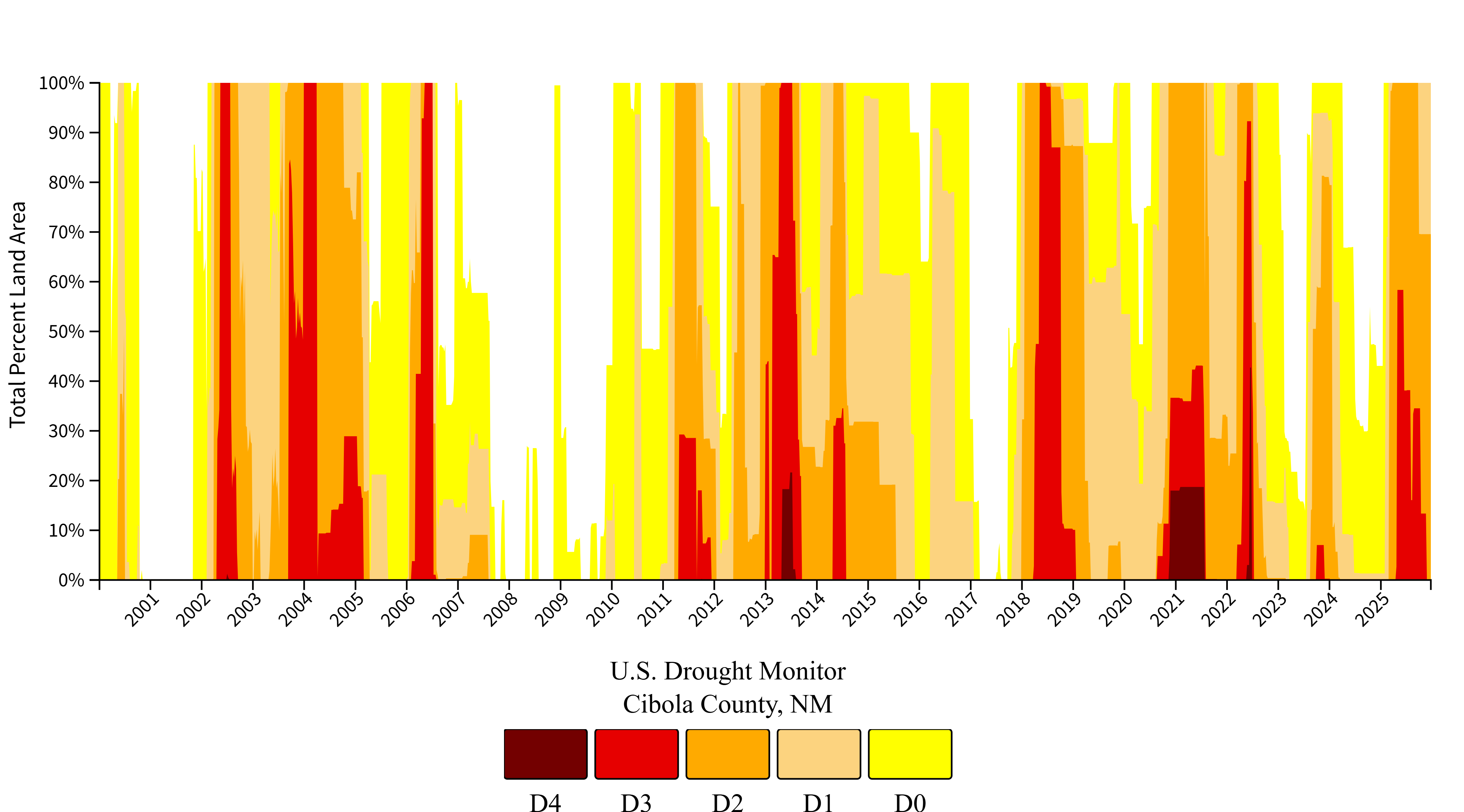
A visual timeline accompanying this article, which tracks weekly drought conditions from the year 2000 through the end of 2025, reveals an unmistakable pattern: drought has become the rule, not the exception.
Over the past two and a half decades, Cibola has endured persistent cycles of dryness, marked by recurring streaks of severe and extreme drought.
The early 2000s brought a harsh introduction to prolonged drought, with the county experiencing extended periods of D3 (Extreme) and D4 (Exceptional) conditions. Although occasional wet years broke through, such as the comparative calm around 2007– 2008 and again in parts of 2019–2020, the recovery was never sustained.
Since 2011, the county has rarely escaped drought classification for more than a few weeks at a time.
In 2022 and 2023, Cibola flirted with relief again, but 2024 reversed that momentum. And now, in 2025, the county closes the year with 100% of the population still affected by drought and nearly 70% of the land classified in the “Severe” category. It has been 19 years since Cibola County last ended a calendar year with no drought reported at all.
The impacts are not abstract.
In 2025 alone, an estimated 10,281 cattle and 3,026 sheep were raised on land categorized under Moderate to Severe Drought. Roughly 478 acres of hay and haylage were affected. Water levels in Bluewater Lake dropped by over 5,500 acre-feet from January to December. A destructive wildfire in Grants, driven by dry fuel and high winds, destroyed homes during a summer when the county was deep in drought.
This historical data reminds us that drought is not a seasonal inconvenience— it is a chronic environmental condition with wide-reaching consequences for agriculture, infrastructure, and community health. Understanding this timeline helps communities plan for the future, advocate for resources, and prioritize conservation.
It also underscores the urgency of monitoring, preparation, and public awareness as Cibola County heads into 2026 with no sign yet of sustained relief.