March ranked 5th driest on record as drought intensifies; extreme drought expands and spring water outlook stays tight
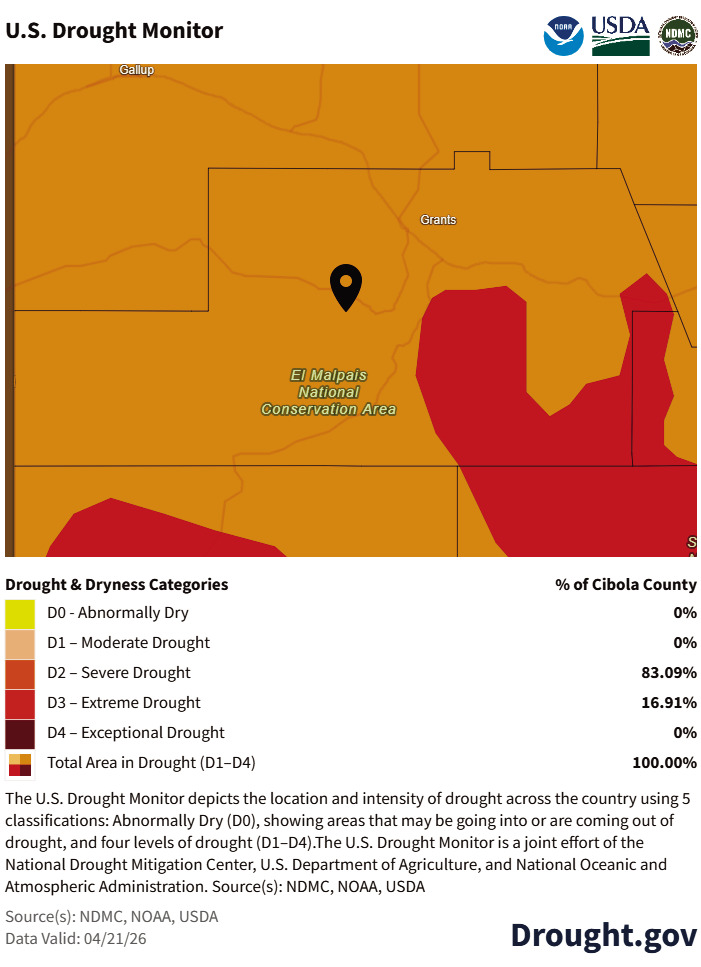
CIBOLA COUNTY, N.M. – Cibola County’s 2026 Drought picture worsened this month, and May is now arriving with less of a “spring recharge” and more “spring fire season”. Updated U.S. Drought Monitor indicators show 27,213 people – 100% of the county – remain affected by drought, with worsening from conditions last month.
In April, the county’s drought conditions worsened, sliding deeper into drought intensity: 83.09% is now in Severe Drought (D2) and 16.91% is in Extreme Drought (D3), meaning 100% of the county is now split between severe and extreme drought.
Earlier this year, much of the county was still categorized as moderate-tosevere; now, moderate drought is being replaced by a more severe and extreme drought footprint.
Federal drought impact estimates continue to place 448 acres of hay and 30 acres of haylage inside drought classifications, along with an estimated 10,281 cattle and 3,026 sheep located in droughtaffected areas.
A Drying Lake and Lack of Rainfall
March 2026 ranked as the 5th driest March on record in the past 132 years, finishing 0.81 inches of precipitation below normal.
Cibola’s local water indicators have tracked a drying trajectory.
For the year so far, January through March ranks as the 33rd driest year-to-date in that 132year record, running 0.98 inches below normal.
Weekly monitoring through late winter and early spring has shown Bluewater Lake steadily declining rather than stabilizing or rebounding, and the Rio San Jose holding in a narrow, low range with only minor fluctuations.
The larger turning point came earlier, when the Zuni/Bluewater Basin’s snowpack collapsed before it could provide meaningful spring runoff – effectively removing the county’s most dependable natural water recharge right at the time it normally helps reservoirs and streams. With winter snowpack gone and March turning historically dry, the county has entered April more dependent than usual on spotty spring storms and, later, the summer monsoon.
At the end of March, Cibola County declared a public-safety disaster in the Ramah area after a public well failure disrupted service for parts of the community, prompting emergency water hauling and bottled water distribution. County officials emphasized the immediate crisis was caused by infrastructure failure, not the total collapse of regional supply, but it unfolded under the same broader drought backdrop that has kept the county on edge.
The water crisis affects all humans and animals in the county, too. Federal drought impact estimates continue to place 448 acres of hay and 30 acres of haylage inside drought classifications, along with an estimated 10,281 cattle and 3,026 sheep located in droughtaffected areas.
Active Burn Bans
Fire restrictions tightened across multiple local jurisdictions as spring winds and drying fuels arrived early.
Cibola County and the Village of Milan are under burn bans.
Stage II restrictions have been enacted at Bluewater Lake State Park and other state lands.
The county’s water story is moving into a new phase where reservoir and river conditions remain constrained and shallow, snowpack is no longer available to support runoff season, and drought intensity has expanded.
Data sources used in this report: U.S. Drought Monitor county statistics and drought classifications; NOAA climate rankings for March and year-to-date precipitation; USDA drought impact estimates for hay and livestock; Cibola Citizen water monitoring reports and related spring drought/fire coverage.