
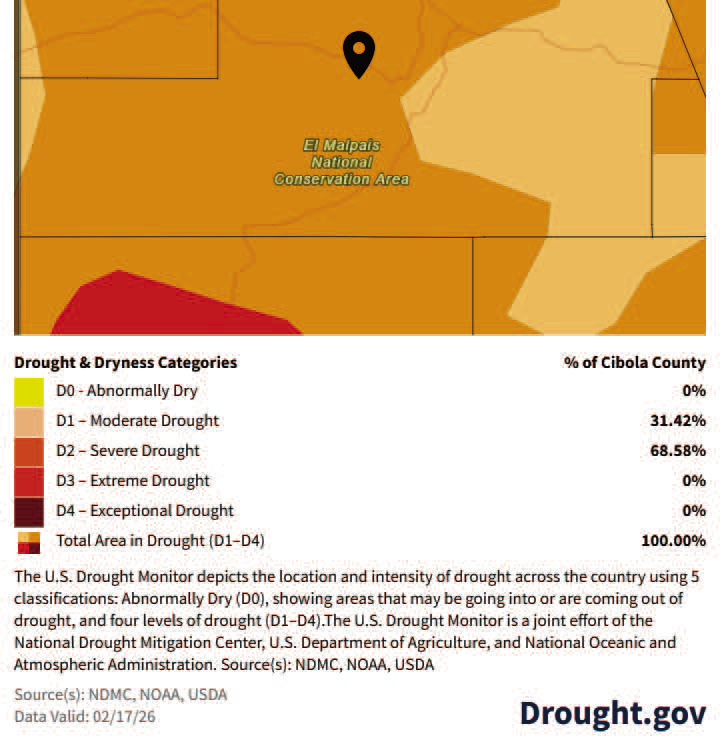
CIBOLA COUNTY, N.M. – February closed with a familiar headline for Cibola County: the drought map still hasn’t moved, even though winter weather has been active enough to create dangerous travel and push small gains into the mountains.
Updated drought indicators show 27,213 people in Cibola County 100% of the population – remain affected by drought, with 31.42% of the county in Moderate Drought (D1) and 68.58% in Severe Drought (D2), unchanged from the prior week and month. The stability matters because it signals the county is not yet seeing the kind of widespread, sustained moisture that improves the drought.
One reason that “no change” can feel confusing is that the climate record is showing a small improvement on paper.
NOAA rankings show January 2026 was the 42nd wettest January on record locally over the past 132 years, coming in 0.15 inches above normal. That is not a huge surplus, but it is a meaningful contrast to late 2025, when December ranked among the driest Decembers on record. The catch is that drought doesn’t respond to a slight monthly surplus the way people hope it will. In a system that has been running dry, moisture has to do several jobs at once – rebuild soil moisture, support vegetation, recharge shallow groundwater, and produce enough runoff to show up in reservoirs and rivers – and February’s monitoring data shows most of that recovery still hasn’t materialized.
That story played out week by week in the county’s key water indicators.
Bluewater Lake continued a gradual winter decline throughout February, sliding from 4,422 acre-feet on Feb. 2 to 4,389 acre-feet by Feb. 10, with later readings continuing to show modest losses rather than the start of a seasonal rebound.
The Rio San Jose at Acoma Pueblo remained pinned at 1.85 feet through the month, holding flat at low levels even when weather systems delivered bursts of precipitation.
The most noticeable movement occurred in the high country: snowpack at the Rice Park SNOTEL site started the month at 1.8 inches of snow water equivalent – about 39% of normal for early February – then sagged mid-month into the 1.5–1.6 inch range, before rising again after late-month storm activity to 1.9 inches on Feb. 23.
Even with that improvement, the basin remained well below the seasonal median of about 5.0 inches and far from the typical 6.0-inch peak reached in early March.
That matters beyond the numbers because the drought footprint still covers the working landscape of the county. Federal drought estimates continue to place 448 acres of hay and 30 acres of haylage within drought categories, along with an estimated 10,281 cattle and 3,026 sheep located in drought-affected areas. Those figures don’t mean every producer is experiencing the same impact, but they do reflect the broader reality: when drought persists into late winter, forage recovery remains fragile, smaller water sources become less reliable, and the entire system becomes more dependent on what happens in the final snowpackbuilding window.
February also served as a reminder that “winter moisture” in Cibola can arrive in ways that don’t necessarily translate into immediate water recovery.
A fast-moving snow squall swept across the county late in the month, briefly reducing visibility to near whiteout conditions along Interstate 40 and across portions of NM 53 and NM 602. The storm delivered bursts of snowfall and created hazardous travel, but the monitoring data that followed still showed only modest hydrologic change.
As the county heads into March, the storyline is narrowing toward one critical question: can the Zuni/Bluewater Basin still build enough snowpack in the next few weeks to support meaningful spring recharge?
In most years, early March is when snowpack approaches its seasonal peak. This year, snowpack has improved in spurts but remains well below normal, Bluewater Lake continues to slide, and the Rio San Jose is still running at a shallow winter baseline.
Data sources used in this report: Drought.gov drought indicators and county impact estimates; NOAA climate rankings for January 2026; U.S. Geological Survey readings for Bluewater Lake and the Rio San Jose at Acoma Pueblo; NRCS SNOTEL Rice Park snow water equivalent and percent- of-median tracking; Cibola Citizen water monitoring reports published Feb. 3, Feb. 10, Feb. 17, and Feb. 25.