Experiencing its 60th driest July on record, Cibola County’s drought situation has shown mixed changes since June. While the overall drought severity has lessened, the decrease in agricultural impact has raised questions that the Cibola Citizen is actively investigating.
According to data from the National Drought Mitigation Center (NDMC), the U.S. Department of Agriculture (USDA), and the National Oceanic and Atmospheric Administration (NOAA), Cibola has seen a slight decrease in drought conditions. While there are improvements, the area is still considered to be in drought.
The U.S. Drought Monitor classifies the severity of drought using five categories, ranging from the least severe designation, 'Abnormally Dry' (D0), to the most severe, 'Exceptional Drought' (D4).
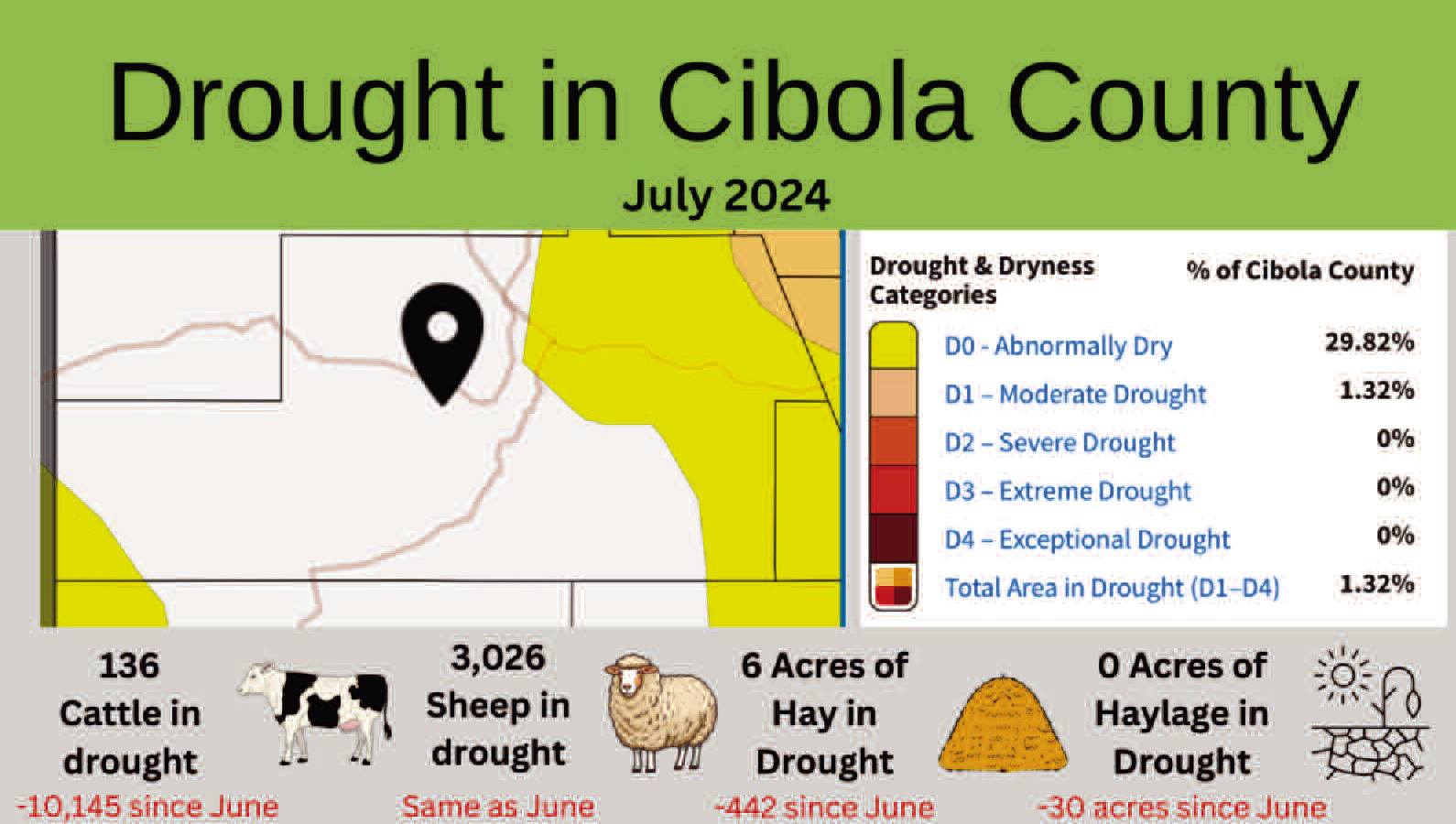
• Abnormally Dry (D0) - 29.82 percent of Cibola is affected, a notable decrease from June when 31.50 percent of the county was affected. The area most heavily effected is the eastern side of Cibola, in the Laguna Pueblo, also heavily effected is a small section in the southwest, the Zuni Pueblo area.
• Moderate Drought (D1) – 1.32 percent of Cibola is affected, a slight decrease from June when 1.40 percent of the county was affected.
• Severe Drought (D2) – 0 percent of the county is affected, continuing from June and previous months.
• Extreme Drought (D3) - No areas recorded, the same as in June and previous months.
• Exceptional Drought (D4) - No areas recorded, the same as in June and previous months.
Through July, the total area of Cibola County under drought (D1–D4) stands at 1.32 percent, indicating a continued improvement in overall drought conditions.
In July, only six acres of hay were in drought, a significant decrease from the 448 acres affected in June. The acreage of haylage affected by drought dropped to zero, down from 30 acres in June. These figures highlight a drastic improvement in the drought conditions impacting Cibola’s agricultural resources.
Effecting livestock, 136 cattle and 40 sheep were found to be in drought during July. This represents a sharp decline from June, when 10,281 cattle and 3,026 sheep were affected. The drastic reduction in droughtaffected livestock has prompted further investigation by the Cibola Citizen.
The Cibola Citizen is working with federal government agencies to verify these data points, as the rapid decrease in cattle, hay, haylage, and sheep affected by drought is raising questions about the accuracy of the reporting or possible underlying factors contributing to these changes.
The agencies found 360 people in Cibola County were directly affected by drought in July, representing 1.3 percent of the county’s population. This marks a decrease of 5.2 percent since last month, indicating further improvements in drought conditions for the population.
July 2024 was the 60th driest July on record over the past 130 years, with a reported decrease of 0.31 inches from normal. Yearto- date (January-July 2024), it has been the 27th wettest period over the past 130 years, with an increase of 1.57 inches from normal.
Data Sources
The National Integrated Drought Information System (NIDIS) is a tool used by the National Oceanic and Atmospheric Administration (NOAA), which has been tracking drought in the Cibola area since 2006. They use historical data and environmental sampling to get a drought reading on years prior, extending back to 1894, providing 300 years of data.
Much of the data utilized by the Cibola Citizen comes from NIDIS, NOAA, the U.S. Department of Agriculture (USDA), and the National Agricultural Statistics Service (NASS). These entities supply data for Cibola’s acreage of hay, the number of livestock, and the population affected by drought.