
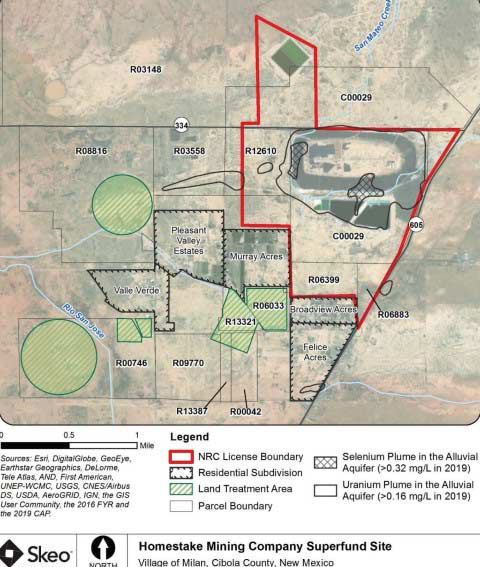
MILAN, N.M. — The U.S. Environmental Protection Agency will hold an open house and community meeting on Tuesday, Oct. 21, 2025, to brief residents on the Homestake Mining Company Superfund Site and to take questions about ongoing cleanup, monitoring, and next steps.
The open house runs from 5 to 6 p.m., followed by a public meeting from 6 to 8 p.m., at the Village of Milan Fun Room, 405 Airport Road.
This report uses information from the EPA’s review of the Homestake site north of the Village of Milan, New Mexico. The review is 160 pages and can be accessed online at https://semspub.epa.gov/w ork/06/100025018.pdf the meeting on Oct. 21 is designed to put the whole review in plain language for residents.
Latest Data Released
The meeting comes as EPA releases its Fifth Five-Year Review of the site, a former uranium mill and tailings disposal facility located about 5.5 miles north of Milan at NM-605 and County Road 63. Uranium milling began here in 1958 and continued, in various forms, until 1990.
The site includes two unlined tailings impoundments— one large pile containing roughly 21 million tons of mill tailings and a smaller pile holding about 1.2 million tons—as well as affected portions of the San Mateo alluvial aquifer and the Upper, Middle, and Lower Chinle aquifers. Groundwater contamination was first documented by the New Mexico Department of Health in 1960; by the mid-1970s, elevated selenium had been confirmed in nearby domestic wells, prompting a series of agreements that eventually connected affected neighborhoods to Milan municipal water.
EPA’s new review emphasizes that human exposure through soil and air is currently under control under standards set by the Uranium Mill Tailings Radiation Control Act, and that the migration of contaminated groundwater is under control via hydraulic containment.
Containment is achieved by extracting contaminated groundwater, treating it through a reverse- osmosis plant rated at approximately 1,200 gallons per minute and a zeolite system rated at roughly 1,500 gpm, and reinjecting treated and supplemental fresh water to maintain a “reverse gradient.”
The site’s network of collection and injection wells, lined ponds, and perimeter monitoring remains active, with institutional controls limiting the use of private wells in impacted areas. Past response actions also connected homes in Broadview Acres, Felice Acres, Murray Acres, Pleasant Valley Estates and Valle Verde to municipal water, and EPA installed radon mitigation systems in homes where indoor levels exceeded guidance.
The U.S. Nuclear Regulatory Commission is the lead agency for tailings stabilization, reclamation, and license termination under Source Materials License SUA-1471; EPA is responsible for ensuring that actions outside the byproduct disposal area meet “Superfund” federal requirements; and the New Mexico Environment Department regulates groundwater discharges through DP-200.
The EPA’s review is complicated. Under Superfund, EPA has divided the site into three operable units: OU1 addresses groundwater restoration; OU2 covers tailings stabilization, surface reclamation, and closure; and OU3 concerns radon in neighboring subdivisions.
EPA selected “no further action” for OU3 in 1989 based on background radon levels; however, the new five-year review calls for an updated radon risk assessment using current toxicity data and tools before EPA can make a fresh protectiveness determination for the subdivisions.
While containment continues, EPA has not yet selected final Superfund remedies for OU1 and OU2.
Over the past decade, EPA has been conducting a Superfund “equivalency” process to determine whether the NRC-directed work meets Superfund standards for investigation, risk assessment, and remedy selection. Homestake completed a remedial investigation with humanhealth and ecological risk assessments, which EPA approved in 2020, and entered into an agreement with EPA the same year to perform a feasibility study which is ongoing.
EPA has referred the site to its National Remedy Review Board for independent technical input on alternatives.
After the feasibility study is complete, EPA will publish a Proposed Plan for public comment and then issue a Record of Decision selecting the CERCLA remedies for groundwater and for tailings closure elements under EPA’s authority.
Restoring Groundwater Impracticable?
A central technical issue in the coming decisions is how “background” groundwater concentrations are defined. In 2006, cleanup targets were set in part using background values above federal drinking water standards, a choice that has been contested locally.
In response to requests from the Bluewater Valley Downstream Alliance and the Multicultural Alliance for a Safe Environment, EPA, NMED, the U.S. Geological Survey, and Homestake undertook parallel reassessments. USGS published geochemical work in 2019; NMED’s 2020 and 2021 modeling suggested that historic mine-water discharges in the Ambrosia Lake valley likely influenced up-gradient alluvial groundwater, complicating the notion of “natural” background. EPA and NMED are now recalculating background for the alluvial and Chinle aquifers and will use those numbers to set preliminary remediation goals in the feasibility study.
Homestake has also told regulators it believes restoring groundwater to current standards may be technically impracticable and has submitted a technical impracticability evaluation.
If EPA ultimately agrees a full restoration is not feasible with current engineering, the agency could consider a TI waiver under CERCLA; such a waiver does not end cleanup, but it can shift the remedy toward long-term containment, monitoring, and enforceable controls designed to be protective of human health and the environment.
The site’s history reflects repeated layers of action and oversight.
Homestake’s mill ceased operations in 1990, the structures were decontaminated and demolished in the early 1990s, windblown soils inside and outside the license boundary were excavated to meet UMTRCA standards and placed on the tailings, and interim radon barriers were installed on the impoundment slopes. Over the years, the groundwater restoration system has expanded, with additional evaporation ponds, increased RO capacity, zeolite treatment, and freshwater injections to maintain control.
Residents who want to dig deeper can review the full five-year review and supporting documents at the information repository at New Mexico State University’s Grants Campus Library, 1500 Third Street, or online at https://semspub. epa.gov/work/06/100 025018.pdf the review is 160 pages.
The agency says it will summarize the latest data, explain where the feasibility study stands, and take questions during Tuesday’s session.
EPA encourages anyone who lives, works, farms, or owns property near the site to attend. The meeting is intended to put the latest technical work in plain language and to get community concerns on the record before EPA proposes final remedies.