
CIBOLA COUNTY, N.M. – In a fast-moving stretch of the 2026 legislative session, House Bill 9 – the Immigrant Safety Act – moved from a contested policy proposal to a signed state law, setting off urgent questions across Cibola County about jobs, local revenue and what comes next for detention operations tied to the Cibola County Correctional Center in Milan.
The measure, which restricts state and local government involvement in contracts used to detain people for federal civil immigration violations, became a focal point for rural counties with detention facilities as lawmakers weighed competing claims: supporters argued New Mexico should end what they described as participation in a system linked to deaths, poor conditions and civil-rights concerns; opponents argued the bill would cause major economic harm in communities where detention- related employment and revenue are embedded in local budgets.
What HB 9 Does
As the bill advanced, debate remained centered on how HB 9 changes what public bodies – including counties, local agencies and political subdivisions – may do.
HB 9 prohibits public bodies from entering into or renewing agreements used to detain individuals for federal civil immigration violations, and it requires public bodies with existing agreements to end them at the earliest date allowed under the contracts’ terms. It also limits public bodies from selling, trading or leasing property to be used for that type of detention and allows enforcement through court action seeking injunctive relief.
Supporters repeatedly emphasized that the legislation targets civil detention contracting and does not alter criminal detention or criminal investigations.
A Rapid Path Through the Roundhouse
According to the Legislature’s action record, HB 9 moved quickly through its required steps: The bill was referred to the House Consumer & Public Affairs Committee (HCPAC) and House Judiciary Committee (HJC) on Jan. 20, the official register of actions reflects the following: On Jan. 26, HCPAC reported the bill with a Do Pass recommendation.
On Jan. 29, House Judiciary reported the bill with a Do Pass recommendation with amendments.
On Jan. 30, the bill passed the New Mexico House of Representatives 40–29.
On Feb. 2, the bill was sent to the Senate Judiciary Committee (SJC).
On Feb. 3, SJC reported HB 9 with a Do Pass recommendation, and later that day the bill passed the Senate 24–15.
On Feb. 5, HB 9 was signed by Gov. Michelle Lujan Grisham, becoming Chapter 5.
Those votes came as local officials from Cibola, Torrance and Otero counties warned legislators that the policy shift could trigger layoffs and destabilize local government revenue streams tied to detention operations. Arguments from local officials like Village of Milan’s Manager Candi Williams fell on deaf ears.
Senate Floor Debate: Jobs, Oversight and Amendments
The Senate Floor debate on Feb. 3 included repeated arguments about whether ending publicbody contracting would improve conditions for detainees or simply shift detention elsewhere – and whether the Legislature had done enough to protect counties likely to experience economic disruption.
During the debate, Sen. George Muñoz, who covers the western half of Cibola County in the New Mexico State Senate and is the chairman of the New Mexico Senate Finance Committee, described the economic concerns facing Cibola County and urged support for an amendment intended to soften impacts. “I have to help protect the community I represent,” Muñoz said, while also warning it would be difficult to retrain affected employees and describing job loss as “only the tip of the iceberg.”
Muñoz also spoke about the region’s long history with immigration and community ties, referencing Gallup and Grants’ history during World War II and calling for state support if the policy change moved forward and communities like Grants and Milan are adversely affected.
Sen. Sharer warned that previous state promises tied to economic transitions had not materialized as expected. He pointed to the Energy Transition Act and argued that funds set aside for retraining did not prevent serious consequences in his county, including a spike in student homelessness. In urging support for a mitigation amendment, Sharer said, “If we’re going to destroy another community we owe it to that community,” and characterized HB 9 as “virtue signaling.”
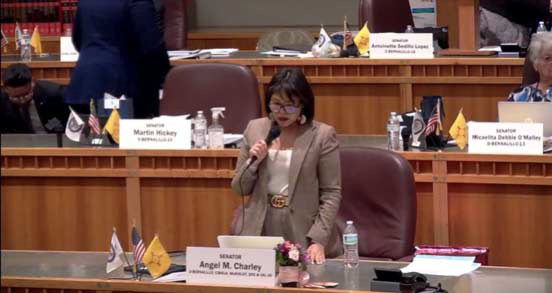
Sen. Angel Charley, who represents the eastern half of Cibola County in the New Mexico Senate and is a freshman member, described Cibola as “underfunded,” “overburdened,” and still living with the long-term impacts of uranium development. Charley argued for mitigation while framing the issue as a question of fairness to communities asked to absorb the consequences of statewide policy decisions. “Cibola County has already given more than its share,” she said. Charley also questioned who benefits from programs like universal childcare if families lose jobs tied to the Milan facility. Charley ultimately voted yes on HB 9.
Multiple senators raised concerns about oversight and outcomes for detainees if detention shifts to other states. One senator, speaking about harm to Otero County, said New Mexico could lose the ability “to ensure safety of immigrants,” adding, “We’re better than that. We’re a lot better than that.”
Senate Judiciary Chair Joseph Cervantes, a sponsor of HB 9 who previously said on Feb 2 at the Senate Judiciary Committee meetings “these counties need the jobs, but not that bad”, challenged the fiscal structure of one proposed amendment and repeatedly framed it as creating uncertainty for the state budget.
In debate over a “hold harmless” approach, Cervantes said the proposal would pull from the general fund to reimburse counties for lost property tax and pressed supporters on how far that obligation could extend if families relocated and tax bases shifted.
Sen. Townsend, who supported additional county protections, challenged the state’s mitigation plan as inadequate. He referred to available money as “a pittance,” and said, “We have missed the opportunity to make sure we are caring for our neighbors.”
Townsend also asked whether HB 9 could expose New Mexico to litigation from the federal government; Cervantes responded that New Mexico must uphold “law and order,” and rejected the idea that the intent was to harm New Mexicans based on out-of-state events.
Several amendments were debated and failed, including a proposal to delay the effective date to July 1, 2028, to give counties more time to adjust. In the debate over that delay, Muñoz argued that near-term lease timelines would drive decisions regardless of the longer effective date, warning that contractors might not renew agreements if they know a ban is coming.
“Complicity,” Safety and Conditions
In the final debate before passage, supporters focused heavily on conditions inside facilities and the argument that the state should not participate in civil immigration detention contracting through local public bodies.
Sen. Duhigg recounted multiple stories involving detention facilities, including Torrance and Cibola, and referenced Roxsanna Hernandez’s death at Cibola in 2020. Duhigg described the accounts as “harrowing and sad,” and argued the bill would end what she called “New Mexico’s complicity” in ICE detention.
Other supporters framed HB 9 as a public safety measure connected to trust in law enforcement and community stability.
Sen. Nova described HB 9 as “a public safety bill,” saying, “When fear governs people’s lives, communities become less safe,” and said law enforcement can lose trust when communities fear engagement. Nova also said job concerns “deserve respect,” while arguing detention contracting is “not stable,” adding, “HB 9 does not abandon these counties.”
Debate also turned overtly moral and religious in the closing stretch.
Nova read from scripture, including Leviticus and Proverbs, and urged a “yes” vote. Sen. Woods referenced warnings about lawlessness from the Federalist Papers. Cervantes closed by speaking about fear among people who look like him and speak Spanish, then invoked Mark 8:36–37 on the tension between economic gain and moral costs.
Lt. Gov. Howie Morales, presiding, reminded the public to maintain respectful decorum.
The bill passed the Senate 24–15. In the final roll-call breakdown noted by the Cibola Citizen, Charley voted YES and Muñoz voted NO.
After the vote, Charley addressed Cibola residents directly, saying, “I believe this vote is in our collective best interest.”
Signed Into Law as Cibola Prepares for Economic Hit
Governor Michelle Lujan Grisham signed HB 9 into law on February 5, 2026. At the exact same time the monthly Coffee with the Managers meeting was ongoing at the Coyote Del Malpais Golf Course.
Governor Michelle Lujan Grisham reminded New Mexicans that the bill does not have any provisions specifically requiring private prisons to close. She invoked the power of the US Constitution and State’s Rights in reasoning for singing the bill which will prevent local governments from contracting with the Department of Homeland Security for immigration detention purposes.
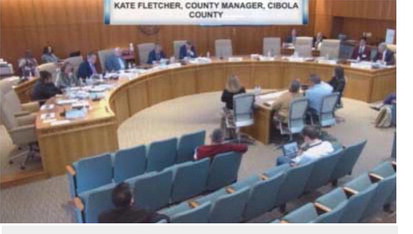
Representatives from Cibola County and the City of Grants discussed the impact coming to Cibola as a result. Cibola County Manager Kate Fletcher explained that while the contract with ICE is set to end on or around May 20, the facility still has a contract with Cibola County and the Department of Homeland Security to hold US Marshal Service detainees.
Fletcher explained that the Cibola County Correctional Center operated by CoreCivic pays $808,794.48 a year in property tax, of this $155,577.09 is sent to the Village of Milan as its municipal share, this accounts for 53 percent of the village’s total property tax intake. Also out of CCCC’s property tax share, $249,330.08 goes to Grants Cibola County School District for a number of reasons. Fletcher and Valencia explained Cibola County will be bracing for a $20.4 million economic hit if CCCC closes as a result of HB 9. She explained while other contracts exist at CCCC, the ICE contract pays out the most.
During this discussion, Chairman of the Cibola County Commission Ralph Lucero said, “[Sen Angel] Charley and [Rep Michelle] Abeyta failed us.”
Both were elected to represent Cibola County, both voted YES on House Bill 9.
Economic Harm Mitigation to the Foreground
With HB 9 becoming law on Feb. 5, the focus shifted quickly from whether the bill would pass to how the state will respond if rural counties experience the economic disruption local officials have warned about.
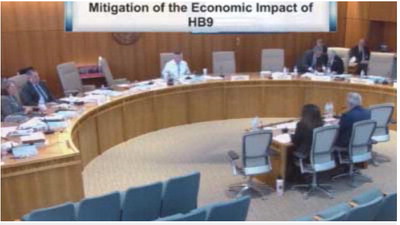
On Feb. 9, the Senate Finance Committee held a meeting with the managers of the three effected counties, Cibola, Otero, and Torrance about necessary mitigation in the event of serious job and tax revenue loss because of HB 9. The committee heard local concerns and asked county managers to present information in writing with tangible numbers so the state can help craft a recovery package.
Cibola County was fully prepared, Chairman of the Senate Finance Committee Munoz told managers from Otero and Torrance to work with Cibola and craft similar data packages.
On Feb. 10, the Senate Finance Committee convened again for a public discussion about mitigation efforts for Cibola, Otero and Torrance counties. The hearing included testimony from Secretary Sarita Nair of the Department of Workforce Solutions and Isaac Romero of the Economic Development Department.
During the hearing, Nair said the Cibola County Correctional Center “can be leased directly to ICE so detention can remain,” and suggested Grants’ proximity to Albuquerque could be part of broader employment conversations. She also said layoffs in Cibola may not be immediate as the facility still has the US Marshal contract to fulfill, and said that “rapid response” and “economic transition programs” would come to affected counties.
Nair said the state learned residents “can’t be re-trained without stipend,” and described programs that link training with college funding to make retraining financially possible.
Romero told lawmakers the department would look at local employers, wages and future opportunities, and said Milan’s Industrial Park is a candidate to be discussed as a “strategic development readiness site,” which could open access to state funds intended to prepare sites for development. He also characterized the challenge plainly: “Rural economic development is really hard,” and said, “This will be a challenge, but it’s a challenge that we as government need to take on.”
Senators pressed the agencies for evidence that re-training works effectively, and for more specific planning.
Sen. Lanier questioned what happened after previous transitions and sought follow-up data on re-employment and wage outcomes in San Juan County. Sen. Padilla pressed for a clearer sense of what businesses could realistically be recruited and how quickly, while also arguing the state already knows enough about the communities to move faster.
Sen. Muñoz criticized what he characterized as “slow-moving” planning and said the response needed to accelerate immediately, warning that families could enter “crisis mode.” In remarks captured by The Cibola Citizen, Muñoz used profanity while demanding immediate action, telling the agencies he wanted a “clear-cut plan” and saying he was prepared to stay “until midnight” to push for solutions. He also threatened to cut agency spending – including travel budgets – and redirect money directly to local governments as the state’s economic development department has not created results and did not appear prepared to offer assistance to affected communities.
Secretary Nair told the committee that upcoming assistance events were being scheduled for other areas – including Feb. 17 in Sunland Park and Feb. 19 in Estancia – while Cibola leadership asked to wait for additional training discussion until after the legislative session.
As of press deadline on Feb. 10, the state legislature has NOT officially proposed a mitigation effort to help keep Cibola safe. One is expected.
The Impact on Cibola County Right Now
HB 9 is now state law. The immediate questions for Cibola County remain centered on implementation timelines and contract realities – and on whether state mitigation efforts will match the scale and speed of the economic risks local officials have described.
According to documents provided by Cibola County, job loss from the Cibola County Correctional Center will be around 180 individuals, with 70 of them in the City of Grants and 18 percent of the Village of Milan’s total water and sewer budget. Munoz warned legislators that some employees are already seeking employment in other communities or states and that the population loss may be devastating.
HB 9 is set to be implemented on May 20, where contracts will have to be terminated and the facility in Milan will have to decide whether to stay open with less contracts and beds used, or close the facility.
The Cibola Citizen will continue tracking state mitigation planning, local government budget responses, and any operational changes tied to the Cibola County Correctional Center and the Village of Milan.
Courtesy Photo