
NASA’s James Webb Telescope is a premier piece of technology that is trying to look beyond what scientists already know about the universe and uncover the origins of space. Through the efforts of America’s foremost scientists, NASA has managed to capture several stunning images of space, and learn much about the origins of stars.
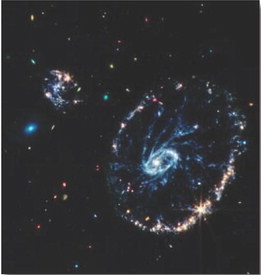
Last week, NASA grabbed several high-resolution photos of a galaxy called “the Cartwheel Galaxy” because of its distorted ring shape. The Cartwheel Galaxy is about 500 million lightyears away from Earth, and it has the shape of the wheel of a cart due to a high-speed collision between a large spiral galaxy and much smaller galaxy. The smaller galaxy is not very visible in the new photos as it was swallowed up by the larger galaxy.
The collision affected the shape and structure of this galaxy, according to a press release from NASA, “The Cartwheel Galaxy sports two rings — a bright inner ring and a surrounding, colorful ring. These two rings expand outwards from the center of the collision, like ripples in a pond after a stone is tossed into it. Because of these distinctive features, astronomers call this a ‘ring galaxy,’ a structure less common than spiral galaxies like our Milky Way.”
The bright spot in the center of the Cartwheel Galaxy is home to a “tremendous amount” of hot dust. The core is also home to large clusters of young stars that have recently been formed. “On the other hand, the outer ring, which has expanded for about 440 million years, is dominated by star formation and supernovas. As this ring expands, it plows into surrounding gas and triggers star formation,” according to NASA.
The James Webb Telescope is a marvel of engineering, and can take such clear photos of star clusters hundreds of millions of light-years away thanks to it’s Mid-Infrared Instrument, known as MIRI. This instrument can peer through the darkness of space to capture crisp images, the clearest ever seen, of galaxies, stars, and other galactic challenges.
The James Webb Telescope has a Near-Infrared Camera, which is the telescope’s primary imager. This camera has the ability to pierce observable light to capture photos of stars which are typically hidden behind the observable light.
“The James Webb Space Telescope is the world's premier space science observatory. Webb will solve mysteries in our solar system, look beyond to distant worlds around other stars, and probe the mysterious structures and origins of our universe and our place in it. Webb is an international program led by NASA with its partners, ESA (European Space Agency) and the Canadian Space Agency,” said Laura Betz with the Goddard Space Flight Center in Greenbelt, Maryland.