
GRANTS, N.M. – Immigration in New Mexico is once again at the forefront of political debate as House Bill 9, the Immigrant Safety Act, moves through the state legislature, intent on ending the detention of illegal immigrants across the state.
This legislation, aimed at ending New Mexico’s ties to federal immigration detention, comes at a time of heightened federal enforcement under the Trump administration, leaving Cibola’s local governments to navigate a politically charged and complex landscape.
The Immigrant Safety Act seeks to bar public entities from entering into agreements that allow Immigration and Customs Enforcement (ICE) to detain immigrants within the state. It would also prohibit the use of public land for immigration detention and require local governments to terminate any existing agreements that facilitate these detentions. Introduced by democrat Representatives Eleanor Chávez, Angelica Rubio, Andrea Romero, Marianna Anaya, and Christine Chandler, the bill follows in the footsteps of seven other states that have passed similar measures to cut ties with the federal detention system.
“New Mexico is a place where we look out for one another, where family and community come first,” said Victor Romero-Hernandez, Communications Manager at Innovation Law Lab. “The Immigrant Safety Act is about living up to those values, ensuring that no one in our state is subject to cruelty and injustice.”
The bill has already passed its first major hurdle, receiving a 'Do Pass' recommendation from the House Consumer and Public Affairs Committee (HCPAC). It will next move to the House Judiciary Committee before facing a full vote in the legislature.
What Does This Mean for Cibola County?
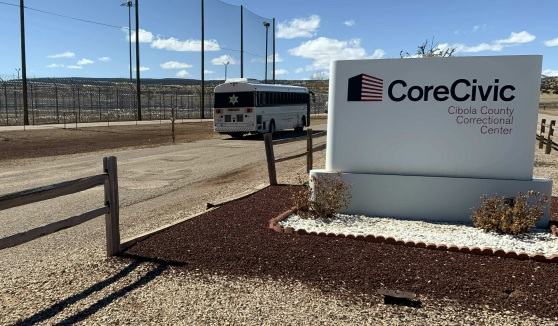
Cibola County finds itself in a unique position regarding HB 9. The Cibola County Correctional Center (CCCC), located in Milan, operates as an ICE detention facility under a contract with CoreCivic, a private prison company.
CCCC has long been controversial due to allegations of human rights violations, excessive use of solitary confinement, and detainee deaths. While CoreCivic has defended its record, watchdog organizations and legal advocates continue to raise concerns.
The Cibola Citizen acquired the government of Cibola County’s contract with CoreCivic, which holds the detainees of local law enforcement: Cibola County Sheriff’s Office, Grants Police Department, Milan Police Department.
Cibola County facilitates an Intergovernmental Service Agreement (IGSA) with ICE, but it does not directly detain federal immigration detainees. The actual detention operations are handled by CoreCivic at CCCC.
The government of Cibola County, nor any of the local law enforcement agencies, directly assist the efforts of ICE. However, the contract signed between the Cibola County and Core-Civic does state:
“WHEREAS, the County intends to enter into an Intergovernmental Service Agreement (IGSA) with the United States Immigration and Customs Enforcement (ICE), a copy of which is attached hereto as Exhibit A”; “WHEREAS, CCA [CoreCivic] owns the Cibola County Correctional Center in Milan, New Mexico (Facility) and desires to house federal inmates at the Facility pursuant to the IGSA”; 'WHEREAS, the County desires CCA to house federal inmates at the Facility pursuant to the IGSA.'
The agreement means that Cibola does not own the detention facility, and rather than detaining inmates on its own, the county contracts with CoreCivic to hold the inmates it processes. Some of the inmates the county processes as part of the IGSA are federal ICE detainees.
A key part of Cibola’s contract with CoreCivic reads, “The County shall pay CCA all funds received pursuant to the IGSA within 10 working days of the County's receipt of the funds from the government, less an administrative fee of $0.50 per day per inmate.”
This section of the contract means that Cibola takes an “administrative fee” of $0.50, or half a dollar, per federal inmate CoreCivic holds at CCCC. While this fee is small, the county likely views it as an administrative cost offset rather than a revenue-generating agreement. The county does not cover operational expenses— CoreCivic does.
According to Cibola County property records, the Cibola County Correctional Center has an assessed taxable value of over $20 million. CoreCivic employs local residents from across the county, meaning payroll taxes (income tax withholding, Social Security, and Medicare) flow to both the state and federal governments. The facility purchases goods and services (food from local restaurants, supplies from local stores, local maintenance tools), generating local and state sales tax revenue.
Senator George Muñoz (D-Gallup), whose district includes the CCCC facility, chairs the Legislative Finance Committee. The committee has noted that HB 9 would have a minimal fiscal impact on the state’s general fund. However, the bill’s fiscal impact report does raise concerns about potential loss of federal funding, particularly if ICE is forced to relocate its detainees elsewhere.
The Trump Administration’s Crackdown
At the national level, President Donald Trump has made clear that he expects stricter immigration enforcement. His recent executive order rescinds protections for sensitive locations like schools and churches, allowing ICE to conduct enforcement operations at previously restricted areas.
Moreover, ICE Director Caleb Vitello was recently reassigned after President Trump expressed dissatisfaction with the agency’s pace of migrant arrests and deportations. This shake-up signals a more aggressive approach to immigration enforcement, which could bring further scrutiny to states like New Mexico which try passing laws limiting cooperation with federal authorities.
Local Governments Struggle with Uncertainty
While some New Mexico officials support HB 9 as a necessary step to protect immigrant rights, others are hesitant due to economic and legal concerns. Local law enforcement agencies are already under pressure to clarify their stance on immigration enforcement.
Cibola County Sheriff Larry Diaz and Grants Police Chief Maxine Monte have said that their department does not conduct civil immigration enforcement and are both following guidance issued by the state. The Village of Milan has yet to respond to inquiries about their cooperation with federal ICE officials, the village did request more time to evaluate and respond to the newspaper’s questions, As of press time, the Village of Milan has not responded.
New Mexico state law and the 10th Amendment to the United States do not require local law enforcement agencies to participate in federal immigration enforcement, and the NM Department of Justice has issued guidance warning about the risks of engaging in civil immigration actions. These risks include civil liability, a loss of public trust, and the diversion of resources from local policing priorities.
Community Perspectives and the Road Ahead
The debate over HB 9 reflects larger questions about the role of private detention centers in New Mexico. The ACLU and other advocacy organizations argue that no detention center is truly safe, pointing to the human rights concerns raised at facilities like CCCC.
“Most New Mexicans have shown time and time again that immigrants are welcome here,” said Felipe Rodriguez, Co-Director of NM Dream Team. “Unfortunately, our state has lagged behind and allowed private immigrant detention companies to propagate and grow in our communities.”
With Trump’s administration demanding increased enforcement, and New Mexico moving in the opposite direction, Cibola County is at the center of a national struggle over immigration policy. What happens next will shape the region’s future for years to come.
Editor’s Note: Between the time the Cibola Citizen began investigating this bill and publication, CoreCivic and the Cibola County Manager may not have had sufficient time to respond to our request for comment.