
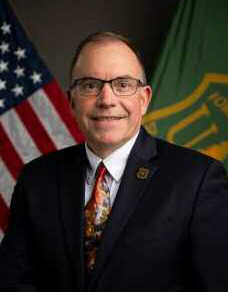
CIBOLACOUNTY— The U.S. Forest Service is under new leadership as Tom Schultz steps into his role as Chief amid growing controversy over mass layoffs that have impacted public land management nationwide, including in Cibola County. With the closure of local offices, loss of trained personnel, and potential risks to wildfire preparedness and recreation access, the changes have sparked local concern.
Schultz, who took office earlier this month, is the first Forest Service Chief who has not previously worked within the agency. In his introductory letter to staff, he acknowledged his background in state land management and private industry, particularly in timber and mineral extraction in Idaho. He expressed a commitment to “active forest management,” emphasizing timber sales, wildfire prevention, and recreation. However, his appointment comes at a time when thousands of probationary Forest Service and National Park Service employees have been fired under President Donald Trump’s Department of Government Efficiency (DOGE) directive, raising alarms about the agency’s future capacity.
Among those fired were fire suppression specialists, recreation officers, and conservation staff, including at least 16 employees from the Cibola National Forest.
The closures of federal offices in Grants and Zuni were justified as cost-saving measures by DOGE, eliminating leases worth $166,109 and $39,819 annually, respectively.
Cibola County has a deep connection to the National Forest and surrounding public lands, both in terms of environmental stewardship and economic impact. The loss of local personnel threatens maintenance of trails, campgrounds, and fire mitigation efforts. The closure of the Grants Forest Service office, which has long provided support to regional land management and firefighting coordination, raises questions about how Cibola will be serviced moving forward.
A protest at the El Malpais Visitor Center in Grants on March 1 drew ecologists, scientists, and former Forest Service employees who voiced their frustrations. Many pointed out that these staffing cuts will result in fewer trained personnel on the ground to monitor wildfires, maintain recreational trails, and support local conservation efforts like ecological preservation in the bat caves.
With at least 16 local Forest Service staff let go and broader cuts affecting hundreds of others across the state, New Mexico’s public lands are facing an uncertain future.
Congressional Pushback
In response to the mass layoffs, Senators Jeff Merkley (D-OR), Martin Heinrich (D-NM), and Angus King (I-ME) hosted a virtual roundtable on March 5 to hear from fired public lands employees and small business owners reliant on tourism and recreation. The senators voiced concerns that the firings were politically motivated and intended to weaken federal land management, making it easier for states to privatize or transfer public lands.
Senator Heinrich, a vocal advocate for New Mexico’s public lands, linked the layoffs to a broader strategy: “Trump, Musk, and Republicans are defunding management of our public lands to make Americans think that they are being poorly managed. This is all part of their scheme to transfer our public lands to states so they can sell them to the highest bidder. I won’t stand for it.”
The discussion also touched on how reductions in staffing will affect wildfire preparedness.
Many of those laid off were “red card” certified firefighters, according to the congressmen—critical personnel for responding to wildland fires. Lydia Jones, a certified emergency medical services ranger at Badlands National Park, and Bailey Langley, a public affairs officer for Umatilla National Forest, both confirmed they were fired for “poor performance” despite their supervisors advocating for them to stay. These dismissals mirror cases across the country, leaving major staffing gaps in fire-prone regions like Cibola County.
In an email, Senator Ben Ray Lujan wrote, “Wildfire season in New Mexico is already here, and cutting firefighting infrastructure at this critical moment is reckless and dangerous. Musk and Trump’s decision to dismantle these resources — especially after the state’s largest wildfire that was ignited by the federal government — puts lives, homes, and communities at risk.”
The Forest Service’s Next Steps
In his introductory remarks, Schultz did not directly address the mass firings but framed his leadership as a reset for the agency. “The Forest Service carries a fiduciary responsibility to the American public. We must steward tax dollars wisely, so I’ll examine how to best optimize our workforce and our expenditures,” he stated.
Schultz emphasized his focus on timber sales and “active forest management,” including fuels reduction through mechanical thinning and prescribed fires. However, with fewer employees on the ground to execute these plans, concerns remain about how effective the agency will be in responding to both conservation and fire suppression needs.
The Forest Service has scheduled an all-employee call for March 10, where Schultz is expected to address concerns. However, results from the meeting were not available by press time.