

New Mexicans Remember the Bataan Death March and the Veterans Who Came Home with the War Still Inside Them
CIBOLA COUNTY, N.M. – On April 9, 1942, thousands of American and Filipino soldiers — including hundreds from New Mexico — were captured by Japanese forces after months of fighting on the Bataan Peninsula. What followed became one of the most harrowing episodes of World War II: a forced 60mile march through tropical heat and starvation, where prisoners were denied water, beaten, and executed at random.
Many of those men were barely trained National Guardsmen from rural towns like Anzac, Grants, and San Rafael. They’d come from the 200th and 515th Coast Artillery units, deployed hastily to defend the Pacific. When they were overrun, there was no rescue. No reinforcements. And for years, no recognition.
“No mama, no papa, no Uncle Sam,” they used to say. “Nobody gives a damn.”
Today, their stories endure — not only in history books or monuments, but in the memories of their families, and in the communities where they tried to live after coming home.
Sam from Anzac
Sam Antonio was around 21 when he entered the Army, one of several brothers who went off to war. Sam was taken prisoner in the Philippines and held for three years. He was tortured. He was starved. His daughter remembers the way he kept serving, even after all of it.
“They wouldn’t let him reenlist in the Army, so he joined the Air Force,” she said. “He never stopped serving.”
Years later, Sam finally received most of the medals he had earned — except for the Purple Heart. Officials claimed there was no record of him being wounded. “But what more wounded do you need,” his daughter asked, “than a man who was tortured for three years?”
General Ahniwake Ray and the USS Franklin
Ahniwake Ray joined the Navy at 17, with his mother’s signature. On March 19, 1945, the aircraft carrier USS Franklin was struck by two 500pound bombs dropped by a Japanese plane just 30 miles from the coast of Japan. The ship carried nearly 100 planes — each fully loaded with fuel and explosives.
The bombs triggered an inferno.
Ray, a fireman 1st Class, was below deck when the blasts hit. Fires ripped through the carrier. Planes exploded one after another. Hundreds of sailors were killed. Ray turned 19 three days later, still onboard, still burying friends at sea.
When he came home, he suffered in silence — what would now be called PTSD. Back then, there was no name for it. His children remember a man who worked hard, went to church, loved his country, and never once called himself a hero.
Brigadier General James B. Barber
James Barber was working as a newspaper editor in Raton when the attack on Pearl Harbor pulled him into the Army Air Corps.
He flew as a spotter pilot in the European Theater and earned a Silver Star for alerting ground forces to incoming German air strikes. He served during the Battle of the Bulge and later continued his service in the New Mexico National Guard, reaching the rank of Brigadier General.
He returned home, quietly, like so many others, and lived out his life in New Mexico.
The Legacy Lives On
The Bataan Death March has deep roots in New Mexico.
Once the heart of New Mexico’s territorial and early state government, the Bataan Memorial Building in Santa Fe has officially been added to the State Register of Cultural Properties. Built in 1900, more than a decade before statehood, the building housed all three branches of government until 1966 and played a central role in New Mexico’s transition from territory to state. It was renamed in 1968 to honor the members of New Mexico’s 200th Coast Artillery regiment who endured the Bataan Death March during World War II.
The building is now home to several state agencies, including the Department of Veterans Services and the Secretary of State. Its grounds feature New Mexico’s Eternal Flame and a memorial to the veterans of Bataan. The Cultural Properties Review Committee voted unanimously to approve the listing in December, citing the building’s architectural and historical importance and its memorial role in honoring the lives lost in one of the war’s darkest episodes.
With its addition to the State Register, the building’s nomination will now advance for potential inclusion on the National Register of Historic Places. Officials say the designation helps ensure the building’s legacy — as both a seat of governance and a place of remembrance — is preserved for generations to come.
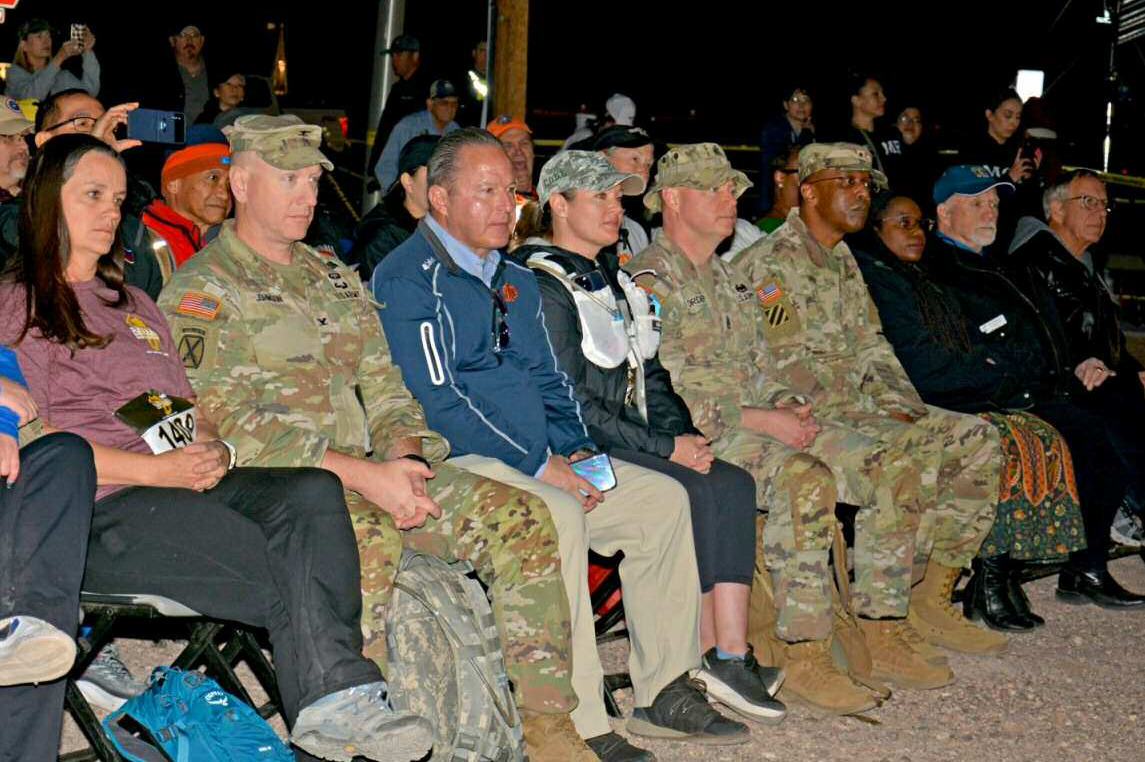
Another way the state honors the Bataan Death March veterans comes each spring, at White Sands Missile Range, thousands of participants gather to walk in memory of the soldiers who endured the Bataan Death March. The route winds for more than 26 miles through desert terrain. Marchers carry heavy packs and finish blistered, dehydrated, and exhausted — a symbolic echo of the original ordeal.
In 2025, more than 4,600 people took part.
Military leaders, medics, students, and civilians came from around the country to honor the fallen and walk in solidarity with those who came home. “The story of Bataan must remain a vibrant part of our national memory,” said Col. Donyeill Mozer. “The immense sacrifices made must never be forgotten.”
Of the 1,816 men sent from the 200th and 515th Coast Artillery units, 829 never returned. Those who did carried physical and emotional scars for the rest of their lives.
Some received medals. Some refused them. Some asked for nothing at all.
But their stories remain. In old photographs. In fading uniforms. In the memories of children who remember silence at the dinner table and nightmares in the middle of the night. In the families who still live here — in Grants, in Anzac, in Milan, in San Rafael.
They are remembered not only for what they endured, but for how they lived after it.
Their wounds did not make them weak. They made them survivors.