
THOREAU, N.M. – One of the last times the U.S. Environmental Protection Agency authorized the state of New Mexico to issue and enforce a hazardous waste facility permit under RCRA, the federal Resource Conservation and Recovery Act, was in 1990 for the disposal of highly radioactive transuranic waste at the Waste Isolation Pilot Plant near Carlsbad.
Now, EPA and the state are back to sell the public on another “pilot,” this time to dispose of waste from the former Quivira uranium mine near Church Rock at a regional solid waste landfill bordering the Navajo Nation community of Thoreau. They also plan to store radioactive waste from Sections 32 and 33 mines at Casamero Lake.
Congress authorized the U.S. Department of Energy's WIPP test facility in 1979 for interim storage, but it wasn't until 1999, after years of opposition and litigation, that the first shipment from Los Alamos National Laboratory arrived at WIPP. Now, 26 years later, EPA has approved a DOE request to dispose of transuranic waste in two new panels at the pilot plant within an ancient 2,000-foot salt bed. Public meetings on that decision are scheduled for 13 p.m. and 6-8 p.m. Aug. 28.
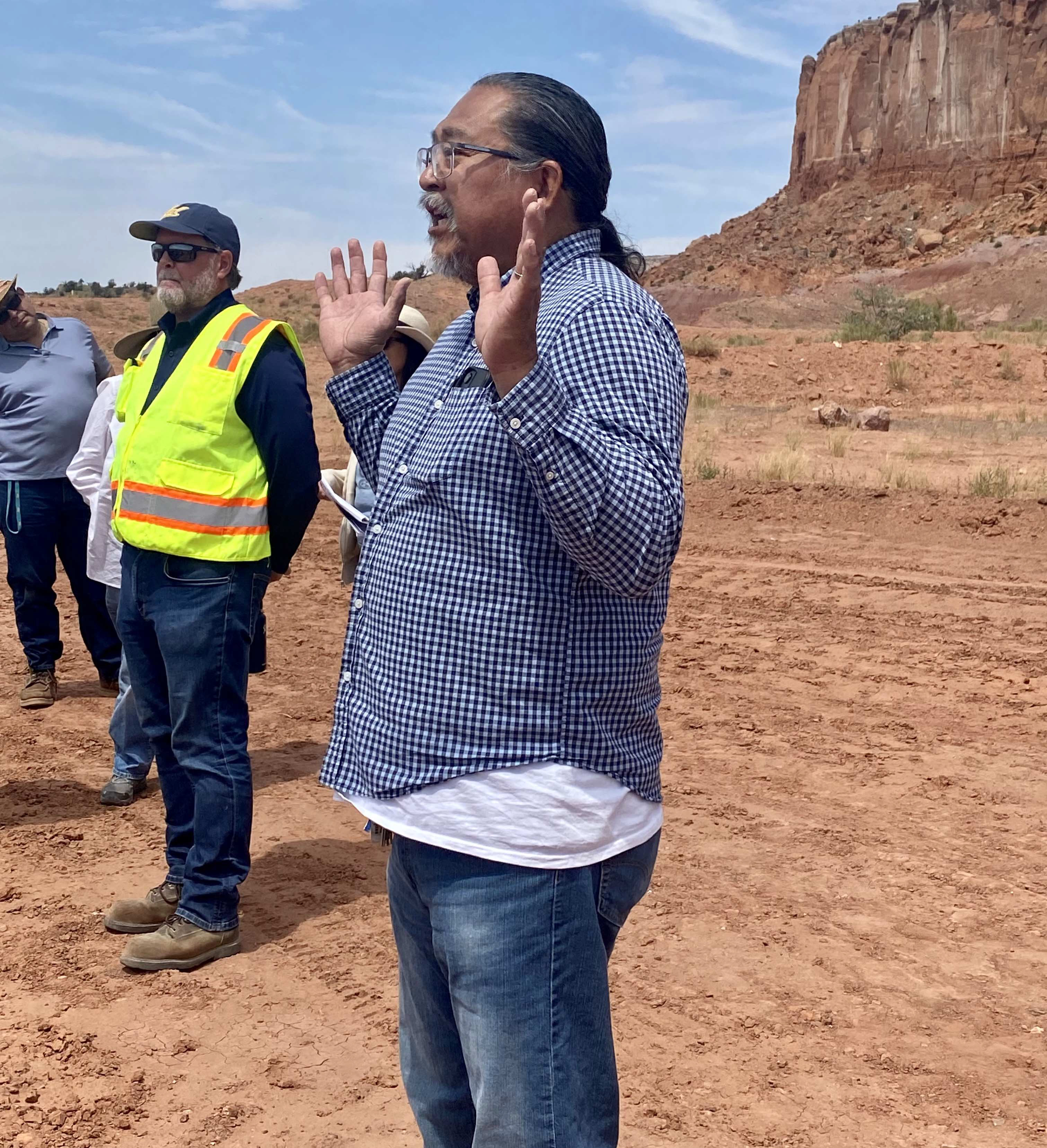
At the Red Rock Regional Landfill, the disposal of low-level radioactive waste from the Quivira Mine, formerly operated by Kerr-McGee Corp., is making its way through EPA and state processes. During a tour Aug. 14, U.S. EPA, state of New Mexico and Navajo EPA officials shared their plan to dispose of 1.1 million cubic yards of uranium mine waste on approximately 40 acres overlooking the former Escalante Power Plant and McKinley Paper.
“The main thing is that the mine waste rock that will be coming here is not a RCRA-regulated waste. It is not a hazardous waste, it is not a solid waste. It is considered very low level radioactive waste,” U.S. EPA's Kenyon Larson, remedial project manager for the Quivira Mine site, said.
Layers of protection
Part of the reason for choosing the landfill site and not leaving the waste in the Red Water Pond Road community is the geographic and geological challenges that make it difficult to manage the waste by consolidating and capping it there, Larson said. The waste is currently located on the edge of an arroyo and mesa in the middle of a residential community.
“Here, there is over 500 feet of very low permeability natural shale between the surface here and the shallowest drinking water aquifer. So there is a very, very large, very low permeability layer that prevents anything from going down,” he said. “In addition, that aquifer that’s down there, the Sonsela Aquifer, is under pressure. It’s an artesian aquifer, so anything that is moving down is not going to go down into that aquifer because of the pressure that’s coming up.”
Garry Moore, executive director of the Red Rock Landfill, noted that the Northwest New Mexico Regional Solid Waste Authority will operate the repository, but the logistics and closure of the mine site are the responsibility of the mine owner, now BHP Billiton, and EPA. “We will not be handling any of the logistics, just the onsite work here,” he said.
EPA's primary contractor, Tetra-Tech, has been chosen to work with the landfill operator on the repository design. Preliminary plans are likely to include a 5 to 6 foot evapotranspiration or “ET” cover – a thick layer of clean material on the top that also has an organic layer which can be vegetated to prevent water from migrating downward.
Talia Boyd, a Navajo tribal member, asked whether they plan to use a liner with the disposal cell. “I know, before, people were saying, ‘Oh, we need a liner but they’re only going to last 30 years. How do we replace it?’” Larson said that was a good point. “Liners don’t work forever. The real way to protect material that might get wet from leaching into groundwater is to prevent it from getting wet at all. So we really placed much more emphasis on a cover over the top.”
Even without an ET cover, mine waste repositories in this area of the country rarely get more than a foot or two of water at the top because the heat that comes after the water lands on it causes it to evaporate quickly, he said.
“If no water ever gets into the waste, there is absolutely no reason for a liner that won’t last anyway. But we do hear a lot from the public about putting a liner in because there’s an added feeling of security from a liner, even if it isn’t an actual security,” Larson said.
Amber Rheubottom, who works with the New Mexico Environment Department, said the disposal cell also likely will have a radon barrier layer of compacted soil beneath the ET cover for extra protection. “Both of those have been done in New Mexico in the past and it is likely that we would require those in the future.”
Never done before Asked how difficult would it be to amend the license to allow waste from other areas, Rheubottom said that so far, the state has said that only Quivira and Sections 32-33 wastes are allowed. After that, “We will evaluate each job proposal on a case by case basis. That’s been communicated in multiple letters.”
Larson said that on the 40-or-so acre site there’s not a whole lot of extra space here for additional wastes. “Just from a physical standpoint, this is only enough space for those two mines. So it would be likely that it would have to go through a totally different process rather than amending the existing one if the decision was made by the state of New Mexico to allow for another off-Navajo mine waste disposal facility.”
Rheubottom said Larson was correct about the limited space. “This has never been done in New Mexico before. We are using this as like a 'test pilot' … This is a collaborative effort and a new way to try something new. We think it can be done in a protective way, so that is where we stand right now. But again, we have not made any decisions. This is not set in stone. No waste can be moved onto this site until those permits are fully approved and that’s a one to three year process.”
Stephen Etsitty, executive director of Navajo EPA, said, “This is the first time I have heard that this is a pilot effort. I always thought that New Mexico Environment Department and the Solid Waste Bureau had some experience disposing of TENORM [Technologically Enhanced Naturally Occurring Radioactive Material] from oil and gas and other extractive industries that end up pulling up radioactive material. Can you shed some light on that?”
Each landfill has a limit for radioactive wastes that it’s allowed, Rheubottom said. “Oftentimes, we have seen that materials from mines – that’s soil, construction debris – exceeds the limit that is allowed under the solid waste regulation, so that is why this is a different facility under a different regulation. Because this is not allowed to be in RCRA disposal cells.”
Etsitty then questioned what experience the state has in permitting for the disposal of radioactive materials in landfills that the state permits.
“It’s not done, that's the thing,” Rheubottom responded. “It’s because landfills have limits on what they are allowed to accept and most of the TENORM material exceeds those limits, and so it has to be placed in a different area and handled differently.”
Nona Bahashone of the Diné Uranium Commission asked how much money the landfill is getting from the federal government for the project. Moore said, “Zero money from the federal government.”
Lawson said U.S. EPA set aside $89 million from the Tronox settlement for the project that has been placed in a separate interest-bearing account. “Obviously, EPA has been using some of that and we have spent some of that,” he said. However, cleanup costs are going to exceed the amount set aside in that special account, he noted, “so we will go to responsible parties for that mine and get the additional funding necessary to complete that action for a total of $189 million.”