
CIBOLA COUNTY, N.M. – New Mexico has started the slow work of cleaning up some of its most neglected uranium sites, and that effort now includes mines in the Grants Mining District that have sat abandoned for decades.
Cleanup activities are underway at four former uranium mine and mill sites across the state, the first projects under the New Mexico Mine Cleanup Initiative.
The initiative is funded with a $20 million appropriation from the Legislature through House Bill 2 (2025). According to the New Mexico Environment Department (NMED), about $12 million of that is projected to go specifically toward “neglected” uranium mines – sites where there is no viable responsible party and no other cleanup program in place.
The work is being led by NMED in partnership with the Energy, Minerals and Natural Resources Department (EMNRD). These agencies are relying on technical contractors to investigate contamination, design reclamation plans, and prepare for actual earthmoving and closure work over the next several years.
Environment Secretary James Kenney described the initiative as an effort to finally address “the unfinished business of abandoned uranium mine cleanup,” backed by legislative funding and the technical expertise of state staff. NMED Uranium Mine Reclamation Coordinator Miori Harms called it “the first step in a truly monumental effort to reverse the legacy of neglect,” and said the state expects to have heavy equipment “on the ground conducting remedial activities” by the end of 2026.
Focus on Red Bluff and Roundy Mines Near Grants
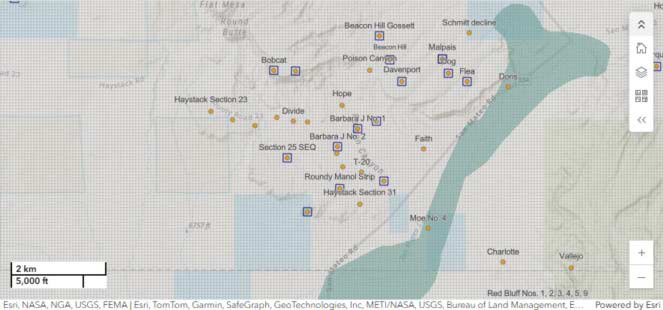
For Cibola County, the most immediate work is centered on the Red Bluff No. 1 Mine and the Roundy Shaft and Roundy Manol Strip Mines, all located on state trust land managed by the New Mexico State Land Office in the Grants Mining District.
Red Bluff No. 1 consists of two pit areas that were excavated into the Todilto Limestone Formation to reach uranium deposits. The pits are oriented along the north and east section lines. The state reports that the disturbance is not visible from Haystack Road itself, but runoff from the site is visible downslope and could potentially affect nearby groundwater through seepage. The nearest residence identified in the report is about one mile northwest of the mine along Haystack Road.
NMED has contracted with ENTACT LLC to carry out the technical work at Red Bluff No. 1 as well as the nearby Roundy mines. The contract took effect on July 1, 2025, and field surveys began in mid-September. During the first quarter of the current fiscal year, ENTACT reviewed historical information about the site, completed initial field inspections, and submitted project management and safety plans.
The company is now in the middle of detailed radiological investigations over roughly 200 acres, along with other required surveys. Those investigations feed into a Site Assessment Report and a Feasibility Study, both expected in the next quarter. The reports will summarize the field data, evaluate cleanup options, and lead to a closure and reclamation plan that in- cludes estimated volumes of contaminated material, possible covers and re-vegetation methods, and a post-reclamation monitoring plan with cost estimates.
The Roundy Shaft and Roundy Manol Strip Mines sit adjacent to Red Bluff No. 1 and are being addressed under the same ENTACT contract. NMED’s report notes that survey work is already underway there as well, including cultural resource surveys, biological assessments, and radiological walkover surveys. The state anticipates making significant progress at these sites by June 2026, when the current round of funding is scheduled to expire.
ENTACT’s work at Red Bluff and the Roundy sites is supported by an encumbrance of about $1.48 million from the uranium cleanup budget. There is no other funding for these sites and no responsible owner identified in the report.
Other First-Round Sites in McKinley County
While Cibola County’s direct involvement is through the Red Bluff and Roundy projects, the first phase of the New Mexico Mine Cleanup Initiative also includes two neglected sites in McKinley County: the Schmitt Decline Mine and Moe No. 4 Mine.
The Schmitt Decline site is located on state trust land managed by the State Land Office. It includes an open and unfenced decline and multiple waste piles of soil and rock around the mine opening, all showing signs of wind and rain erosion. The nearest residence identified in the report lies about 1.22 air miles away, near the junction of Highways 605 and 509.
Moe No. 4 Mine, also in McKinley County, sits on state trust land and includes a headframe, a collapsed decline or shaft, at least three waste rock piles, and a reddish silty settling area where radiation readings are high. The report notes that site contamination appears to extend from state trust land onto adjacent private property to the west, and the site is located roughly a quartermile east of San Mateo Creek.
How the Agencies are Working Together
To support this work, NMED and EMNRD’s Mining and Minerals Division entered into a Memorandum of Agreement in 2025. The agreement brings in staff from the Mining Act Reclamation Program and the Abandoned Mine Land Program to provide technical assistance through the full lifecycle of cleanup, from obtaining site access and conducting surveys to reclamation and final radiation closeout surveys.
The total encumbrance for this MOA is $2.5 million, with $42,704.33 already spent as of the first quarter. NMED expects that roughly $500,000 of that will be used during Fiscal Year 2026, though the exact amount to be disencumbered may change.
What it Means for Cibola County
For Cibola County residents, the most immediate relevance of this statewide initiative is the attention now being paid to Red Bluff No. 1 and the Roundy mines in the Grants Mining District.
These are among the first neglected uranium sites in New Mexico to receive dedicated, state-funded assessment and planning for reclamation under the Uranium Mine Cleanup Act.
NMED and EMNRD emphasize that the lessons learned from these initial projects will guide how the state scales up work at additional sites in future years. For communities in and around Grants that have lived with the legacy of uranium mining for generations, this marks the beginning of a long-term, state-led effort to finally confront at least part of that legacy on the ground.