Public result review comes as students complete this year’s statewide assessments
GRANTS, N.M. – As Grants Cibola County Schools students complete the annual state testing, the most recent publicly available academic data offers a snapshot of where the district and surrounding region stood as students entered the final months of the 2025-2026 school year.
Students have been taking the New Mexico State Standardized Assessment over the last three weeks, the results will not be available immediately. District and state-level assessment results are typically released months after testing is completed, meaning the next round of public data is not expected until later this year, possibly not until November.
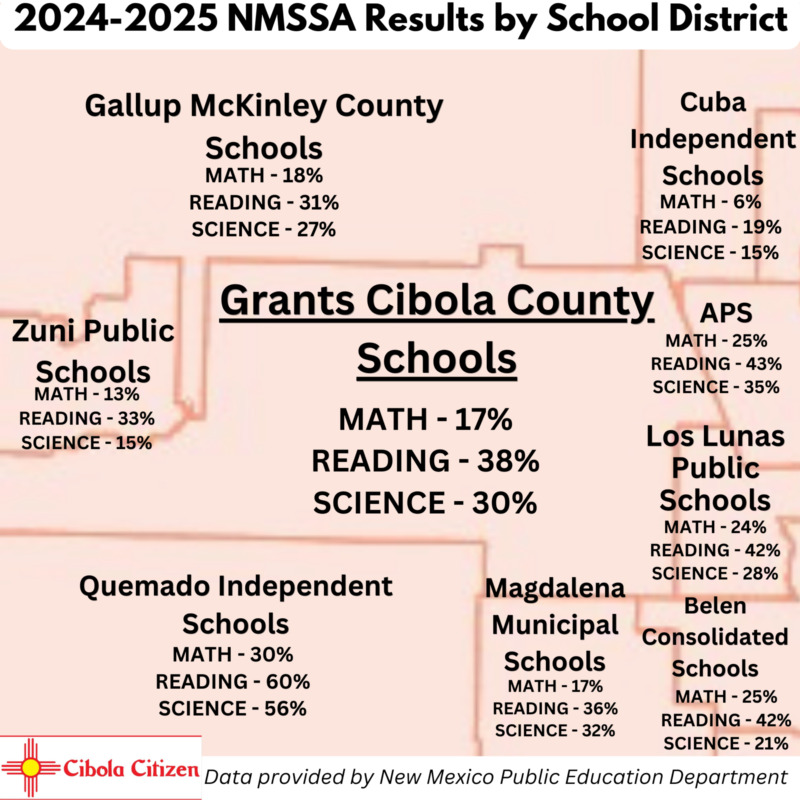
For now, the most recent statewide data available through NM Vistas and the New Mexico Public Education Department shows Grants Cibola County Schools reported 17% proficiency in math, 38% in reading, and 30% in science for the 20242025 school year.
Those numbers are not just education statistics. In Cibola County, they are also part of the broader economic story.
Public schools are one of the largest recipients of local property tax distributions.
A Cibola County Treasurer’s Office distribution report reviewed by the Cibola Citizen showed Grants Cibola County Schools had received $3,820,123.18 in property tax distributions from July 2025 through March 2026, the largest single recipient listed in the county’s distribution report during that period. The same report showed Cibola County government received $3,440,633.25, followed by Cibola General Hospital, New Mexico State University-Grants, the City of Grants and other public entities.
That means education is not separate from the local economy. It is one of the public systems residents directly support, and one of the systems that helps determine whether Cibola County can grow, attract employers and prepare local students for work after graduation.
The latest public academic results show GCCS performing near the middle of several nearby and regional districts in some areas, while also highlighting the broader academic challenges facing many rural and western New Mexico school systems.
According to the data from the New Mexico Vistas state accountability tool, for the 2024-2025 school year, Grants Cibola County Schools reported 17% proficiency in math, 38% in reading and 30% in science.
Gallup McKinley County Schools reported 18% in math, 31% in reading and 27% in science.
Zuni Public Schools reported 13% in math, 33% in reading and 15% in science.
Cuba Independent Schools reported 6% in math, 19% in reading and 15% in science.
Some nearby districts reported higher results.
Quemado Independent Schools reported 30% proficiency in math, 60% in reading and 56% in science.
Magdalena Municipal Schools reported 17% in math, 36% in reading and 32% in science.
Albuquerque Public Schools reported 25% in math, 43% in reading and 35% in science.
While Los Lunas Public Schools reported 24% in math, 42% in reading and 28% in science.
The comparison shows two things at once: GCCS is not alone in facing difficult academic conditions, but the results also show how much work remains if the county wants stronger student outcomes and a stronger local workforce.
That workforce question has become more urgent as local economic development leaders talk about future industry, energy, infrastructure, health care and technical jobs in Cibola County.
Cooper Jones, executive director of the Cibola Communities Economic Development Foundation, recently told the Cibola Citizen that economic development and education are closely connected. Jones said addressing child poverty and workforce readiness requires building clearer links between classrooms and local employment.
“Economic development is the most effective tool against child poverty,” Jones said in a written statement. “We are tackling the ‘underequipped’ workforce issue by aligning classroom curriculum directly with local industry needs.”
Jones said CCEDF, the local school district and New Mexico State University are working to build “pathways” that connect students to highpaying local jobs after graduation. Active pathways include nursing and welding. Pathways in development include business, broadcasting, heavy equipment operation, commercial driver’s license training and mining or uranium sciences.
“The future of Cibola County depends on a workforce that is ready on day one,” Jones said. “We are no longer just hoping for jobs; we are building the people to fill them.”
That statement reflects one of the central questions facing Cibola County: how to connect education, poverty reduction and economic growth in a way that produces real opportunities for local families.
As the 2025-2026 school year nears its end, the results from this year’s state assessments will eventually provide a new measure of whether students are gaining ground. Until then, likely in November, the 2024-2025 data remains the clearest public snapshot available.