
Diego Lopez, Editor
Editor’s Note: When the Cibola Citizen wrote this article, there were only six projects on the Fast-Track list. When the Citizen check before sending this week’s edition for publication, there were seven projects on the list.
CIBOLA COUNTY, N.M. — Three uranium mining projects in northwestern New Mexico—including on sacred Mount Taylor—have been added to a fast-tracked federal permitting list, marking a significant escalation in the national push to expand domestic uranium production. The designation, announced quietly at the end of May, has already prompted concern among local communities and a strong response from the New Mexico governor's office.
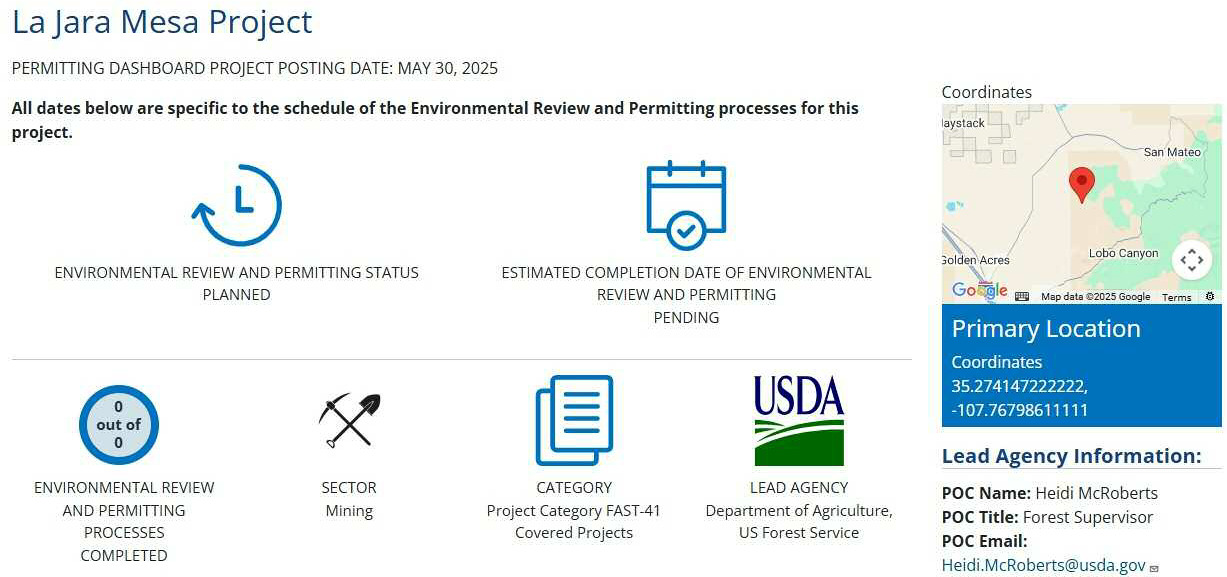
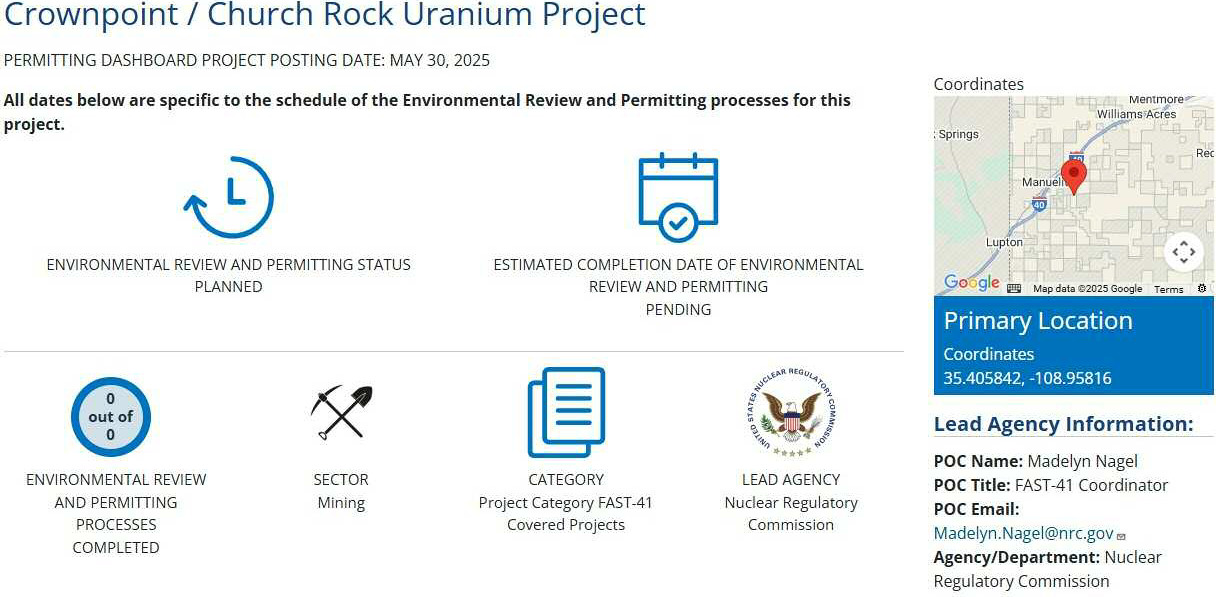
The La Jara Mesa project in the Mount Taylor Ranger District; the Grants Precision ISR Project near San Mateo; and the Crownpoint- Churchrock Project in McKinley County are now part of the 'FAST-41' program.
The designation, created under the Fixing America's Surface Transportation Act, gives select infrastructure projects enhanced federal permitting coordination and oversight, but does not change any existing environmental or legal requirements.
These three New Mexico- based uranium sites represent half of all mining projects nationwide currently listed under the FAST41 initiative.
According to the Permitting Council, these projects will receive 'focused, hands-on permitting support' intended to accelerate review timelines and improve interagency coordination.
The inclusion aligns with President Donald Trump’s recent slate executive orders calling for accelerated nuclear energy development and mineral extraction on U.S. soil. In a June 2 news release, Laramide Resources, owner of the La Jara Mesa and Crownpoint-Churchrock mines, wrote: 'As momentum builds around a new era for nuclear power, it is important to recognize that uranium is the fundamental starting point of the entire fuel cycle.'
State Pushback
New Mexico Governor Michelle Lujan Grisham's administration responded forcefully, emphasizing that federal support does not override state law.
'It is illegal to mine uranium in New Mexico without a mining permit from EMNRD and a groundwater permit from the New Mexico Environment Department— period,' said Michael Coleman, Communications Director for the governor. 'We’re confident that the state’s strong and rigorous permitting process would preclude any need for intervention by law enforcement.'
Coleman also pointed to more than $1 billion in federal cleanup funds that remain unspent for legacy uranium sites across tribal and rural New Mexico, writing: 'The federal govern- ment should make good on its obligation to remove dangerous hazards and toxins left by mining companies before permitting any additional mines in our state.'
Tribal and Community Concerns
The La Jara Mesa project has been a flashpoint for over a decade due to its location on Mount Taylor, a mountain held sacred by several pueblos. The project proposes underground uranium mining with surface support facilities, all within the Mount Taylor Ranger District.
The Roca Honda project, also located on Mount Taylor, is not part of the FAST-41 initiative but is listed under a separate 'transparency' designation. Both La Jara Mesa and Roca Honda are now on the Permitting Dashboard, a federal website that tracks major infrastructure projects. The site lists La Jara Mesa's estimated permitting completion date as March 2028 and Roca Honda's as November 2027.
The Crownpoint-Churchrock project proposes in-situ recovery uranium operations on private and Navajo allotment lands in McKinley County. Although it holds a Nuclear Regulatory Commission license, the project still requires state approvals to proceed.
Legal Tensions
A regulator from the state Mining and Minerals Division, D.J. Ennis, recently confirmed that no project can legally move forward in New Mexico without state approval, even if the project lies largely on federal land. Environmental attorneys in the state also argue that any attempt by the federal government to gut environmental reviews would likely be challenged in court. If mining were to begin without proper approvals, Ennis said New Mexico State Police may be called in to shut down the mines.
While there is currently no sign of state law enforcement being deployed, some observers note that these permitting clashes could test the boundaries of federalism, tribal sovereignty, and environmental law.
The FAST-41 designation does not guarantee approval or funding for any project, but it does establish formal federal support to speed the permitting timeline. It also adds political and economic pressure to communities still grappling with the legacy of uranium mining.
For Cibola County, the stakes are mounting. Mount Taylor is not only a sacred mountain but also a historical, cultural, and environmental landmark. With federal policy accelerating and state authorities holding the line, the future of uranium mining in New Mexico may hinge on what happens next in the shadow of the mountain.
The governor’s office said it expects the state permitting process to remain firm, regardless of pressure from Washington.
Federal permitting timelines may now be visible to the public, but the path forward remains far from certain.