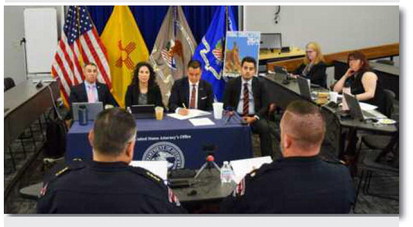
ALBUQUERQUE, NM — The U.S. Attorney's Office for the District of New Mexico recently held a significant Tribal consultation at the University of New Mexico’s School of Law, addressing critical issues affecting Native communities. The consultation, held on July 18-19, brought together delegations from 17 Tribes, the All Pueblo Council of Governors, and the Bureau of Indian Affairs to discuss the devastating impact of fentanyl, the need for enhanced law enforcement training and retention, and the broader challenges faced by Native families.
U.S. Attorney Alexander M.M. Uballez, who initiated the consultation, reaffirmed his office's deep commitment to serving Tribal communities, describing it as one of his 'greatest honors.' He highlighted the office's increased resources for community outreach, education, and training for Tribal law enforcement, along with the expansion of the Indian Country Crimes (ICC) section with four new Assistant U.S. Attorneys focused on addressing violent crime on Tribal lands.
Since August 2023, Uballez’s office said he has personally met with representatives from ten different Tribes and Pueblos to foster direct communication and better understand their unique needs. The office’s efforts include 28 community outreach activities and nine training sessions for Tribal law enforcement, reaching over 1,000 people.
One of the major concerns voiced by Tribal representatives during the consultation was the escalating impact of fentanyl on their communities. Nearly all participants described how fentanyl is ravaging their cultures, leading to increased violent crime, higher death rates, and rising homelessness. In response, Uballez outlined a comprehensive strategy to combat fentanyl trafficking in Tribal areas, which includes expanding the Organized Crime section, designating dedicated drug prosecutors, collaborating with the DEA, and securing federal funding for addiction treatment services.
The U.S. Attorney's Office also facilitated more than $10 million in grants over the past year to enhance public safety, support victim services, and strengthen Tribal justice systems.
A notable aspect of the consultation was the focus on Missing and Murdered Indigenous Persons (MMIP) cases.
Tribal leaders expressed deep concerns about persistent communication gaps and unresolved investigations. MMIP is a major issue in Cibola County, with several cases going unsolved across Cibola involving murdered and missing indigenous persons like Mona Renee Vallo who died as a result of a fatal hit-and-run outside the Pueblo of Laguna or Barbara Gould from the Village of Bluewater who disappeared in the Zuni Mountains.
In response, ICC Supervisor Elisa Dimas and MMIP AUSA Eliot Neal emphasized efforts to establish Tribal Community Response Plans, which aim to improve coordination and response to MMIP cases.
Law enforcement training and retention emerged as critical issues during the consultation. Tribes reported a high turnover rate among their officers due to competitive salaries offered by non-Tribal agencies and limited career advancement opportunities.
In response, Uballez and his team committed to supporting comprehensive training programs and helping Tribes secure federal assistance to build and sustain robust law enforcement departments.
Pueblo of Jemez Police Chief Roger Foster and Navajo Nation Vice President Richelle Montoya praised the U.S. Attorney's Office for its efforts in improving relations and communication with Tribal communities. Montoya highlighted the need for ongoing support in training and equipping Tribal officers, expressing the desire for more guidance and resources.
The District of New Mexico, the first federal prosecutor's office to establish a dedicated Indian Country Crimes section in 2010, continues to prioritize public safety in Tribal communities while recognizing the unique cultural heritage and sovereignty of New Mexico's Native American Tribes.
This consultation reflects the office's ongoing commitment to upholding the principles of Tribal sovereignty and Indian self-determination, as set forth in former President Bill Clinton's Executive Order 13175 on 'Consultation and Coordination with Indian Tribal Governments.'