
Through shifting rainfall patterns, persistent dry spells, and hard-fought moments of relief, Cibola County spent 2024 grappling with the relentless impacts of drought on its land, livestock, and people.
While periods of rainfall offered fleeting relief, the overall pattern of the year was one of adaptation and resilience. From dry fields struggling to recover to ranchers facing tough choices about their herds, the impacts of drought were felt across the county's agricultural sector, local economy, and daily lives of its residents.
Data provided by the National Oceanic and Atmospheric Administration (NOAA), the National Integrated Drought Information System (NIDIS), and the U.S. Department of Agriculture (USDA) paint a picture of shifting conditions throughout the year. Each month brought its own set of challenges and brief windows of improvement, reflecting the complex and often unforgiving relationship between Cibola County and its environment.
This report aims to summarize the key drought developments of 2024, exploring how they affected agriculture, livestock, wildfire risks, and local communities.
Monthly Overview of Drought Conditions
The story of Cibola County's drought in 2024 began with optimism.
January brought rainfall significant enough to rank the month as the 19th wettest on record. The landscape briefly responded, with ranchers and farmers reporting minor improvements. Yet, beneath the surface, the drought's grip remained firm. Hay fields, while green on top, hid dry and cracked soil below, and livestock still relied heavily on supplemental feed.
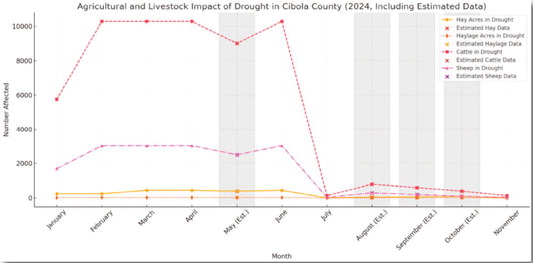
February brought a shift in focus. While precipitation kept the county out of the most severe drought classifications, the impact on livestock became more pronounced. Ranchers reported rising numbers of cattle and sheep affected by drought conditions, straining already tight resources. Despite modest improvements in haylage fields, the county's agricultural backbone continued to bear the weight of persistent dryness.
March arrived with mixed signals. It was one of the driest Marches on record, and the effects showed. Hay acreage under drought conditions surged, even as livestock numbers held steady. For farmers, the month felt like a balancing act, with every bale of hay counted and every drop of water carefully allocated.
April followed with a sense of weary stability. While drought classifications remained mostly unchanged, there was little optimism for dramatic improvement. Hay and haylage acreage remained static, and livestock numbers reflected ongoing stress. Meanwhile, the looming wildfire season had local fire crews preparing for the worst.
Relief finally arrived in June. Ranking as the fourth wettest June on record, the month brought widespread rain, allowing the soil to recover in many areas. Fields began to show healthier growth, and grazing land offered more sustainable forage for livestock. For many farmers and ranchers, while June felt like a much-needed pause in an otherwise relentless year for farmers, the Encerrita Fire sparked up in the Zuni Mountains this month, burning 2,496 acres.
The summer months of July and August carried this drought momentum forward, albeit unevenly. Some areas saw continued improvement, while others remained stubbornly dry. Ranchers made tough calls about herd sizes, and farmers adjusted expectations for their harvests. The sense of stability remained fragile.
As fall approached, conditions plateaued. September and October brought neither major setbacks nor significant improvements.
By November, the county reached a point of relative drought stability.
While the month ranked as the 34th wettest November on record, agricultural and livestock impacts had lessened compared to the year's harshest months – only 136 cattle and 40 sheep were estimated to be affected by the drought, according to the USDA National Agricultural Statistics Service. Ranchers reported little drought in agriculture fields this month, with only six acres of hay and 0 acres of estimated to be under drought according to the USDA NASS.
Drought data for December was not released as of press time, the Cibola Citizen has requested all relevant data.
Agricultural Impact
Agriculture remains the backbone of Cibola County, and drought conditions placed consistent pressure on farmers and ranchers throughout the year. In the early months, hay fields were saddled by drought, and by March, acreage under drought conditions peaked.
June offered brief respite, with rainfall improving conditions across key agricultural areas. Grazing fields saw renewed life, and hay production stabilized slightly. Yet, the cumulative impact of months of dryness lingered into the fall, with farmers reporting below-average harvests by year-end.
For many, the year was defined not by a single catastrophic event but by the slow, grinding stress of managing fields and livestock under uncertain conditions.
Cattle and sheep ranchers faced some of the toughest decisions in 2024.
February marked a sharp rise in livestock numbers affected by drought, with cattle and sheep relying heavily on supplementary feed and scarce water sources. By March and April, the situation stabilized but did not improve significantly.
June’s rains provided momentary relief, with water troughs refilled and grazing land showing signs of recovery.
By November, the number of livestock in drought had decreased to 136 cattle and only 40 sheep.
The Cibola Citizen noticed a high number of sheep affected by drought in Cibola County when the numbers reported by the federal government were placed on a graph. The numbers for sheep remained static (3,026) from February through June, despite changes in other indicators like hay and cattle, searching for clarity, the newspaper has sent multiple information requests to the USDA which have not been returned. Sheep are typically more drought tolerant than other animals, according to the paper Small Ruminants: Farmers’ Hope in a World Threatened by Water Scarcity published by the US National Institute of Health, which may explain their population in high drought parts of the county.
Wildfire season remained a looming threat throughout 2024. In June, a lightning strike in the Zuni Mountains sparked the Encerrita Fire, which burned almost 2,500 acres before being contained. The event served as a stark reminder of how quickly dry conditions could turn destructive.
Local fire crews worked tirelessly throughout the summer, conducting prescribed burns and enforcing fire safety measures. Community awareness played a key role in preventing larger disasters, with residents taking steps to clear flammable materials from their properties.
Thanks to ranchers, farmers, fire crews, local residents and forest stewards, Cibola has been working to increase preparedness and conservation. Because, even if the data may not currently reflect drought conditions, Cibola County is registered as “in drought” by the US Department of Agriculture.