From schools and county government to hospital funding and higher education, the tax dollar moves farther than many residents may think
GRANTS, N.M. – When Cibola County residents pay property taxes, the money does not stay with county government. It funds society that pays into it.
Property tax is a massive effort. The money moves through a large system – one that begins with the county assessor’s office, passes through state certification and into billing at the county treasurer’s office, and ends with money being distributed among several public entities, including county government, city and village government, the public school system, Cibola General Hospital, higher education and the state.
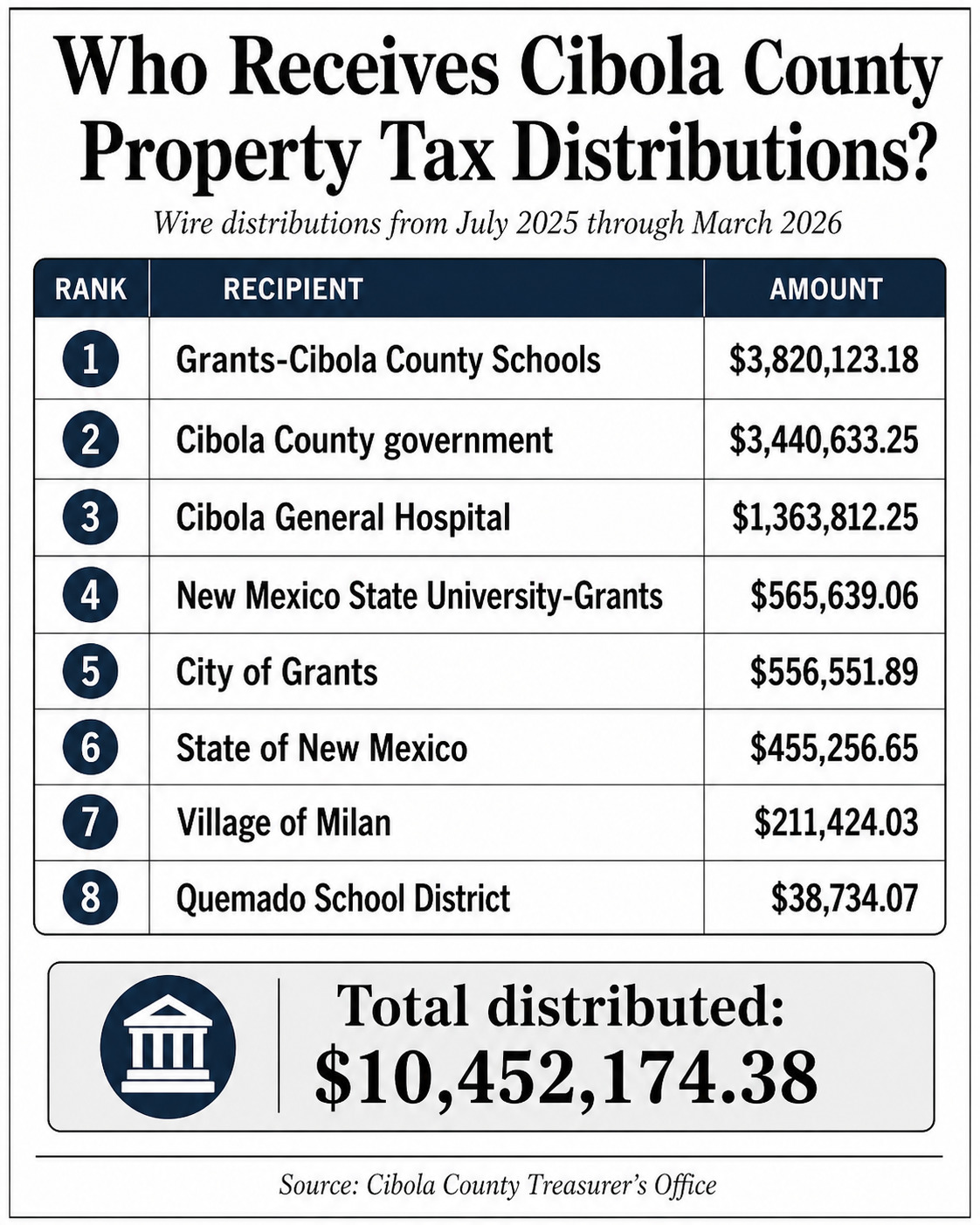
A distribution report prepared by Cibola County Treasurer JoAnne Martinez shows that from July 2025 through March 2026, a total of $10,452,174.38 in distributions were sent out from county property tax collections.
That means the money property owners pay in taxes is not just funding county government. It supports a broader structure of local institutions and obligations – some of which are ordered by state law and others are chosen to be paid by voters.
Cibola County officials walked the Cibola Citizen through that process in an interview that included County Manager Kate Fletcher, Finance Director Paul Ludi, Deputy Assessor Jenna Rodriguez and Treasurer JoAnne Martinez.
County officials say the property tax system is often misunderstood, even by people who pay into it every year.
Property Tax Begins with Assessment
Cibola County Deputy Assessor Jenna Rodriguez, who is the sole candidate running for the office of Cibola County Assessor this year, explained that the assessor’s office is responsible for determining the taxable value of property across the county.
The work of the assessor’s office includes examinations of residential land, non-residential land, property improvements, personal property, mobile homes, livestock categories, and review of potential exemptions. Fletcher described the assessor’s office as one of the most specialized departments in county government because assessors must work through state requirements, certification standards, valuation schedules, protests and ongoing reappraisal duties.
Fletcher said that, unlike many county offices, the assessor’s department must maintain a highly trained and state-certified staff because the work is technical and state-regulated.
During the interview, Rodriguez said Cibola County’s total taxable value stood at $440,933,730.
The assessor’s office explained how those taxable property values are determined.
According to Rodriguez, the assessor’s office looks at land, improvements, mobile homes, personal property, livestock, and exemptions before arriving at net taxable values.
Once values are certified by the assessor, the New Mexico Department of Finance and Administration receives them and must verify their accuracy in Santa Fe.
It is at the New Mexico Department of Finance and Administration, where the “yield control formula” – which determines the total property tax cost of state required dollars and voterapproved bonds – is applied and rates are certified back to Cibola County. From there, the county assessor has only a short window to finalize the rates and prepare the tax roll.
Fletcher and Rodriguez stressed that Cibola County does not set the tax rate on its own.
Instead, the structure is shaped by New Mexico state law, certified rates, and voter-approved “mill levies” and bonds which are district-specific obligations with separate taxing authorities attached to different parts of the county.
One of the most common public misunderstandings is the idea that county officials simply choose what people will pay.
As Fletcher explained, Cibola County’s lawful responsibility is to assess, collect and then distribute property tax. The treasurer does not decide who gets more money. The assessor does not raise or lower values by personal discretion. Those decisions, they explained, are determined by state law.
Cibola County officials said the entire process is structured, formula-based and heavily governed by state statutes and rules.
Billing and Collecting Property Tax
Cibola County Treasurer Martinez and Ludi explained that the county treasurer’s office receives the tax roll, generates the bills, collects the money and then distributes it according to the state-certified rates.
When a property owner pays their bill, that money first goes into a special property tax account. This is because, as officials explained, money is constantly coming in and money is constantly going out to tax recipients such as Cibola General Hospital, school districts, the City of Grants and the Village of Milan.
Cibola County Treasurer JoAnne Martinez said that distribution work must be exact “to the penny” because every district and agency is entitled to its full amount set under law.
Martinez said the total property tax amount on the rolls was $13,730,270, with special assessments listed separately at about $286,296.
Cibola County Finance Director Paul Ludi explained that, for budgeting purposes, the county uses a three-year average collection rate of 95.87%, reflecting the reality that not every tax bill is paid in full on time. Ludi said that rate is used in county budget planning because local governments must project what they realistically expect to receive, not just what is theoretically owed.
Where Does Property Tax Money Go?
The following is data courtesy of the Cibola County Treasurer’s Office of property tax distributions from July 2025 through March 2026. This was compiled and listed from the largest single recipient to the smallest: Grants-Cibola County Schools has so far received $3,820,123.18 Cibola County government has so far received $3,440,633.25 Cibola General Hospital has so far received $1,363,812.25
New Mexico State University-Grants / College has so far received $565,639.06 City of Grants has so far received $556,551.89 State of New Mexico has so far received $455,256.65 Village of Milan has so far received $211,424.03 Quemado School District has so far received $38,734.07
This totals out to $10,452,174.38 in property tax distributions since July 2025 to March 2026. The tax year ends in June.
Data reviewed from the Cibola County Treasurer’s Office shows that “schools” and county government together accounted for the largest shares of property tax money distributed during the period reviewed, but they also show how many recipients are built into the local property tax structure.
The schools category is not one single pot of money. County data shows separate lines for school operational funding, debt service, debt tech service and capital improvement. Quemado School District and Grants Cibola County Schools have their own separate operational, debt service, tech service and capital improvement lines as well.
Property taxes fund more than general government activity. They also support specific long-term public obligations such as education.
The same logic applies to other recipients. The City of Grants’ share is broken into operational and debt service. This money is budgeted in their general fund to pay for daily operations while a portion pays for debt.
For the small Village of Milan, their share of property tax money is budgeted in general fund for general government operations.
Cibola General Hospital funding appears in its own category, voters increased the rate for CGH in November 2025. The hospital is governed by its nonprofit board who direct funding.
County officials were especially careful to separate the county’s own role from the distributions.
Fletcher and Ludi said the Cibola County government can only budget and use their own lawfully entitled portion of the money. Once the county receives its share, that revenue goes into the general fund to support county operations and fund county responsibilities. Fletcher pointed to the sheriff’s office and Cibola County Regional Communications Center – the regional 911 – as examples of the kind of public obligations that counties must support while balancing limited revenue.
That means the county does not keep 100% of paid property taxes. The county distributes collected tax money out to lawful recipients, and each recipient then budgets its own portion.
Protesting the Valuation
Rodriguez said one of the most common complaints the assessor’s office hears is some version of: “Why are my neighbor’s taxes lower than mine?”
Her answer was that no two properties, no two owners, and no two sales are exactly alike.
Rodriguez explained that exemptions, valuation changes, sale timing, classification and added improvements can all affect what ends up on the bill. A property in Grants may sit inside a different municipal and school structure than a property that sits in the county. A property in Quemado School District will pay a different “schools” property tax from one that sits in GCCS. A mobile home may be classified differently depending on whether it is permanently affixed or handled as personal property.
Officials also emphasized an important distinction: people protest value, not the tax rate.
Property owners receive a notice of value – that is the letter sent to property tax owners saying, “THIS IS NOT A BILL.” Officials said this notice begins the period in which property owners can challenge the valuation if they believe it is wrong. Rodriguez said taxpayers have, by state law, 30 days from the notice date to file a protest, and the office then has time to review those protests, work with the property owner and, if needed, move the matter to a formal protest board process with state involvement.
Another common misconception, officials said, is that if a person does not receive a bill, they do not owe the tax.
That is not correct. During the interview, officials said the bill is essentially a courtesy mailing and an expected part of the process, but the obligation to pay exists regardless of whether a bill arrived in the mailbox.
The Role of Voters
Voters also play a bigger role in property taxes than some taxpayers may realize.
County officials said many pieces of the local property tax structure are tied to mill levies, debt service and other obligations that have been approved over time, particularly for schools and the hospital.
That means local elections and ballot questions can have a direct effect on what property owners pay and how much money public institutions receive.
Property taxes are one of the clearest ways Cibola County residents fund the public systems around them. The county’s distribution report shows those dollars move through a much broader structure than many people may realize — one that includes schools, county government, the hospital, higher education, municipalities and other public obligations.
If there is a takeaway in all that complexity, it may be this: public systems do not hold together by accident. Fletcher said keeping county government functional requires “good planning,” and the records reviewed by the Cibola Citizen show a system in which the money is tracked, the rules are followed and the work is being carried out.