
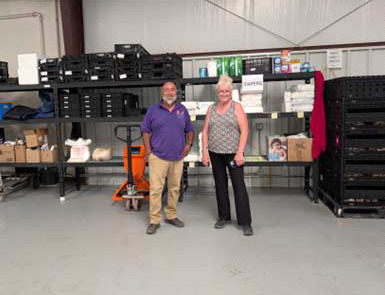
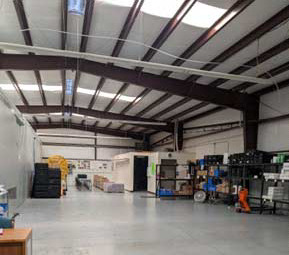
GRANTS, N.M. – The Grants Community Pantry has recently moved to its new, larger location.
Started in 2000 in a church parking lot by two men who used ice chests, these men saw the need in Cibola County. Because Cibola County is a financially struggling county in the state of New Mexico, the Gallup Community Pentry has already begun.
How the Pantry Started and Why it Moved
Determining that a food bank would be beneficial for Grants, they began with feeding people and it “grew literally on a daily and weekly basis” Executive Director/ CEO Alice Perez explained. Eventually they were able to establish the old building on Stephens Avenue and work out of that for many years.
By 2015, the “building was dilapidated… it was falling apart at the corners.” Perez admitted.
For three- or four-years Perez looked all over Grants for a different building that would be suitable for the pantry.
In 2021, an opportunity came from the State of New Mexico to apply for a funding to secure new buildings and make a better future for the industry of food insecurity distribution. The pantry applied for $2.5 million and received $1.8 million, which was used to purchase their new building on Sakelares Boulevard. Because it was state funds, the pantry “went to the City of Grants and we asked them if they would be the fiscal agent. They agreed upon it. They took it to the city council and the city council agreed,” Perez explained.
“We have tried to move forward in a very positive and meaningful manner for the community of Grants and Cibola County.”
Turning the new building into the community pantry did not come without obstacles, some of these challenges included timing and dealing with it on a state level.
The facility coordinator, Donald Jaramillo said “The state doesn’t always hand out millions toward food insecurity, it just happened to be that year.”
The federal government supplied the states with a certain amount of money due to the pandemic, and each state got to choose what they wanted to be done with the money. The state of New Mexico decided that they wanted to help address food insecurity, so they invited all non-profits to apply for the grant, Perez and Jaramillo explained.
“Its specific funding for food insecurity. It’s not like the city could build a bridge with that money or buy vehicles with that money. It had to go toward food insecurity organization that alleviated food insecurity. That’s why the pantry qualified.” Jaramillo explained.
The previous pantry location was 3,500 square feet, while the new one is a little over 7,500 square feet. There is now a large freezer and a large cooler/fridge, allowing them to have more food space.
Now that they have a larger facility and more space to store the food, they are now including diapers and dog food, things they didn’t provide before, or if they did, they supplied less. “We’re able to have so much more stock, so we’re able to give out more on a regular basis.” Jaramillo said.
The community pantry has two full-time employees and one part-time employee.
On Tuesdays, Wednesdays, and Thursdays, over six volunteers help. “They play a huge part.” Jaramillo explained the importance of volunteers “They welcome folks at the desk, they fix the boxes… they bag fruit, they sweep the parking lot. We couldn’t do it without them.”
Sometimes entire classes, boy scouts or girl scouts, church groups and different organizations will help, notably there is an elderly couple that has volunteered at the community pantry for over twenty years. Volunteers are encouraged to take their volunteer job and write it on their resume.
Available Resources
Behind the community pantry is several acres worth of land that the staff intended to turn into a community garden. Which they plan to sell the produce to locals.
Additionally, there are now two types of boxes: A smaller family gets a smaller box while a larger family gets basically double the smaller box. “We give them at least a twenty-five-pound box. We try not to ever turn anybody away.”
On average 80 to 120 families go to the pantry. On August 5, there were 146 families - not individuals – who went seeking food.
Emergency food boxes are for people who do not qualify for tcap program. This could be used for people who have a payment and don’t have enough money to pay for groceries, so the pantry will assist them until their next paycheck. “Let us give you and your family enough food to take care of you till next payday.” Perez said. “There’s nothing [to be ashamed about]. We’re all 10 seconds away from being faced with food insecurity.”
Perez explained, “We are here for the community.”
The building has extra offices, where they hope to have like-minded businesses “to make it a one-stop place for the community members and to make it easy [and] accessible for people to have more services.”