CIBOLA COUNTY, N.M. – A burst of thunderstorms may have offered a temporary reprieve this weekend, but the long-term numbers tell a different story: 2025 is shaping up to be one of the driest years Cibola County has experienced in more than a century.
According to the U.S. Drought Monitor and National Centers for Environmental Information, Cibola County is in its 13th driest year-to-date since 1895, with a deficit of 3.13 inches of precipitation from normal levels between January and August.
August alone was the 35th driest on record, running 0.76 inches below normal, even with scattered rain showers over the past two weeks.
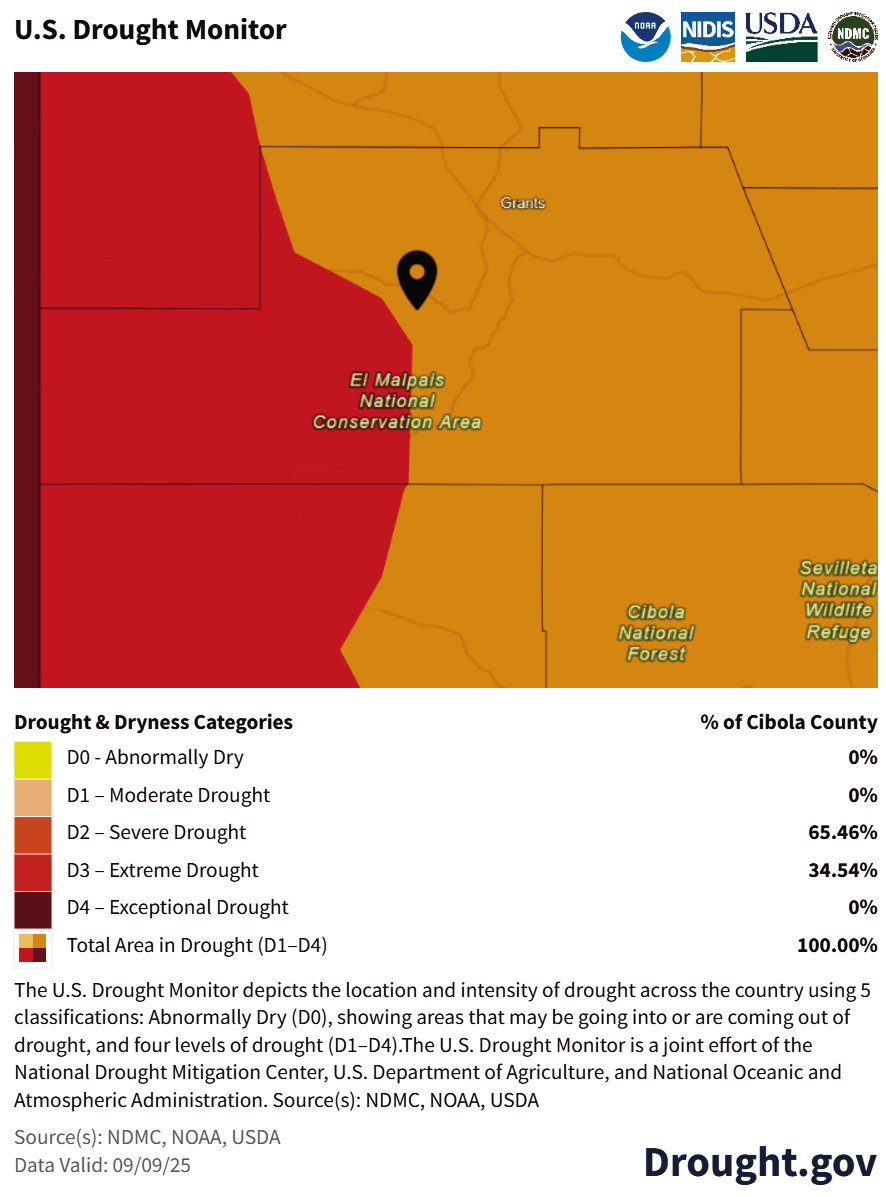
As of this week, 100 percent of Cibola County remains in drought, with 65.46 percent of the county in Severe Drought (D2) and the remaining 34.54 percent in Extreme Drought (D3). The drought has shown no change for several consecutive weeks or months, leaving nearly 27,213 residents under persistent dry conditions.
Agriculture Feels the Strain
The toll on agriculture continues to mount.
Drought estimates show 448 acres of hay and 30 acres of haylage are impacted countywide, along with more than 10,281 cattle and 3,026 sheep grazing on stressed or depleted rangeland.
Water levels at Bluewater Lake — a vital recreational and environmental resource — remain low. As of September 2, the lake held just 5,162 acre-feet of water, down from more than 10,000 acre-feet this spring.
The Rio San Jose, while still flowing, measured 2.07 feet at its latest gage reading.
Despite the dry outlook, the weekend brought muchneeded rain and dramatic skies. On Saturday, Sept. 13, the National Weather Service issued a Severe Thunderstorm Warning for northwestern Cibola and parts of McKinley County. Radar detected 60 mph wind gusts and quarter-size hail, with the storm passing through Ramah, Pescado, and Upper Nutria.
Shortly afterward, a Flood Advisory was issued for portions of southeastern Cibola County including Laguna Pueblo, Mesita, and Alamo, as 0.5 to 1 inch of rainfall caused minor flooding in low-lying areas and arroyos.
The scattered storms were enough to cool the region briefly, but not enough to shift drought conditions. NOAA data shows Cibola remains dry across multiple long-term timescales.
Trail Fire in the Zunis
As monsoon moisture mixes with hot temperatures and dry fuels, wildfire risk remains high across the region. On Sunday, Sept. 14, firefighters responded to a new blaze in the Zuni Mountains northwest of Quartz Hill, known as the Trail Fire.
The fire was reported at 2 p.m. and has burned approximately five acres.
Officials with the U.S. Forest Service and New Mexico State Forestry say the cause remains under investigation, though lightning was detected in the area. Crews successfully halted forward progression, and no communities are at risk.
Smoke may be visible west of Grants and Milan, but no further updates are expected unless conditions change.
Although the New Mexico State Forester lifted statewide fire restrictions on September 5, Cibola County, the City of Grants, and the Village of Milan continue to enforce local burn bans. Open burning and fire pits are still prohibited across the county under Ordinance 2022-003, and residents are urged to follow all local fire safety regulations.
As of mid-September, the Mount Taylor Ranger District remains in “High” fire danger status, according to the U.S. Forest Service.
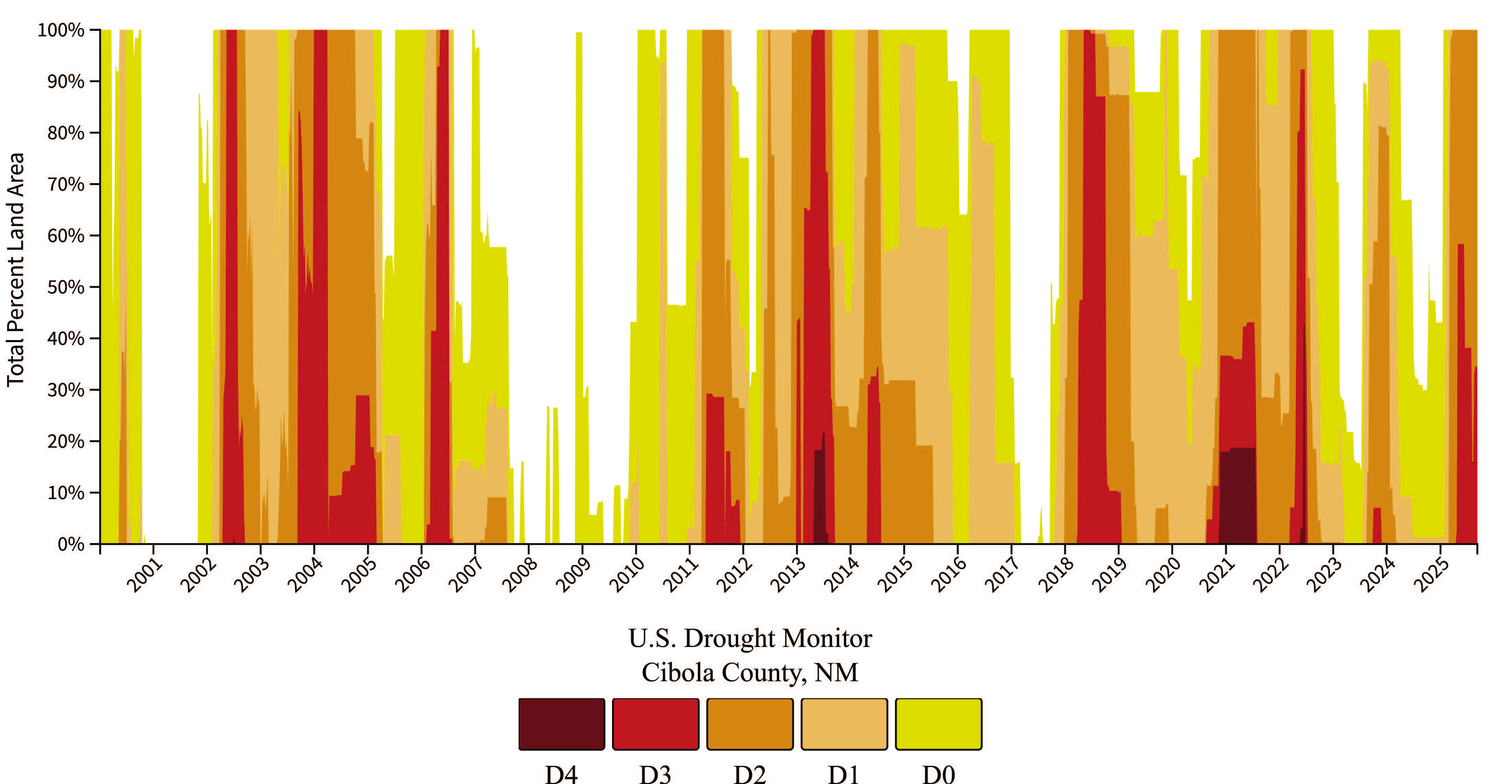
ADeeper Look at 25Years of Drought in Cibola County This chart shows the severity of drought in Cibola County over the last 25 years.
The U.S. Drought Monitor’s historical chart for Cibola County tells a story that no single weather report can convey.
Spanning week by week from the year 2000 through the present day, the chart paints a striking visual timeline of the county’s evolving relationship with drought. Bright yellows mark periods of abnormally dry weather, while darker shades—deep red and maroon—represent the worst drought categories: severe, extreme, and exceptional.
What emerges is not a pattern of short-lived hardship, but rather a chronic condition.
Over the past 25 years, Cibola County has rarely, if ever, been completely free of drought. The historical chart shows only brief interruptions of normal moisture levels, scattered between long, unbroken stretches of dryness. For many younger residents, drought isn’t a rare natural event—it’s the background condition of their entire lives.
The early 2000s brought intense droughts that were worsened by limited infrastructure and prolonged by weak monsoons. While some reprieves appeared in 2015 and again in 2019, they were short-lived. Since 2021, the chart turns darker again—reflecting how severe and extreme drought conditions have dominated the landscape through most of the 2020s so far.
Now, as of August 2025, the data remains grim.
100 percent of Cibola County is in drought, with 65.46 percent classified as Severe (D2) and 34.54 percent under Extreme (D3) drought. That means over 27,000 residents are currently affected—every single person in the county. There has been no change in the drought status for the past several weeks or even since July.
And the rainfall hasn’t helped much.
While isolated thunderstorms have rolled through parts of the county, including severe weather near Ramah and Pescado earlier this month, the overall effect has been modest. In fact, August 2025 ranks as the 35th driest August in the past 131 years, according to NOAA records, measuring 0.76 inches below average.
The story gets even drier when looking at the entire year: from January through August, Cibola County is experiencing its 13th driest year on record, down 3.13 inches from normal levels.
Dry 2025, Only Months Remain
With just over three months remaining in the year, 2025 is already in the books as one of Cibola’s driest on record. Even as storms roll through and fire crews remain vigilant, the broader picture remains sobering.
This Constitution Day, as New Mexicans reflect on their rights and responsibilities, Cibola’s drought story serves as a reminder of the region’s continued vulnerability to climate extremes— and the importance of vigilance, stewardship, and shared information in times of environmental stress.
Editor’s Note: Before press time, the Cibola Citizen learned about another wildfire has been reported in the region, this time near Pinehill on the Cibola National Forest, as dry fuel and drought conditions continue to elevate fire danger across the county.
The Little Water Fire, managed by the U.S. Forest Service under the Cibola National Forest division, was reported nearly two days ago and has burned approximately 16.8 acres of timber understory. The fire remains active as of the latest incident report, with no listed containment and minimal resource listings beyond initial engine response.
The incident is located roughly 12.7 miles northeast of Pinehill, an area managed under Cibola National Forest jurisdiction.
Although cooler temperatures and higher humidity (currently 57°F and 54% humidity) have helped slow the fire’s spread, the Forest Service has not yet announced any containment milestones or suppression updates. Winds remain low at 2 mph, but the forecast still includes gusts up to 9 mph.
No structures have been reported as threatened, and no evacuations have been issued at this time.
The fire joins a growing list of wildland incidents in Cibola County this season, including the Porter Ranch Fire, Alamo Fire, La Mosca Springs Fire, and Cinder Cone Fire, all fueled by the region’s persistent drought.