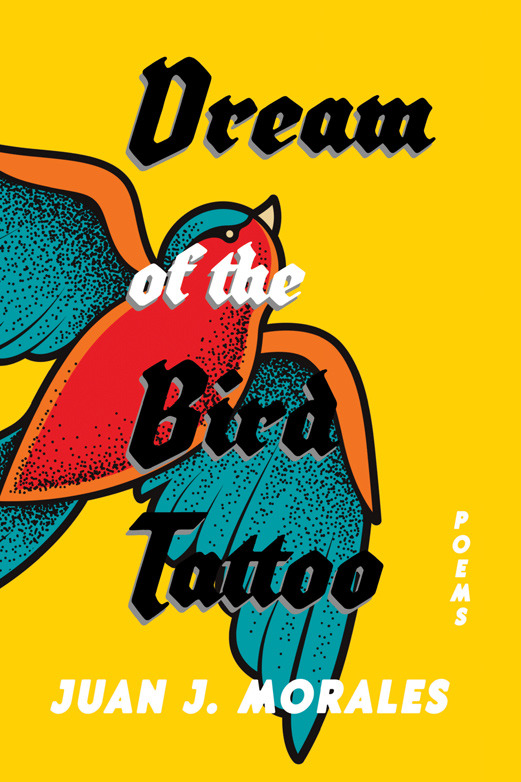

Title: “Dream of the Bird Tattoo, Poems & Sueñitos” Author: Juan J. Morales Publisher: University of New Mexico, unmpress.com Published: 2025 Paperback, 112 pages including four black-and-white bird illustrations ISBN: 978-0-8263-6758-7
“The more that you read, the more things you will know. The more that you learn, the more places you’ll go,” Dr. Seuss Juan J. Morales is the son of an Ecuadorian mother and Puerto Rican father. Growing up in Colorado and hearing family stories about Puerto Rico and LatinAmerica have been the inspiration for much of his poetry. This collection is focused on Juan’s journey through grief after his father José passed away in 2019. Interspersed with his poetry are nine pieces titled “Shit My Puerto Rican Father Said.”
One of those describes Pop [José] watering the lawn wearing a white tank top that exposed his faded tattoos and the shrapnel wounds on his shoulders and arms.
Another one, “Bury Me in a Guayabera,” describes the author’s reactions to his father’s annual gift of a guayabera shirt. “These shirts are a tradition,” wrote Juan in the first line of the poem.
Each shirt features four front pockets and two vertical stripes of pleating and/or embroidery. It is considered the most traditional piece of men’s clothing associated with the cultural life of Latin American and Caribbean populations.
This book has numerous pieces about Juan’s dreams, some happy memories and others that are sad tributes to the dead.
“Every time Mama would say, ‘Maybe we should get a dog,’Dad would tell her, ‘If you want a dog, I can bark.’” There is a short one about his father’s instructions on sex education to his teenage son.
“Do you know about sex?” José asks.
Juan says “Yes.” José responded, “Don’t do it.” And that was the end of his parental advice.
The poem “Death Jokes” is a short piece about his father not fearing death.
The second stanza: “‘When I die, I’m going to be buried with my check book, so whenever you spend money, you’ll have to tell me hello.’ I laughed.”
The poet’s emotional response to his father’s passing led him on a journey of discovery. He found comfort in sharing memories with his mother and with family friends; Juan sought professional counseling; and he began practising yoga. One search led the grieving son to visit a spiritual medium who prophesied that Juan would be visited by a strange bird.
His father appeared in a dream but his face was obscured. On his shoulder was a tattoo of la golondrina. The bird appeared as a green phoenix made of neon light and it spoke to him: “This is the bird you are looking for, before flying out of the dream and waking me, just like a sunrise,” recalled the author.
La golondrina is a symbol that appears in much of Latin American culture. The migrating swallow symbolizes forced exile and people who are longing for their homeland.
Mexican physician Narciso Serradell Sevilla wrote La Golondrina (The Swallow) in 1862 while exiled in France following the December 1861 joint invasion of Mexico by France, Britain and Spain to recover unpaid debts.
The song has become a cultural hymn and is used for farewells, moments of loss, and departures. It is a traditional piece played during Mexican funeral services.
José, a native of Puerto Rico, served in the U.S. Army during the wars in Korea and Vietnam. He was an ROTC instructor at the University of Iowa, Iowa City from 1978-81. His son, Juan, is a professor at Colorado College-Pueblo. This poetry collection honors Juan’s father.
“I started writing and drafting some of the sueñitos and poems in this book twenty years ago, so I’m happy the little dreams found their home in this book,” recalled the poet.
Sidebar:
Juan J. Morales is a professor and department chair of English & World Languages at Colorado State University, Pueblo.
Morales’ mother is from Ecuador and his father was born in Puerto Rico, a U.S. territory.
He dedicated this book to his father, José Morales Lugo, April 19, 1932 - February 2, 2019.
Morales has written three other books of poetry: “Friday and the Year That Followed” (2006), “The Siren World” (2015), and “The Handyman’s Guide to End Times' which received the 2019 International Latino Book Award.