
GRANTS, N.M. - A meeting was held on December 4, 2025 to discuss the wetlands action plan for the headwaters of Bluewater Creek.
The meeting had inperson and online attendees from the New Mexico Environment Department, Riversource, former archaeologists, the U.S. Forest Service, Mount Taylor Ranger District, and more, with a majority of them having some type of experience in this department.
The presentation outlined the project’s progress, including public meetings, field observations, and the formation of a steering committee, and sought feedback on wetland values, stressors, conditions, and restoration strategies.
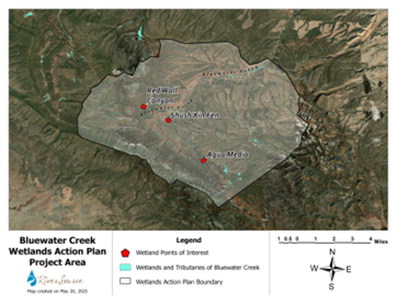
It focused on the importance of wetlands, highlighting their ecological and cultural significance. The study identifies key wetland areas, including the Shush’Kin Fen, Red Wall Canyon, and various wet meadows, and documented their values such as water supply, wildlife habitat, and cultural practices. However, stressors like livestock grazing invasive species, and road erosion threaten these wetlands, necessitating restoration efforts.
The discussion focused on the wetland restoration strategies for the Shush’Kin Fen and surrounding areas.
Wetlands Restoration Action Strategies
1. Grazing management - improving livestock management will help to ensure that wetland plants and soils are not over-utilized by herbivores which leads to several benefits. The USFS is taking steps by adding fencing on the Serna Pasture.
2. Induced Meandering in Bluewater Creek and tributaries - Using baffles, one rock dams, wicker wood, and post vanes to restore floodplain access and increase sinuosity of channels will improve wetland habitat and water quality.
3. Shush’Kin Fen Restoration - Using sod plugs to fill gaps where surface water is draining out of the fen will help prevent further degradation.
4. Road management Assessing roads for drainage improvements will improve forage productivity by harvesting water into meadows, decreasing soil erosion, and improving fish habitat.
5. Planting and Protecting Riparian Shrub and Tree - Pole planting cottonwoods and willows will increase wildlife habitat, reduce water temperature, and help stabilize stream banks. Protecting the existing stands of willows will sustain their benefits.
6. Invasion Species Control
Controlling invasive and noxious species will ensure that native species will not be outcompeted in their native habitat.
7. Filling in Data Gap and Additional Research Filling in data gaps such as the condition of wetlands along the creek between the Agua Media earthen dam and Shush Kin Fen. Follow-up on the condition of Red Wall Canyon wetland is needed. Better information about the location & extent of noxious weeds is also needed. This research and other information will help land managers and stakeholders to better refine actions.
Proposed strategies include improved grazing management, induced meandering of streaming, sod plug harvesting, road assessment and design, pole planting of willows and cotton woods, and invasive weed control. Rich Schrader, the host from river source also emphasized the need for further research on wildlife special, forage production, and wetland conditions in the area.
Fencing to protect the area from livestock grazing was suggested, along with potential water management solutions like small swales. The recurring problem of recreational access and fence damage was also highlighted as a challenge for the entire forest district.
The discussion focused on the challenges of managing recreation impacts, particularly from off-road vehicles, on wetlands. Invasive, both terrestrial and aquatic, were also identified as a significant concern. The group explored potential solutions, including the use of solar wheels to reduce cattle grazing pressure on the creek and the implementation of a turf trash business to minimize soul disturbance. After the ideas were presented, the attendees were able to write their ideas on Post-It notes and attach them the the wetland restoration strategies and map for consideration.
Riversource is currently making modifications to the plan, which will be submitted for review by the stakeholder advisory group on December 19, 2025. It is expected to be approved and ready to implement by mid-February 2026.