
CIBOLA COUNTY, N.M. – Early March data shows Cibola County entering a critical stretch of the water year with no snowpack in the mountains.
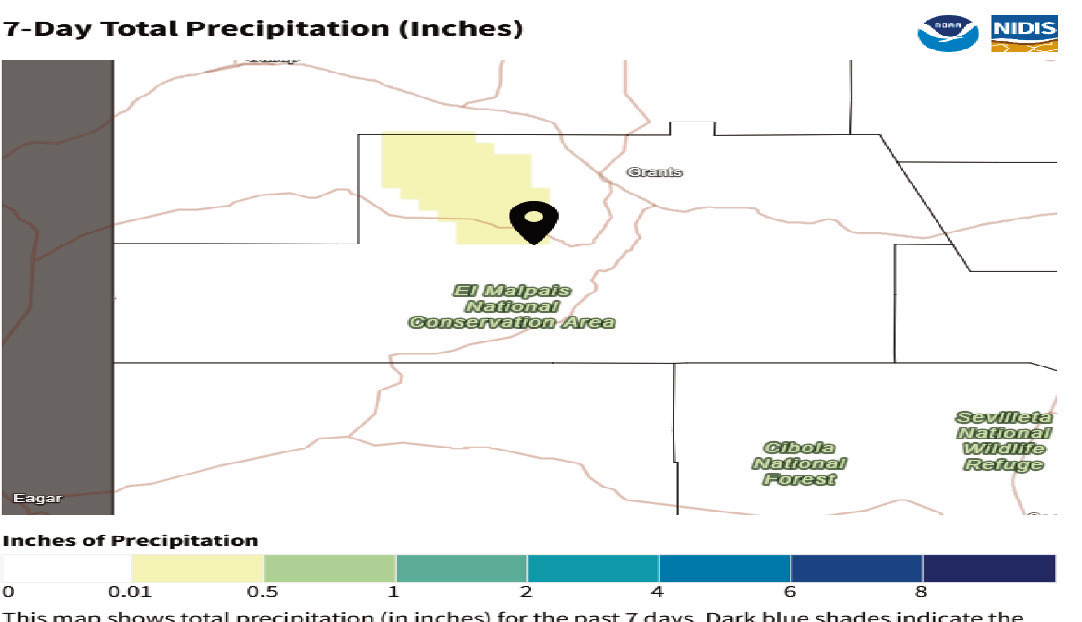
Precipitation over the past week was nearly nonexistent across most of the county, Bluewater Lake held steady at low levels, the Rio San Jose remained flat, amid snowpack in the Zuni Mountains effectively disappearing from the gauge – an ominous signal as the basin approaches what is typically its seasonal peak period for runoff.
Bluewater Lake
U.S. Geological Survey provisional data showed Bluewater Lake at 7,368.26 feet on the afternoon of March 9, down slightly from 7,368.35 feet on March 2.
The change is small, but it continues the month-tomonth pattern seen through winter: the reservoir is not rebuilding, and any gains that might come from spring conditions have not begun to appear.
Rio San Jose
The Rio San Jose gauge at Acoma Pueblo measured 1.86 feet on March 9, unchanged from March 2.
A field measurement taken March 3 also recorded 1.86 feet, reinforcing the trend of steady but shallow base flow with no measurable response to recent weather.
Snowpack – Zuni/Bluewater River Basin
The most striking signal in this reporting period came from snowpack monitoring.
The NRCS SNOTEL report for the Zuni/Bluewater River Basin showed Rice Park (8,480 feet) at 0.0 inches of snow water equivalent on March 9, with a basin index of 0%.
For context, the median snow water equivalent for this date is listed at 5.2 inches, and the basin’s median peak is 6.0 inches, typically reached in early March. A zero reading at this point in the season indicates that whatever snowpack had accumulated earlier in winter has either melted out, compacted away, or failed to persist – removing one of the basin’s main pathways for spring runoff and reservoir recharge.
Taken together, this week’s data points in one direction: Cibola County is moving through early March with minimal precipitation and without meaningful snowpack support in the Zuni Mountains. Unless conditions change quickly, the basin’s spring recharge window could be sharply limited, keeping pressure on Bluewater Lake, the Rio San Jose, and the broader watershed as temperatures rise.