
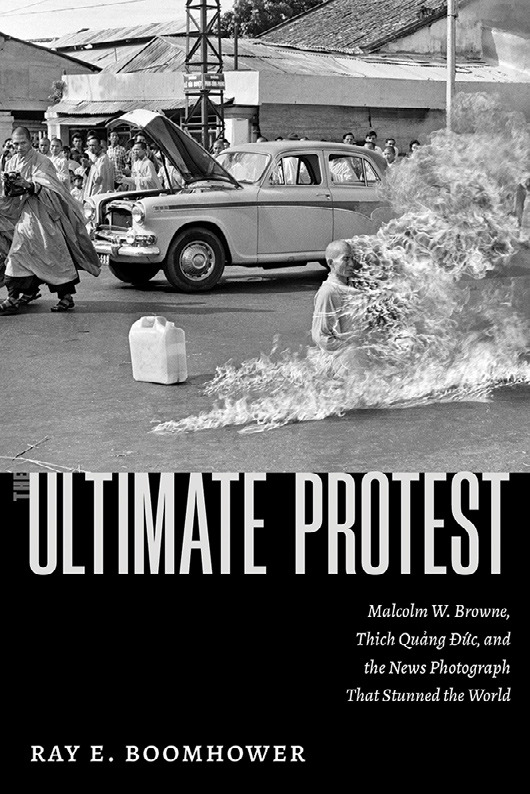

Rosanne Boyett Title: The Ultimate Protest Author: Ray E. Boomhower Publisher: University of New Mexico Press, unmpress.com Published: 2024 Hardcover, 318 pages, 29 black-and-white photographs ISBN: 978-0-8263-6570-5
“The only thing you absolutely have to know, is the location of the library,” Albert Einstein Ray E. Boomhower introduces The Ultimate Protest with “The single, small-caliber bullet ripped through the thin, aluminum skin of the Piasecki H-21troop-carrying helicopter.”
His book traces the life of Malcolm Browne, 19312012, one of the Pulitzer Prize winning journalists reporting from Vietnam in the 1960s.
Browne’s mother was a devout Quaker and his father, an architect, was a devout Roman Catholic. He attended kindergarten through high school at Quaker schools. Browne earned degrees from Swarthmore College, Pennsylvania (founded in 1864 by the Religious Society of Friends) and New York University in Manhattan, N.Y.
His first job was with Foster D. Snell as a laboratory chemist. The company specialized in industrial research, product development, and toxicology testing in addition to insecticide testing and screening.
Drafted in 1956, Browne was stationed in Korea where he joined the U.S. Army Public Information Office.
“As a matter of fact, I am an accidental journalist,” recalled Browne.
The young recruit demonstrated a talent for linguistics and later became proficient in French, German, Vietnamese, Russian, and Spanish. These language skills served him well during his career as a reporter covering foreign affairs in Asia, the Middle East, and Central and South America.
Boomhower describes the events that led to Browne’s tenure with the Associated Press where at age 30 he became the Saigon bureau chief (196165). Reporting the news in a neutral manner was a journalist’s primary responsibility according to Browne.
People were leaving the region because of the authoritarian regime of Ngo Dinh Diem, a devout Roman Catholic. He was the first President of the newly formed Republic of Vietnam (South Vietnam) after a controversial referendum ousted Emperor Bao Dai in 1955.
The Ngo Dinh Diem government, which was supported by the U.S. military, was notorious for persecuting Buddhists who comprised approximately 50-70 percent of the population.
In June 1963 a Buddhist monk, Thich Quang Duc, committed suicide by selfimmolation in a Saigon plaza to protest government persecution.
Five months later, November 1963, Ngo Dinh Diem was assassinated in a CIA-backed coup d'état led by General Dương Văn Minh, Republic of Vietnam army.
Browne was forced to smuggle news stories to other AP offices outside of Vietnam and spent many hours at the Saigon airport diligently searching for travelers willing to carry folded newspapers that concealed his articles.
Two Pulitzer Prize photographs became iconic symbols of the Vietnam War: Browne’s photo of Buddhist monk Thich Quang Duc setting himself ablaze, and the photo by Associated Press staffer Nick Ut, “The Terror of War.” This 1972 photo captures the moment a naked girl, 9year-old Phan Thi Kim Phuc, is seen running with outstretched arms to escape her burning village after South Vietnamese bomber planes mistakenly dropped napalm on Trảng Bàng, a Buddhist temple. (Dow Chemical Company was the primary manufacturer and sole supplier of napalm to the U.S. military during the Vietnam War.)
The first American military advisors arrived in Vietnam in 1950; by 1965 there were 3,500 American combat troops along with 25,000 military advisers.
By April 1975 when the war ended, the U.S. identified 58,220 military personnel as dead or missing in action.
More than two million civilians, 200,000 to 250,000 South Vietnamese soldiers, and 1,100,000 Viet Cong perished in the conflict between 1950-75, according to the 1995 Vietnam government report.
Browne resigned from AP in 1965 and joined ABC News. And in 1968 he began a 30 year career covering science and foreign affairs for The New York Times newspaper.
Browne testified at a U. S. Senate Governmental Affairs Committee hearing in the 1990s; he reminded those present that democracy depends on a free people informed by honest journalism.
“Honest reporting was the last thing most people wanted when the subject was war. There may never have been a bad war. War is thundering good theater, in which cheering the home team is half the fun,” said Browne later.
SIDEBAR
Ray E. Boomhower, a native of Indiana, received a 1982 Bachelor of Arts in journalism and political science from Indiana University, Indianapolis. He was awarded a 1995 master's degree in U.S. history from Indiana University. Boomhower is a former reporter for two daily newspapers, the Rensselaer Republican and Herald Bulletin newspapers, and has written numerous books and articles on Indiana’s history.
He is the author of 18 books including “Gus Grissom: The Lost Astronaut,” “Robert F. Kennedy: And the 1968 Indiana Primary,” “Indiana Originals: Hoosier Heroes & Heroines,” “The Soldier's Friend: A Life of Ernie Pyle,” “Fighting for Equality: A Life of May Wright Sewall,”and his most recent, “The Ultimate Protest.”
Boomhower currently serves as senior editor of the Indiana Historical Society Press.