Economy Shows Strain, Stability and Room to Grow
CIBOLA COUNTY, N.M. – Cibola County’s population has not changed dramatically in recent years, but the county’s economy is still moving.
The most recent U.S. Census Bureau estimates place Cibola County’s population at 26,807 as of July 1, 2025. That is slightly higher than the 2024 estimate of 26,686, but still below the April 2020 estimate base of 27,046. Since 2020, the county’s population has declined by an estimated 0.9%.
The numbers show a county holding close to steady, but not growing quickly. For a rural county spread across thousands of square miles, that raises a practical question: how does Cibola County build an economy strong enough to keep families here, support public services and prepare for whatever comes next?
That question runs through much of the Cibola Citizen’s 2026 Economic Report.
Cibola County has major public institutions that remain central to daily life, including Grants-Cibola County Schools, Cibola General Hospital, New Mexico State University-Grants, county government, the City of Grants and the Village of Milan. It also has small businesses, local employers, a developing cannabis retail sector, housing needs and ongoing conversations about workforce, infrastructure, mining, energy and regional development.
At the same time, the county continues to feel long-term economic strain.
Federal labor data show Cibola County had 8,672 employed residents in January 2026 and an unemployment rate of 6.3%. Long-term data show employment rose through much of the 1990s and 2000s before falling sharply around the Great Recession. Since then, the number of employed residents has remained below the highs reached before 2010.
Wage data shows another part of the same story. According to the New Mexico Department of Workforce Solutions, Cibola County’s average annual wage in covered employment was about $50,284 in the third quarter of 2025. That compares with $62,088 statewide and $62,296 in the Northern Region.
For many families, that difference affects rent, mortgage payments, transportation, child care, savings and the amount of money
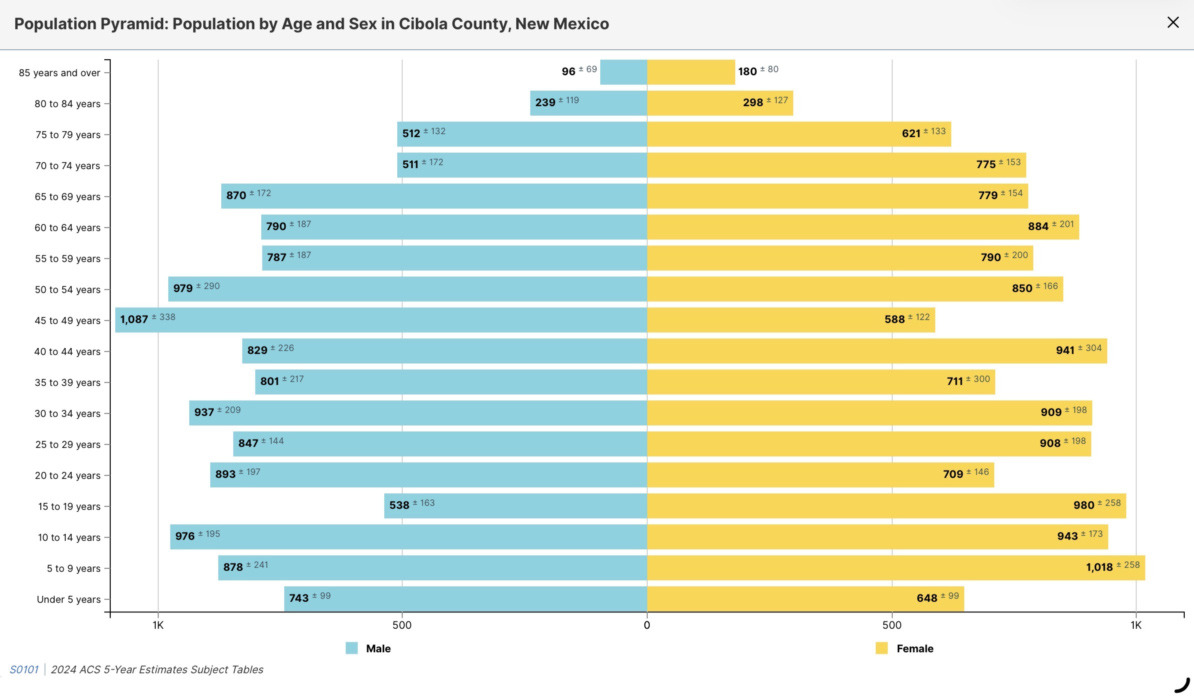
A 2024 American Community Survey five-year population pyramid for Cibola County shows the county’s population by age and sex. The chart shows a broad spread of residents across working-age groups, children and older adults, underscoring the county’s challenge of supporting families, preparing younger residents for future jobs and meeting the needs of an aging population. Data from U.S. Census Bureau ACS 2024 five-year estimates.
Courtesy Photo that circulates through local stores and services.
Census estimates for 2020-2024 placed Cibola County’s median household income at $50,759, with an estimated 25.9% of residents living in poverty. Among children, the pressure is even greater. Recent Census and Kids Count data show roughly four in ten children in Cibola County live in poverty.
Those numbers make education and workforce preparation central to the county’s future.
The most recent publicly available NM Vistas data show Grants Cibola County Schools reported 17% proficiency in math, 38% in reading and 30% in science for the 2024-2025 school year. Students are completing this year’s state assessment cycle now, but those results are not expected to be publicly available until later in the year.
Schools are also one of the largest recipients of local property tax money.
The following is data courtesy of the Cibola County Treasurer’s Office of property tax distributions from July 2025 through March 2026. This was compiled and listed from the largest single recipient to the smallest: Grants-Cibola County Schools has so far received $3,820,123.18 Cibola County government has so far received $3,440,633.25 Cibola General Hospital has so far received $1,363,812.25
New Mexico State University- Grants / College has so far received $565,639.06 City of Grants has so far received $556,551.89 State of New Mexico has so far received $455,256.65
Village of Milan has so far received $211,424.03 Quemado School District has so far received $38,734.07
This totals out to $10,452,174.38 in property tax distributions since July 2025 to March 2026. The tax year ends in June.
The distribution shows how closely the local economy is tied to public institutions. Property taxes help support schools, county services, health care, higher education and local governments.
Housing is another piece of the same picture.
At its April 22 meeting, the Cibola County Board of Commissioners approved moving forward with publication of the title and general summary of Affordable Housing Ordinance 2026001. The action does not build housing by itself, but it begins the formal process for adopting a local ordinance that could allow the county to support affordable housing projects or programs under New Mexico law.
Other pieces of the economy are changing in smaller but visible ways.
Since adult-use cannabis sales began in New Mexico in April 2022, dispensaries in Grants and Milan have reported more than $13.8 million in combined cannabis sales through March 2026. Cannabis does not define Cibola County’s economy, but it has become part of the local retail mix and, in Grants, a source of tax revenue directed toward recreation.
Local governments also continue to depend on gross receipts tax collections to support services and planning. A sharp dip in Cibola County’s March 2026 distribution was tied to a onetime state tax adjustment involving amended returns and a medical deduction, according to correspondence from the New Mexico Taxation and Revenue Department. County officials said the drop appeared to be an outlier rather than a continuing trend.
Cibola County also received a clean audit for fiscal year 2025. For a rural county working with limited resources, clean financial reporting can help support grant applications, planning and public confidence.
The future of Cibola County’s economy will be built on the work being done today.