March ranked fifth driest on record as county enters May under severe-to-extreme drought conditions
CIBOLA COUNTY, N.M. – Cibola County is entering May with worsening drought, declining water supply and a growing patchwork of fire restrictions across local, state and federal lands.
According to data accessed May 5 from the U.S. Drought Monitor and Drought.gov, 100 percent of Cibola County is in drought, affecting an estimated 27,213 residents. The county is now split between Severe Drought and Extreme Drought, with 83.09 percent classified as Severe Drought and 16.91 percent classified as Extreme Drought.
The change comes after a dry start to spring.
March ranked as Cibola County’s fifth driest March over the past 132 years, finishing 0.81 inches below normal precipitation, according to federal climate data reported through Drought.gov. From January through March, the county recorded its 33rd driest start to a year, running 0.98 inches below normal.
The numbers matter because Cibola County missed much of the natural recharge that normally comes from winter snowpack and spring runoff. Local water monitoring by the Cibola Citizen, based on U.S. Geological Survey and NRCS data, has shown Bluewater Lake declining through spring, the Rio San Jose remaining in a narrow range, and Zuni/Bluewater Basin snowpack disappearing before it could provide meaningful runoff.
As of May 5, Bluewater Lake measured 7,367.05 feet in elevation, down from 7,367.21 feet on April 28, according to provisional U.S. Geological Survey data. The Rio San Jose gauge at Acoma Pueblo measured 1.92 feet on May 5, unchanged from the previous week.
At the beginning of the year, Bluewater Lake held 4,489 acrefeet of water on Jan. 5, while the Rio San Jose measured 1.89 feet. Snowpack at the NRCS Rice Park SNOTEL site in the Zuni/Bluewater River Basin measured just 0.3 inches of snow water equivalent on Jan. 5, only 13 percent of normal for that date.
Snowpack improved briefly in late January and February, but collapsed in early March. By March 9, the Rice Park site reported 0.0 inches of snow water equivalent, removing one of the basin’s most important sources of spring recharge.
That means Cibola County is now moving toward summer more dependent on spotty spring storms and the eventual monsoon season.
The dry conditions are also affecting agriculture.
Federal drought estimates place 448 acres of hay, 30 acres of haylage, 10,281 cattle and 3,026 sheep within droughtaffected areas in Cibola County. Those figures do not mean every producer is affected in the same way, but they reflect the broad reach of drought across the county’s working landscape.
Fire Restrictions
As the water picture tightens, fire restrictions are expanding.
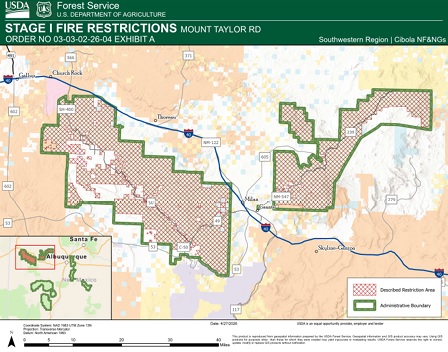
The Cibola National Forest and National Grasslands announced May 5 that Stage I fire restrictions will take effect Friday, May 8, at 8 a.m. on the Mt. Taylor, Magdalena, Mountainair and Sandia ranger districts. The restrictions are scheduled to remain in effect through Aug. 31 at 11:59 p.m., unless rescinded earlier.
The Mt. Taylor Ranger District includes major public lands used by residents and visitors for camping, hiking, fuelwood gathering, hunting access and general outdoor recreation.
According to the U.S. Forest Service, Stage I restrictions mean fires, campfires, charcoal grills, coal stoves and wood stoves are allowed only in developed campsites and picnic areas where agency-built fire rings or grills are provided. Campfires are prohibited at all dispersed camping sites under the order.
Propane stoves, lanterns and heaters may still be used if they meet manufacturer safety specifications, have on-and-off switches, and are used in areas cleared of flammable material within three feet of the device.
Smoking is allowed only in enclosed vehicles or buildings and developed recreation sites. Chainsaw use is still permitted under the Stage I order.
The Forest Service said restrictions are based on several factors, including current fire danger, fire activity, predicted weather, fuel moisture, availability of firefighting resources and regional fire preparedness levels.
The agency also reminded the public that leaving a campfire unattended is illegal year-round. Campfires must be dead out and cold to the touch before people leave. Fireworks and other pyrotechnic devices are always prohibited on national forests.
Bluewater Lake State Park remains under Stage II fire restrictions, which are more restrictive than the Forest Service’s Stage I order. According to information posted for Bluewater Lake, visitors may not build, maintain, attend or use a fire, campfire, charcoal, coal or wood stove, including in developed campgrounds or picnic areas.
The Stage II restrictions at Bluewater also prohibit fireworks, chainsaw use, welding, torches, off-road vehicle use except in limited parking situations, explosives and the use of internal or external combustion engines without a spark arrester. Smoking is limited to enclosed vehicles, buildings or developed recreation sites where the area is cleared of vegetation and flammable material.
Those restrictions have been posted as ongoing since March 15.
Cibola County and the Village of Milan are also under local burn restrictions. Under Emergency Ordinance 01-2025, Cibola County imposed a countywide burn ban because of current and expected weather conditions. Milan falls under the same severe local restriction by ordinance.
At the state level, the New Mexico State Forester enacted statewide fire restrictions April 6 for nonfederal, non-Tribal and non-municipal lands. Those restrictions prohibit smoking, fireworks, campfires, prescribed burning, open burning, agricultural burning, debris burning and gas flaring related to oil and gas production, with limited exceptions.
Residents and visitors should check the rules for the exact land they are on before lighting any flame, using equipment that can spark or assuming campfire use is allowed.
A Small Spark
A small wildfire reported this week near Cibola County also points to the region’s dry-season risk. The Grasshopper Fire, located in McKinley County about 11.3 miles southeast of Gallup, was reported May 4 and listed at three acres, according to the McKinley County Emergency Management Office. The fire is outside Cibola County, but it is within the broader Cibola National Forest region.
The arrival of restrictions also coincides with the anniversary season of Smokey Bear, the New Mexico-born symbol of wildfire prevention whose message remains especially relevant in western New Mexico.
While drought is not new to Cibola County, the current situation is concerning because several indicators are lining up at once: the county is fully in drought, extreme drought has expanded, March was historically dry, snowpack failed to support spring runoff, Bluewater Lake continues to decline and local fire restrictions are already in place before summer begins.
For landowners, Cibola County Emergency Manager’s Office says now is also a good time to clear dry vegetation away from homes, outbuildings, fences and equipment areas. Fire officials regularly recommend creating defensible space by removing dry grass, brush and other flammable material near structures.
The Forest Service said official fire restriction orders are posted on the Cibola National Forest and National Grasslands website at www.fs.usda.gov/r03/cibola/ alerts. The Mt. Taylor Ranger District can also be reached at 505-287-8833.