
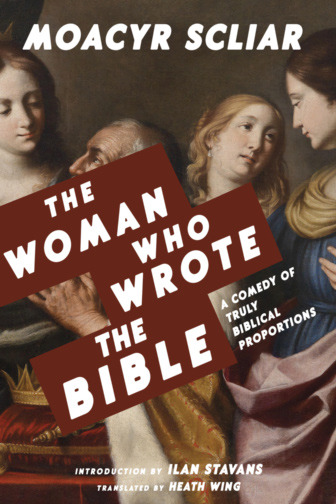

Title: “The Woman Who Wrote The Bible” (A comedy of truly biblical proportions) Author: Moacyr Scliar Originally published in Portuguese, 1999 Translated by: Heath Wing Introduction: Ilan Stavans Publisher: University of New Mexico Press, Jewish Latin American Series, unmpress.com Published: 2026 ISBN: 978-0-8263-6931-4 Paperback: 136 pages
“If you have a garden and a library, you have everything you need.” Marcus Tullius Cicero (106 BC - 43 BC), Roman statesman, lawyer, scholar, philosopher, orator, and writer.
Women’s lives have been rigidly controlled by patriarchal societies for untold centuries. This tradition includes fathers using their daughters as bargaining chips to solidify political allegiances. Educating women was considered a waste of time.
This long-established custom is the underlying premise of Moacyr Scliar’s version of the origins of the Old Testament. His humorous satire is based on the myths surrounding King Solomon, who ruled the tribes of Israel and Judah and the city Jerusalem during the 10th century BCE.
The story begins with the teenage protagonist describing life in the isolated village where her father is the tribal chief and herding sheep is the main source of sustenance. As the eldest, her father’s scholar taught the unnamed main character reading, writing, and math. From early childhood, the villagers were constantly comparing the Ugly One to her younger sister’s physical beauty. The older girl responds by spending all her days in the barren foothills that surround the village.
Life changes dramatically for the fifteen-yearold when she becomes the newest acquisition to Solomon’s royal court. The king has solidified political alliances and consolidated his empire with the addition of each woman.
The new arrival rides a camel for days to reach Solomon’s court. She is shocked to learn that there is no privacy within the confines of the harem quarters. Each of the 700 wives and 300 concubines have a bed but no other personal space. It is a jarring experience for the young woman.
The Ugly One must now contend with constant ridicule from Solomon’s harem. Endless days pass as she awaits a summons to the royal bed chamber to consummate her wedding vows. The youthful protagonist spends her time creating detailed fantasies about what will happen when Solomon sends for her.
She describes the night of her nuptials - “He was the king and I was his obedient wife, just another obedient wife. With a brusque gesture I ripped off my veil and exposed my face. He shuddered. Like the priest before who had examined me, he shuddered from fright . . .”
The educated teenager decides that her best strategy is to seduce Solomon with her mind instead of her body. And she dedicates herself to this goal. The result is her version of the Old Testament, which King Solomon considers his legacy. But fate intervenes before she can complete her “modern” interpretation of the ancient scrolls.
Cleopatra arrives at the royal court.
The African queen and Solomon indulge in a passionate extra-marital affair. The Ugly One is forced to listen to their amorous indulgences because only a thin wall separates her room from Cleopatra’s quarters.
Cleopatra’s wiles lead to Solomon’s downfall he forsakes his vow to worship only the Hebrew God and succumbs to the spell of foreign idols, according to biblical accounts.
The Ugly One feels no allegiance to Solomon. She climbs the palace walls during a chaotic scene, escapes the royal court, and heads out on foot to pursue her own dreams.
“The biblical setting of the novel did make translating the book’s humor easier, given that the Bible is a shared touchstone in Western cultures,” explained Heath Wing. “While my approach may sound a bit dramatic, I was motivated by the reality that humor can be a challenge to translate across cultures. A joke that doesn’t land just doesn’t land, regardless of how good it is in the original language.”
SIDEBAR:
Moacyr Jaime Scliar, 1937-2011, was a Brazilian writer and physician. His parents emigrated from Bessarabia (part of modern-day Moldova) in 1919.
Scliar earned his 1962 medical degree from the Universidad Federal de Rio Grande do Sul, Porto Alegre, Brazil. Much of his writings deal with Jewish identity in the Diaspora and being Jewish in Brazil.
“The Woman Who Wrote the Bible” earned Brazil’s most prestigious prize, the Jabuti Award.
Scliar authored more than 100 books in addition to short stories, novels, young adult fiction, children's books, and essays. His book Max and the Cats is the inspiration for Yann Martel’s film, “The Life of Pi,” which received the 2012 Academy Award for Best Directing. Scliar’s works have been translated from Portuguese into English, Dutch, French, Swedish, German, Spanish, Italian, Hebrew, Czech, Serbian, Georgian, Slovene, and Danish. His translated fiction is listed in the UNESCO international bibliography of translations.