
Committee to direct funding toward roads, trails, watershed work, range infrastructure and wildfire resilience projects
CIBOLA COUNTY, N.M. — As drought continues to strain western New Mexico’s forests, rangelands and rural communities, three national forests are seeking New Mexicans willing to help decide how federal funds should be used for local natural resource projects.
The Gila, Lincoln and Cibola national forests announced June 15 that they are seeking applicants for the Southern New Mexico Resource Advisory Committee, commonly known as a RAC. The committee is being reestablished under the Secure Rural Schools and Community Self-Determination Act, a federal program that supports rural counties affected by the presence of federal lands.
Once the committee is fully assembled, federal funds can be released for eligible local projects.
Those projects may include noxious weed control, trail and road improvements, range and campground infrastructure, watershed restoration and other work intended to benefit public lands and nearby communities.
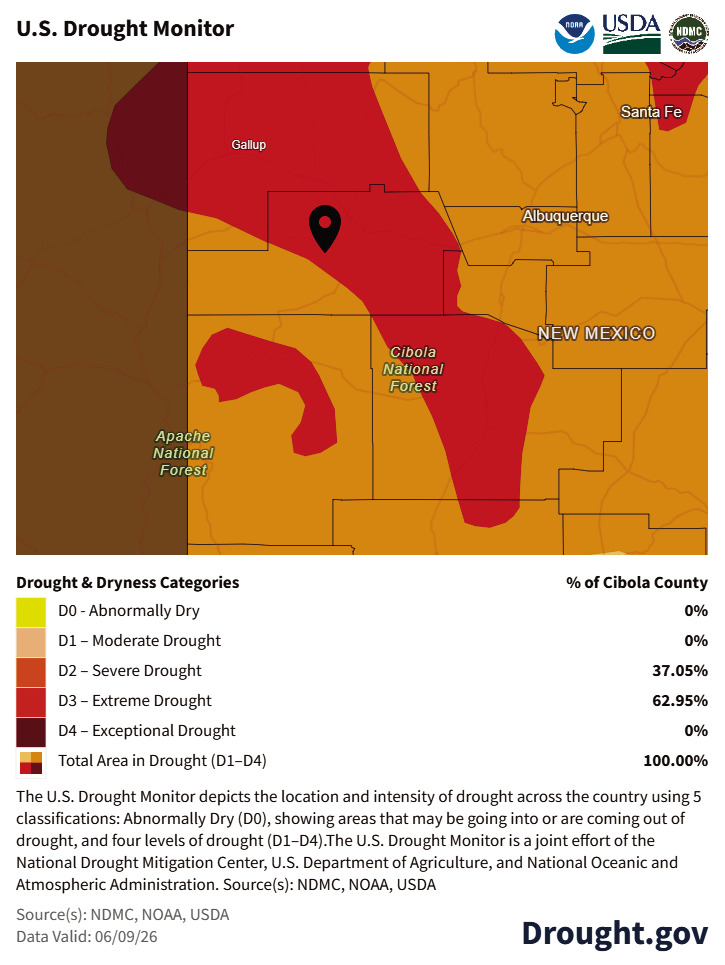
According to the U.S. Drought Monitor map valid June 9, 100 percent of Cibola County is in drought. The county is split between Severe Drought, which covers 37.05 percent of the county, and Extreme Drought, which covers 62.95 percent. No part of the county is currently listed as drought-free, abnormally dry, or in moderate drought.
The map also shows severe and extreme drought conditions extending across much of western New Mexico, including areas around Gallup, the Zuni Mountains, the Cibola National Forest and nearby public lands. Catron County, already listed among the preferred counties for RAC applicants, sits in one of the most forestconnected parts of the state, with the Gila National Forest and portions of the Cibola National Forest playing major roles in local land use, fire response and watershed health.
That makes the committee more than a bureaucratic appointment. It is one of the ways rural communities can influence which projects receive federal support.
The Southern New Mexico RAC will review and recommend Title II project proposals. These are projects tied to public lands and natural resource stewardship. In practical terms, that could mean work to improve a damaged forest road, reduce invasive weeds, restore a watershed, repair range infrastructure, improve a campground, or complete other projects that help communities live with large areas of federal land.
The Forest Service is seeking applicants from three broad categories.
Category A includes recreation, energy, minerals, timber, grazing and other land-use interests. Category B includes environmental organizations, dispersed recreation, wildlife, watershed and historical interests. Category C includes elected officials, tribal representatives, educators and members of the public.
Applicants must live in New Mexico. The Forest Service said preference will be given to applicants from Grant, Catron, Sierra, Socorro, Otero or Lincoln counties. Members serve voluntarily for four years and attend quarterly meetings, either in person or virtually. Travel costs for in-person meetings will be reimbursed.
The Forest Service said the RAC is intended to include broad representation so funding recommendations are not made from only one perspective. That matters in rural New Mexico, where the same forest road may serve ranchers, hunters, firefighters, woodcutters, hikers, tribal communities and emergency responders.
The committee does not replace the Forest Service, county governments or tribal governments. Instead, it gives local residents a formal role in reviewing projects and recommending how certain federal funds should be spent.