
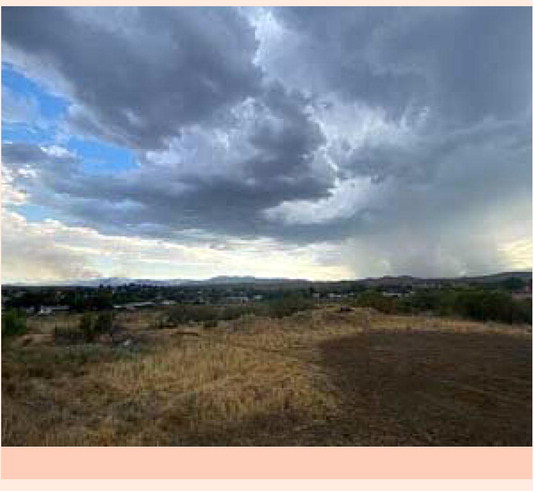
GRANTS, N.M. - The Southwest monsoon is a pattern of pronounced seasonal increase in thunderstorms and rainfall over the southwestern United States and northwestern Mexico. Thunderstorms are fueled by daytime heating and build up during the late afternoon and early evening. Typically, these storms vanish by late night, and the next day starts out fair, with the cycle repeating daily. We see this in New Mexico during July and August most years and this year is predicted to be a good monsoon. To everyone interested in gardening and plants, this is a welcoming sign.
Monsoon season is an especially good time to plant. All plants need more water in the first few months after they are planted. Our monsoon season not only brings water to the plants but afternoon clouds that cool the intense afternoon heat from the sun. This allows plants to concentrate on developing roots that will carry them through the fall and winter. They will still need attention but less frequently than at any other time of the year.
If you have been thinking about your water bill getting too high, your well running dry, or you haul your water, try some of these things to decrease water use.
• Water lawns and gardens during the early morning hours, when temperatures are cooler and there will be less water evaporation from the sun. Less evaporation will also occur if you water in the evening, although this leaves some plants susceptible to fungus. Water deeply so the water goes down all the way to the roots rather than a light sprinkling that just wets the leaves and top inch of soil.
• Check your irrigation system for leaks and sprinkler heads pointed in the wrong direction. If you see water run off, you are watering too much.
• Add a thick layer of bark mulch, about 3 inches around plants, trees, and bushes. This retains moisture in the soil so you won’t have to water as much, and suppresses weeds.
• Decrease the size of your blue grass lawn: Convert to a low water grass such as blue grama or buffalo grass.
Designate areas of your yard to plants that have similar water needs:
• Plants that rarely need water: Blanket Flower, Blue Flax, Rocky Mt. Penstemon, and Wild Showy Four-O-Clock.
• Plants that need water infrequently: Chocolate Flower, Verbena, Mexican Evening Primrose, and Cone Flower.
• Plants that need regular supplemental water: Day Lily, Salvia, Goldenrod, and Wine Cup.
If you have lost a tree in the past drought or are thinking about a tree for shade and beauty, there are varieties suited to our area: Drought tolerant trees are: New Mexico, Locust, One-Seed Juniper, Pinon Pine, and Utah Juniper. Other trees for our area are: Catalpa, Golden Raintree, Ash, Locust, and Japanese Pagoda Tree.
If you are looking for a bush, there are a number of very drought tolerant bushes: Apache Plume, Fernbush, Mt. Mahogany, Chamisa, and various sages.
For more information check out the many websites and books with details on drip irrigation and other plants and trees for our area. For websites, type “New Mexico drought tolerant plants”. Check out your local library for books. A great local author is Judith Phillips. All sources give the cold tolerance growing zones so you don’t end up with plants that can’t tolerate our below zero weather. Grants and lower elevation areas are Zone 5 or 6. The higher elevations and mountains are Zone 4 to 5.
Edith Iwan is a Cibola-McKinley County Master Gardener who lives and works in Thoreau. As a Master Gardener she assists the County Cooperative Extension Service in providing accurate, research- based gardening information to county residents. If you have any gardening questions, please call the NMSU Cibola County Extension at 505-287-9266 or NMSU McKinley County Extension at 505-863-3432