
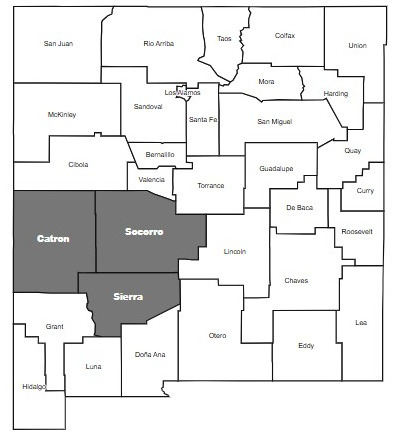
CATRON COUNTY, N.M. – A livestock compensation authority created by three New Mexico counties says it has expanded its ability to reimburse ranchers for losses associated with Mexican wolves, including confirmed livestock kills, probable depredations and some indirect economic damages.
The County Livestock Loss Authority, or CLLA, was created by Catron, Sierra and Socorro counties through a Joint Powers Agreement in late 2022., the authority replaced the Mexican Wolf/Livestock Coexistence Council as the entity processing claims from livestock producers for Mexican wolf depredations and wolf presence.
Catron County released an explanation from the office of County Manager Deborah Mahler of the program after what it described as “many inaccuracies” circulating on social media about how the authority operates. What is the CLLA?
The CLLA was initially funded through contributions from the three participating counties and the federal Livestock Demonstration Grant, which is administered through the New Mexico Department of Agriculture. Additional funding was approved through state legislation in 2024 and 2026, according to the county.
Those state funds allow the authority to compensate producers for confirmed and probable depredations as well as certain indirect damages.
For a livestock death suspected to involve a Mexican wolf, the producer must first contact a USDA investigator, who examines the carcass and prepares a report. Once the producer receives that report, it can be submitted with a completed CLLA application to the authority's administrator.
The CLLA says complete claims involving confirmed or probable wolf depredations can generally be processed for payment within approximately two weeks.
Compensation is based on the market value of the animal at the time of death. Market rates are calculated using information from livestock economists Dr. Craig Gifford of New Mexico State University, Dr. Derrell Peel of Oklahoma State University and Dr. David Anderson of Texas A&M University, according to Manager Mahler.
The authority can also compensate producers for losses involving other livestock and guardian animals. Compensation for horses and mules is governed by a separate policy adopted by the CLLA Board.
Overcoming Challenges to Offer more Support
The program extends beyond animals killed directly by wolves.
State legislative funding is also being used for what the authority calls “indirect damages,” including economic losses associated with stress on cattle in areas affected by Mexican wolves. The program can account for impacts including lower conception rates, reduced weaning weights and reduced weight gain among yearlings.
Those calculations are completed by biologists through the U.S. Fish and Wildlife Service program, according to Catron County. The CLLA and the three member counties do not determine those compensation rates.
The authority also administers annual payments for conflict-avoidance measures through the federal Livestock Demonstration Grant.
The CLLA Board recently approved its application for 2024 conflict-avoidance expenses. Applications are being distributed to livestock producers who were affected by the Mexican wolf program and implemented measures intended to prevent conflicts during 2024.
Catron County said the authority has made significant changes during the past two years aimed at getting compensation to affected producers more quickly, while acknowledging that payments may not cover every financial impact experienced by a livestock operation.
Information on compensation rates and CLLA policies is available at cllanm.org.
Livestock producers seeking a 2024 conflict-avoidance application or additional information can contact CLLA Administrator Deborah Mahler at deborah.mahler@catroncountynm.gov or 575-533-6423.