
Late monsoon rains ease drought, but recovery remains uneven
CIBOLA COUNTY, N.M. – Late-season monsoon rainfall has significantly improved Cibola County’s drought picture, but the county has not fully recovered from months of dry conditions.
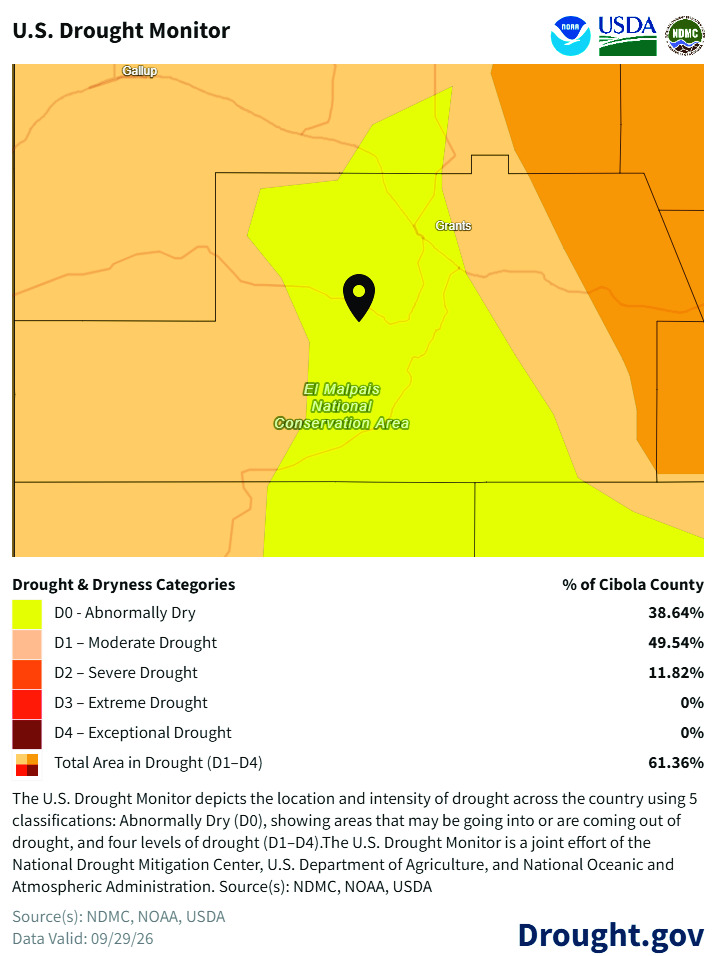
According to the latest U.S. Drought Monitor data, 16,698 people in Cibola County, or about 61.4% of the county’s population, remain affected by drought. That marks a 38.6% decrease from both the previous week and the previous month.
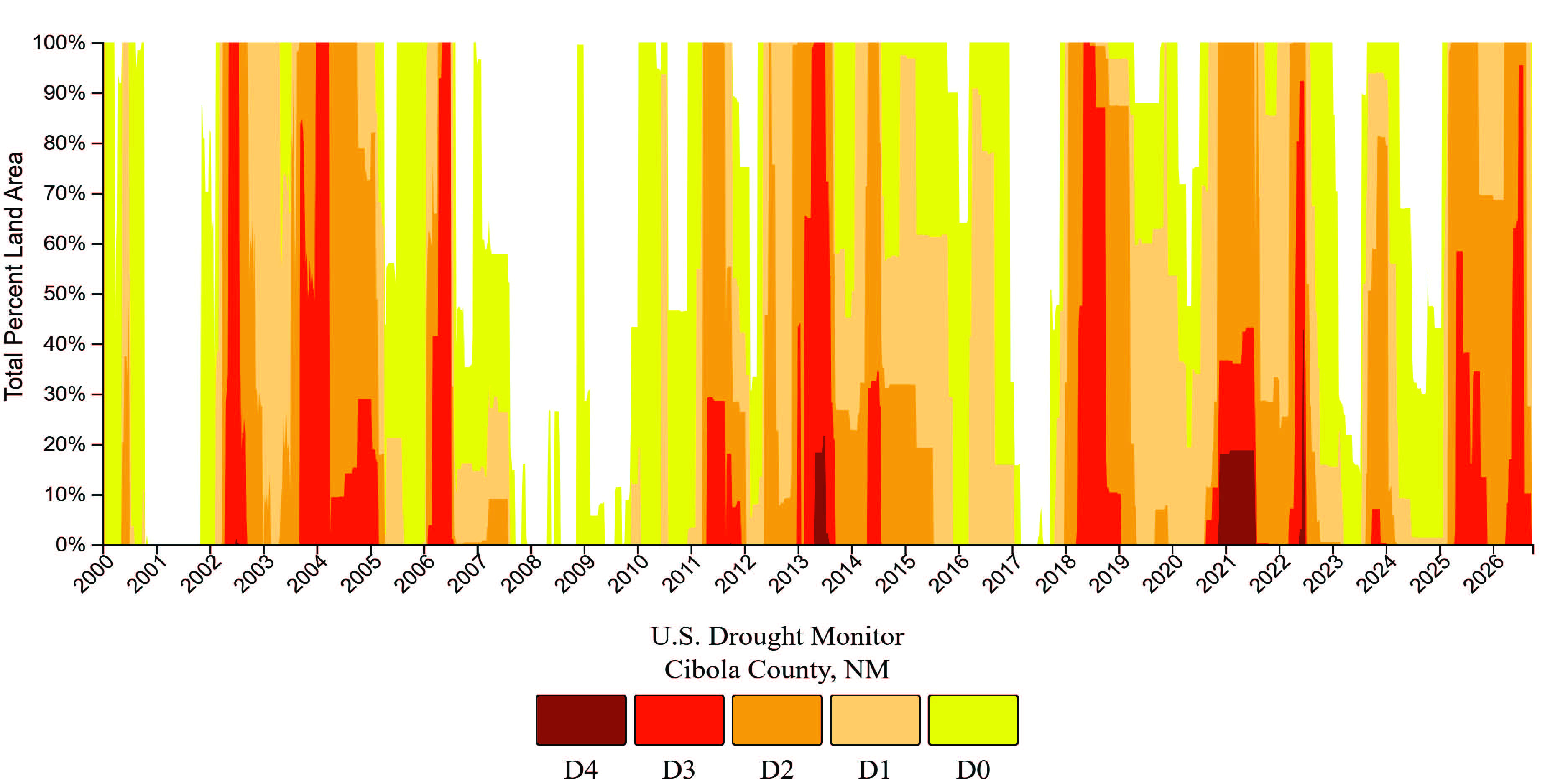
The latest drought breakdown shows 38.64% of Cibola County classified as Abnormally Dry (D0), 49.54% in Moderate Drought (D1), and 11.82% in Severe Drought (D2). Extreme Drought (D3), which covered much of the county earlier this summer, is no longer listed in the current county breakdown.
The improvement marks one of the most important changes in Cibola County’s drought status this year.
At the end of June, nearly all of Cibola County was classified in Extreme Drought. In August, the county remained 100% in drought, with most of the county in Severe Drought and a smaller portion still in Extreme Drought.
After repeated late-summer and September rainfall, the drought map has shifted into a less severe pattern.
Despite the rainfall August itself was still dry. Federal climate data shows August 2026 ranked as the 40th driest August on record over the past 132 years, finishing 0.69 inches below normal. January through August ranked as the 23rd driest start to a year in the same record, with precipitation running 2.5 inches below normal.
That means Cibola County entered September with a significant moisture deficit already in place. The late rains helped, but they arrived after months of drought had already affected reservoirs, soils, vegetation and local water systems.
Bluewater Lake and Rio San Jose
The Cibola Citizen’s water monitoring data shows the uneven nature of the recovery.
Bluewater Lake continued to decline through August despite repeated monsoon activity. The lake measured 7,365.00 feet on Aug. 2 and fell to 7,364.44 feet by Sept. 1, a loss of about 0.56 feet during the month. Compared with Jan. 1, when Bluewater stood at 7,368.77 feet, the lake was about 4.33 feet lower at the start of September.
Late September finally brought a measurable response.
Bluewater Lake stood at 7,364.15 feet on Sept. 22, then rose to 7,364.26 feet by Sept. 29 after repeated storms. The increase of 0.11 feet was modest, but it reversed the weekly declines that had dominated the year.
The Rio San Jose responded more sharply to the late-month storms. At Acoma Pueblo, the river measured 1.95 feet on Sept. 22 and rose to 2.53 feet by the morning of Sept. 29. U.S. Geological Survey data also recorded a much larger, short-lived surge late Sept. 28, when the river reached 4.32 feet before dropping back by the next morning.
That quick rise and decline illustrates how rapidly water can move through the local system during heavy rainfall. It also shows why a single storm response does not necessarily equal longterm recovery. Streams and arroyos may surge quickly during runoff events, while reservoir storage and drought conditions can take longer to improve.
Flooding Across Cibola County Among Significant Monsoon
The same rainfall that improved drought conditions also created hazards across the county. September storms brought repeated flood watches, saturated soils, road closures and standing water. Grants, Acoma and Laguna made sandbags available during the late-month storms, and El Malpais National Monument reported flooding along Highway 117 south of Skeen Campground.
To’Hajiilee Community School also organized sandbagging efforts as community members worked to protect the campus from additional flooding. The flooding concerns reflected a pattern seen throughout the late monsoon period: once soils became saturated, additional rainfall ran off more quickly into arroyos, lowwater crossings and drainage areas.
By the end of September, Cibola County’s monsoon season had become one of the most significant in recent years.
A monsoon analysis prepared for the Cibola Citizen found that New Mexico averaged 9.15 inches of rain during the 2026 monsoon season, making it the thirdwettest monsoon statewide since 2002.
Cibola County averaged 13.05 inches, the county’s second-wettest monsoon since 2002.
Much of that improvement came late in the season. The report noted that August was closer to average, while the final two weeks of September pushed totals well above normal and contributed to significant flooding.
The first week of October showed how quickly some storm impacts can fade.
Bluewater Lake measured 7,364.23 feet on Oct. 6, down only slightly from Sept. 29 and still above its Sept. 22 reading. The Rio San Jose, however, fell from 2.51 feet on Sept. 29 to 1.91 feet on Oct. 6, returning near its pre-storm level after the late-September surge.
The new water year began Oct. 1. At the Rice Park SNOTEL station in the Zuni/Bluewater River Basin, the previous water year ended with 17 inches of precipitation, or 87% of the site’s median of 19.6 inches. The station reported 0.2 inches of snow-water equivalent on Oct. 6, providing an early marker as attention begins shifting toward fall precipitation and winter snowpack.
The latest drought report shows a county in better condition than it was during the summer, but not fully out of drought. Extreme Drought has disappeared from the county breakdown, and less of Cibola County is now classified in drought. At the same time, more than 16,000 residents remain in drought-affected areas, Bluewater Lake remains well below its January level, and the county’s water outlook will depend on what fall storms and the coming winter snowpack provide.
Late monsoon rainfall changed the direction of the drought. The next question is whether that improvement can carry into the new water year.
Data sources used in this report: U.S. Drought Monitor and Drought.gov county drought statistics; NOAA climate rankings for August and year-to-date precipitation; U.S. Geological Survey data for Bluewater Lake and the Rio San Jose at Acoma Pueblo; NRCS SNOTEL data from Rice Park; Cibola Citizen water monitoring reports; Cibola Citizen weather and flooding coverage; National Weather Service flood watches and rainfall observations; New Mexico Department of Transportation travel advisories; and Rob Carver’s 2026 New Mexico monsoon analysis prepared for the Cibola Citizen.