Cibola’s COVID-19 cases remain on decline despite large single day surge
Reporter CIBOLA COUNTY, N.M. – New Mexico hospitals are overwhelmed with COVID-19 patients, there are not enough beds for both people with COVID and people who are involved in serious accidents. Because of this, New Mexico’s healthcare system is so badly strained that it has now entered Crisis Standards of Care. This means hospital resources will be distributed to those with the “greatest opportunity to benefit,” and not all patients will be treated with the same urgency; overwhelmed hospitals and medical staff simply do not have the ability to provide the level of care they usually would for all patients. These crisis standards come with legal framework to protect hospitals and care providers while fighting COVID-19 on the front lines; since the pandemic began, this is New Mexico’s second time in crisis standards
The mask mandate will remain in place until at least November 12 in New Mexico. Governor Michelle Lujan Grisham’s Office announced the extension of the mask mandate on October 15. The extension comes after an explosion of new cases across New Mexico on Oct. 12, which altered the state’s COVID-19 data.
After the reported cases on Oct. 12, Cibola County was upgraded from “Very High-Risk” to “Extremely High-Risk” because on Oct. 17 the county was averaging 57 daily cases per 100,000 people. The county will decrease to “Very High-Risk” once it hits 45.7 cases per 100,000 people.
As of Oct. 18, there were 300 people in New Mexican hospitals with COVID-19, down from 332 on Friday.
Crisis Standards of Care
On Oct. 18 Acting Secretary of the New Mexico Department of Health David Scrase announced that New Mexico will be entering crisis standards of care.
In a press release, NMDOH explains that this is in an effort to ensure a more standardized and equitable procedure in taking care of patients. According to New Mexico Crisis Standards of Care Plan, created by the NMDOH Epidemiology and Response Division, Crisis Standards of Care exist to “Minimize death and serious illness by distributing finite resources to those who have the greatest opportunity to benefit.”
Ten other states have also entered Crisis Standards of Care since the Delta Variant began to surge.
“Many of us just assume if we get a serious illness there will be an ICU bed available for us,” Secretary Scrase said in an Oct. 15 press release, “That has not been the case for every New Mexican over the past six weeks.”
Mask mandate
On Oct. 15 the office of New Mexico Governor Michelle Lujan Grisham extended the statewide mask mandate until at least November 12.
After explaining that there are not enough beds available for every patient with COVID-19 or other injuries and illnesses, Secretary Scrase said. “Now is not the time to abandon basic precautions. Our hospital and health care partners remain incredibly, incredibly concerned about the serious illness they are dealing with, and the pressure place upon their institutions and personnel by continuing infections. Tight-fitting masks make a difference, wearing one protects you and your family.”
For a short time, the mask mandate had been rescinded but as the Delta Variant began to surge across New Mexico and overwhelm the hospitals, Governor Lujan Grisham announced the reimplementation of the mandate in August to help slow the increase of COVID-19 cases.
Booster shots In the Oct. 13 edition of the Cibola Citizen, there was a misrepresentation of information. We thank CGH for bringing this to our attention and for helping to keep the community healthy during this unprecedented health crisis.
As of Oct. 18, there was only one approved COVID-19 vaccine booster shot: Pfizer-BioNTech. Other vaccines have yet to receive approval for their boosters.
According to CGH’s Cynthia Amanda Tena:
Dependent on the criteria for a booster, people should get both a booster and flu shot. Officials recommend that it is a good timing to get both flu shot and COVID-19 vaccine together.
a. CDC recommends that the following groups should receive a booster shot of Pfizer-BioNTech’s COVID-19 Vaccine at least 6 months after completing their Pfizer-BioNTech primary series (i.e., the first 2 doses of a COVID-19 vaccine):
i. People aged 65 years and older
ii. Residents aged 18 years and older in longterm care settings
iii. People aged 50– 64 years with underlying medical conditions
b. CDC also recommends that the following groups may receive a booster shot of Pfizer-BioNTech’s COVID-19 Vaccine at least 6 months after completing their Pfizer-BioNTech primary series, based on their individual benefits and risks:
i. People aged 18–49 years with underlying medical conditions
ii. People aged 18– 64 years at increased risk for COVID-19 exposure and transmission because of occupational or institutional setting. These recommendations only apply to people who previously received a Pfizer-BioNTech primary series (i.e., the first 2 doses of a COVID-19 vaccine). Occupations at increased risk for COVID-19 exposure and transmission include front line essential workers and health care workers as previously detailed by the CDC:
1. First responders (healthcare workers, firefighters, police, congregate care staff)
2. Education staff (teachers, support staff, daycare workers)
3. Food and agriculture workers
4. Manufacturing workers
5. Corrections workers
6. U.S. Postal Service workers
7. Public transit workers
8. Grocery store workers
Data anomalies Data anomalies by the state have altered the course of Cibola’s COVID-19 Delta Surge.
Due to the Indigenous People’s Day Oct. 11 holiday, COVID-19 cases were not reported as normal by the State of New Mexico. Oct. 11 was a Monday, when the Cibola Citizen collects data for the weekly COVID-19 report.
COVID data is usually reported by the state around 3 p.m., on Oct. 12 the data wasn’t posted until after 4:52 p.m., giving the Citizen staff mere minutes before sending off the Oct. 13 paper for printing to update the COVID-19 data on Page A1.
In April 2021 the state stopped reporting new daily case data on weekends. Because data wasn’t reported for three consecutive days, the data reported on Aug. 12 was drastically higher than the projected true daily rate. This is because the report included data for four consecutive days (Oct. 9, 10, 11, and 12) instead of daily.
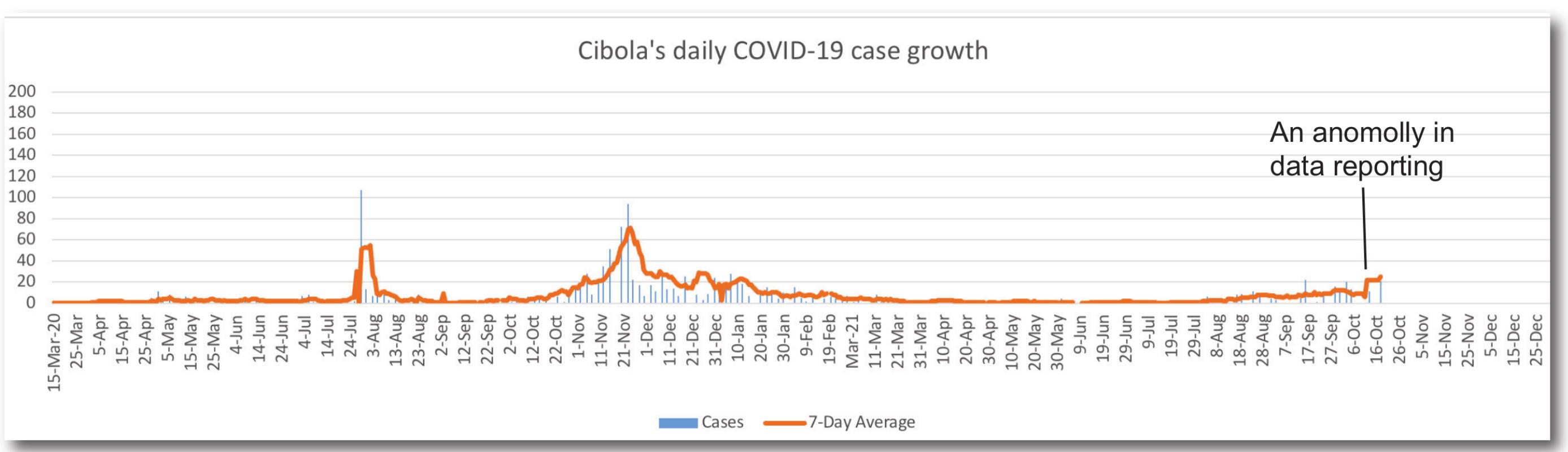
The data reported on October 12 included 120 new cases and rocketed Cibola’s daily average of new cases from nine per day on October 8, to 22 cases per day; It is unlikely this is an accurate reading, as the true number is projected to be lower. The report included no new deaths.
Before the newly reported cases, Cibola County was reporting anywhere from eight to 20 new confirmed cases per day. The data reported on Oct. 12 was higher than expected even for four days’ worth of data. It will likely be another week before the data evens out and daily case averages decrease.
Despite the anomalies in data reporting, Cibola appears to be plateauing, but until the data corrects over the following weeks from this anomaly in reporting, the true rate of daily COVID-19 infections will be difficult to gauge.
Impact on COVID-19 data
This anomaly in reporting does alter Cibola’s overall COVID-19 data, the Cibola Citizen will represent this anomaly in graphs that we publish.
This anomaly created Cibola’s highest single daily COVID-19 case increase since July 27. The last major single day jump in cases saw 178 new cases; the Oct. 12 report saw 120.
When represented on a single day case growth graph, there will be a large spike in cases on Oct. 12. Cases had been on the decline since the end of September and this single anomaly in the data misrepresents the work the county has done to lower its in crease in new cases.
No cases reported on the weekends means that Monday reports are typically more inflated with cases than they should be. With the added holiday on top of the weekend, the data reported on Oct. 12 was higher than average.
On Oct. 8 Cibola County’s average daily case growth had fallen to nine. Despite a lack of data being reported on the weekends, the trend didn’t buckle until Oct. 11. On the holiday, Cibola’s daily case growth had collapsed to six. On October 12, the daily case growth jumped to 22 because of the lack in reporting and large single day report.
The data doesn’t recognize that these new cases are for four days, it believes all 120 cases came on one day which is why the seven-day average of new cases is significantly higher than it had been before the large increase. The anomalies drastically alter Cibola’s COVID-19 data.
Because of this single day large increase in cases, which is not an accurate representation of the true daily case change, the math used to determine daily case growth will be using skewed data, which influenced the daily change rate for six days following the sudden increase. The single day increase went up again on October 19.
Data hstill needs to level out and is accurate to the best of the state’s ability at the moment, it is very likely that this data is still inflated due to the large increase in cases following the holiday.
Case spread in Cibola
EXTREMELY HIGH-RISK
1 in 6 Cibola residents have been infected with COVID-19
1 in 192 Cibola residents have died of COVID-19
Cibola is at Extremely High-Risk because on Oct. 18 the county had an average of 57 daily cases per 100,000 residents. Cibola will downgrade to High-Risk when it reaches 45.7 daily cases per 100,000 residents.
*Data courtesy of New Mexico Department of Health and John Hopkins Bloomberg School of Public Health.