
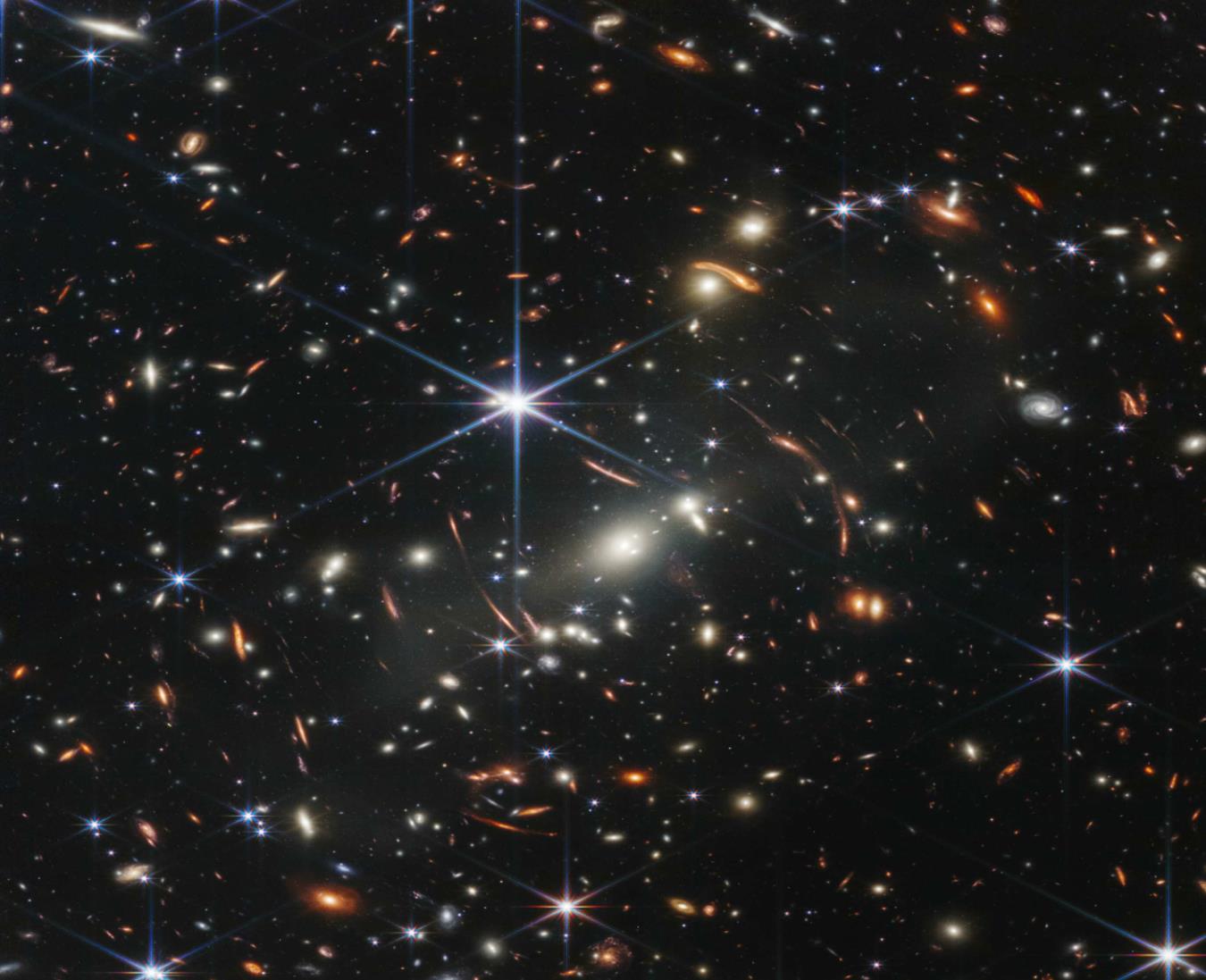
The National Aeronautics and Space Administration – better known as NASA – joined US President Joe Biden as he unveiled the deepest infrared image of the universe yet. The historic moment was met with questions about the images in the picture and excitement that those living today are the first humans in history to see clearly and so deeply into space.
The White House event was held on July 11 and gave the world a look at something no other human has ever seen before. Some of the galaxies seen in images revealed at Monday’s briefing are 13 billion years old. The way these galaxies and stars are seen is the way they appeared 4.6 billion years ago; this is due to how long it takes light to get from the source to the telescope that took the photo.
James Webb Space Telescope
The James Webb Telescope first took flight in December 2021. Launched from French Guiana in December on a rocket, the telescope then fell into orbit around sun, unfolded itself in space, and began to take pictures.
In the coming days and weeks, NASA will be releasing new images which are expected to help break through every branch of astronomy.
“This image is filled with galaxies, some more than 13 billion years old, which means they formed just after the Big Bang,” according to a White House press release, the telescope is looking for “Details about the atmosphere of an exoplanet outside our solar system, ‘stellar nurseries’ where stars form, galaxies that interact and trigger star formation and black holes, and a glimpse into how stars die.”
Building this project required thousands of scientists and engineers, showing a need for more members in the Science, Technology, Engineering, and Mathematics fields.
What is in the Picture?
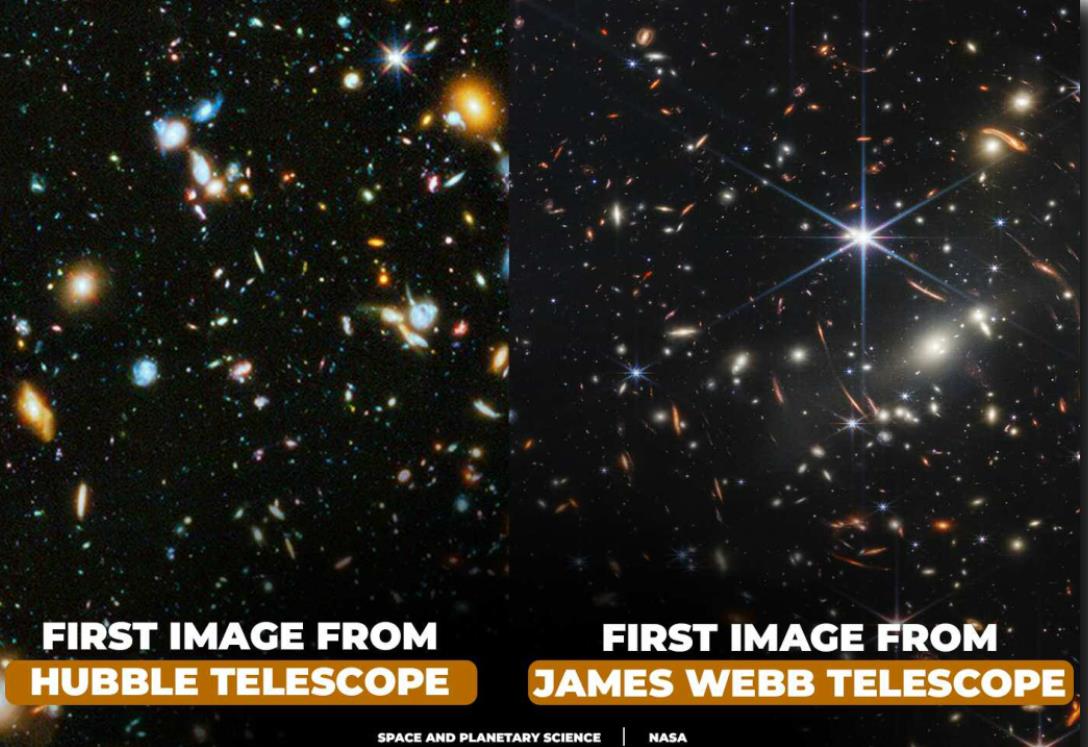
“Webb’s image is approximately the size of a grain of sand held at arm’s length, a tiny sliver of the vast universe. The combined mass of this galaxy cluster acts as a gravitational lens, magnifying more distant galaxies, including some seen when the universe was less than a billion years old. This deep field, taken by Webb’s Near-Infrared Camera (NIRCam), is a composite made from images at different wavelengths, totaling 12.5 hours – achieving depths at infrared wavelengths beyond the Hubble Space Telescope’s deepest fields, which took weeks. And this is only the beginning. Researchers will continue to use Webb to take longer exposures, revealing more of our vast universe,” according to a NASA press release on Webb.
The image released on Monday shows a galaxy cluster called “SMACS 0723” the way it appeared 4.6 billion years ago. There are many galaxies in front of and behind the cluster.
Light from these galaxies took billion of ears to reach this point in the universe. “We are looking back in time to within a billion years after the big bang when viewing the youngest galaxies in this field. The light was stretched by the expansion of the universe to infrared wavelengths that Webb was designed to observe. Researchers will soon begin to learn more about the galaxies’ masses, ages, histories, and compositions,” according to NASA.
Blue galaxies in the photo contain a multitude of stars, with little space dust. Red blobs on the photo indicate thick space dust. Green galaxies are estimated to be full of various chemical com pounds. Researchers plan on using this data to learn more about how galaxies form, merge, and grow. The mission is hoping to learn more about why galaxies stop producing stars.
The area seen in the photo is observable in the night sky by the constellation Volans, to the south.