
SANTA FE, NM— March was the month when creative minds were given the opportunity to stretch, grow, and spread wings. To celebrate National Poetry Month, The Department of Cultural Affairs in Santa Fe held a statewide Ekphrastic Poetry Contest. All who were compelled to set pen to paper directed by their own style and literary visions were welcomed, youths and adults. Ekphrastic poetry is defined as poems inspired by other works of art. The artwork they were to use as inspiration was on display at various venues operated by the DCA, and can be seen at the New Mexico Department of Cultural Affairs website, as are all the poems.
This was the first year for the contest. As a result, there weren’t enough young contestants in each of the categories, so the winners list recognizes the talents of more than one poet. Of the more than 100 submissions, Lauren Camp, State Poet Laureat, and a panel of experts chose the following winners, announced April 22:
Youth Category (6th to 12th grade)
Winner: 'Untitled' by Diego Viscarra | Inspired by Age of Dinosaurs Winner: 'Bobo bu Ko' by Abram Baldillez | Inspired by BoBo bu Ko Robotic Assemblage Winner: 'A Letter to My Space Man' by Marley Launer | Inspired by Lumen Space II Winner: 'The Sky Doesn't Leave When It Rains' by Amelia Martinez | Inspired by Pablita Passes (Walking Rain) Winner: 'Cracked Ice' by Isabella Lobaina | Inspired by Water Girls Honorable Mention: 'A Million Little Tears' by Jenna Chavez | Inspired by Pablita Passes (Walking Rain) Adult Category
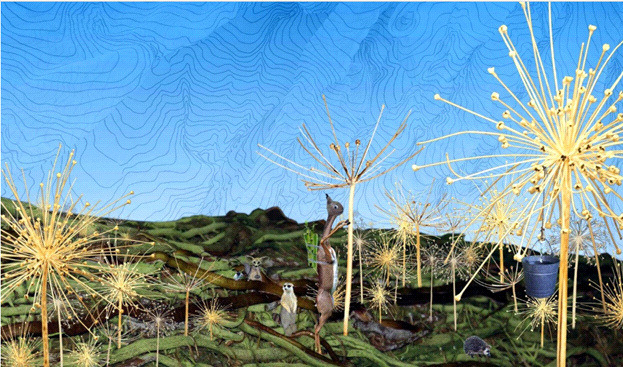
Winner: 'Walk With Me' by Susan Gatewood | Inspired by Age of Dinosaurs Winner: 'His Garden of Peace' by Terry Mulert | Inspired by Band of Familiar Winner: 'Budding Life' by Alison Penn | Inspired by Blessing of the Fields Winner: 'Grandpa' by Erica Photiades | Inspired by BoBo bu Ko Robotic Assemblage Winner: 'Awakening' by Tammy Iralu | Inspired by Children playing on swing, Jemez Pueblo School, New Mexico Winner: 'Lumen Space II' by Rebecca Aronson | Inspired by Lumen Space II Winner: 'Pablita Passes' by Andrea Watson | Inspired by Pablita Passes (Walking Rain) Winner: 'Mesilla Joyride' by Kristin Knight | Inspired by The Mesilla Guard Winner: 'Sing Out' by Alison Ely | Inspired by Untitled (Tree of Life) Winner: 'Water Girls' by Shauna Osborn | Inspired by Water Girls Honorable Mention: 'Untitled' by Jodi Creager | Inspired by Blessing of the Fields Honorable Mention: 'Age of Dragons' by Taylor Smith | Inspired by Age of Dinosaurs Honorable Mention: 'Holding On' by Thelma Giomi| Inspired by Children playing on swing, Jemez Pueblo School, New Mexico Honorable Mention: 'Untitled (Tree of Life) by Candice Yanez | Inspired by Untitled (Tree of Life) In the adult category, Terry Mulert was a champ with his poem, “His Garden of Peace”, that was inspired by his chosen painting “Band of Familiar” by Rebecca DiDomenico. One interesting quality of his poem is the light and cheerful, but thoughtful tone. And while this does mimic Ms. DiDomenico’s painting, the subject is his own. Furthermore, he leaves interpretation to the reader.
Mulert is an artist with multiple means of self-expression. He also is accomplished in wood sculptures of redwood and maple that he once exhibited at a gallery he owned and operated in the mountain village of Cordova with his partner of 37 years, Paula Castillo, who is also an artist. They are now in Belen where they moved to help her parents.
Mulert’s extensive experience proves his love for the written word. He has been involved in writing and publishing since he was 18, with some small manuscript formats, journals, periodicals, university-based publications, non-profits, and “some exciting responses to different contests.” He is now 60.
The poet went on to share his lifetime of literary experiences.
“I’ve been an artist all my life: the visual, poetry, publishing, readings, supporting other poets work. I used to be a professor in a small college in Espanola and I did the years of poetry readings for others with the literary magazine, and the literary club, and we would do readings in Espanola for just so many, I mean hundreds and hundreds and hundreds of people were supported. My wife Paula and I have done salons in our gallery, and in our home, and in our studios for decades where we would do readings, and performances, and theatrical pieces in a discussion-based setting, just like the word sounds, like a salon thing. You know, invite a lot of different people. We've been doing that for decades.
“The publishing world these days is so different than it was 20 years ago, just because of the shear volume of poets submitting (work). But in the state of New Mexico there are several things I could point to. New Mexico State University has a literary journal called Puerto del Sol, I’ve been in that. Miriam Sagan is a well-known poet and editor out of Santa Fe, she’s done numerous things, and there was an anthology that she did some time ago.
“I was going to say something about what's wonderful about being in New Mexico. Albuquerque and Santa Fe have deep, long histories of the literary arts, and I was not involved in all of those moments in time, but being at University of New Mexico for quite a long time there were a group of poets up in the high road area to Chimayo, Cordova, Dixon, that I became very intimate with, and many of them are passed away, I’m 60, these folks were older than me, they were in their hay day, so to speak. That was during the Beat era, the '50s and the '60s, and that was an area of specialty of mine, and interest in the literary arts. Jack Kerouac, Alan Ginsberg, Gary Snyder, Gregory Corso, and William Burroughs, I gravitated toward that period of time in American literature. and when I when I ended up in New Mexico I just kind of fell in with this crowd of folks who were part of that movement. Pierre Delattre is one person, Alvaro Cardona-Hine is another. They both passed on just in the last six or seven years. Pierre just died 2 years ago. So, I’m very grateful for that influence on my life. And then Paula and I, having met each other in Denver, way back in 1982, which sounds like a long time ago now, when we were both in college, and then we got married in 1987 and went to Europe for 3 years, came back and in 1990, permanently in Cordova. And we've been doing art together for all that time.
Asked why he chose the painting by DiDomenico to illustrate his poem, he explained, “When I looked through all the paintings (offered by DCA), I didn’t know if I would connect to anything, I thought, let’s see if anything connects to me with the work I’m doing right now. That one did because it seemed the most unfamiliar. So, I knew at that moment that it would give me a lot to work with and I would have to go on this short little journey to connect with it.”
Do all the artist’s poems have the same energy or does he express himself with the same impressions?
“Yes, the work that I do as a poet comes from a place that is very consistent. However, it’s not often that I sit down and write a poem with purpose. Typically, when I write it’s with complete exploration. When I begin, I have no idea how the poem is going to come into being. I really have no idea how it will, or if it will, succeed.
“I measure success in a poem in several ways. Based on my experience as a reader of many, many poets, of many decades of reading work, that I feel like I can judge this piece of reading work and deem it to be worthy of a lasting quality, not for others, but for me. In six days, or six hours, or six minutes I won’t turn around at it and say, this goes in that other file, which is poems that are unfinished.
“Once a poem makes it into the finished pile, or category, that’s a poem that is with me, and it’s in my ongoing manuscript in the spirit of Walt Whitman who continued to add poem after poem after poem throughout his entire lifetime to Leaves of Grass, that’s sort of how I see my work.
“I would say this poem is slightly more accessible to a wider range of readers than some of my other work. But it’s very consistent and very similar to many of the pieces I’ve written.”
Comparing the poem with the painting might raise a few questions. It is easy to understand why Mulert leaves interpretation to the reader. He enjoys the creative process, and DiDomenico’s work has made a connection on that level, but there is nothing literal between the two works.
In “His Garden of Peace” there is a man walking “like a branch blown free from the forest.” In the painting there es a little creature that looks like it could be part deer and part trying to climb one of the trees. They are both beautiful images, and different. You are the reader.
Don’t you love that it's the sound of his feet being eaten by the breeze? You can almost imagine that happening, symbolically.
And the things he carries through his life, don’t we all carry things, memories, tokens? It's not realistic, yet it sounds relatable, but different for each person.
He walks until his heart turns to gold…
You are the reader.
Mulert and DiDomenico have not met, but Mulert hopes they will at the poetry reading on the 19th that will be held at the National Hispanic Cultural Center in Albuquerque. All the poets and artists have been invited. And so are we all.
All the poems and paintings can be seen at https://newmexicoculture.or g/poetry.