
GRANTS,NM—The Cibola Arts Council shared the original broadcast of the New York Philharmonic Young People’s Concert, “A Copland Celebration”. The DVD performance was at its usual scheduled time on a Friday, May 18th.
The public performance was held in the Philharmonic Hall on Dec. 27, 1970, in recognition of the composer having turned 70 on November 14.
“Copland has often been called the 'Dean of American Composers. But he isn't the oldest. He's just unique,” said Bernstein in his introduction. He explained further, “He (Copland) has led American music through paths, both pleasant and thorny, for half a century. And he's never ceased fighting for the cause of new music, especially new American music.”
Bernstein chose to honor him by playing “two of his most popular works, his Concerto for Clarinet and String Orchestra and an excerpt from the ballet suite, Billy the Kid.”
The conductor considered these pieces to be “on the light side” in comparison to the composer’s symphonies and his chamber music. His concerto does sound light, and my description doesn’t do justice to Stanley Drucker’s performance. You have to see for yourself how he moves with the music as he translates it to his clarinet. His movements almost mimic Bernstein’s conducting movements. Maybe that’s why Bernstein is so renowned, he connects with the orchestra.
The conductor called Copland’s style a “big city, sophisticated” style that reflected the atmosphere of New York, its jazz, slang, Latin American rhythms, and accents of the city streets. Bernstein, of course, has a much better ear than some of us. He also hears “biting, funky dissonances”. To an untrained ear, also an ear of a different generation, those dissonant notes sound genius, but instrumentally difficult.
The Clarinet Concerto, first commissioned and performed by Benny Goodman, is one of Copland’s jzzy compositions.
“It is scored for an orchestra with no brass and no percussion at all, said Bernstein in his introduction of the piece. “And yet, it all comes swinging out with a great beat.”
The orchestra was simple, made up of only strings, a harp, a piano, and the solo clarinet. It played the “Concerto for Clarinet and String Orchestra” slow, and restful, but the strings and clarinet are lovely together, inspiring introspection, or just relax and enjoy.
Stanley Drucker and NY Philharmonic strings. Photo courtesy of Trine and YouTube.
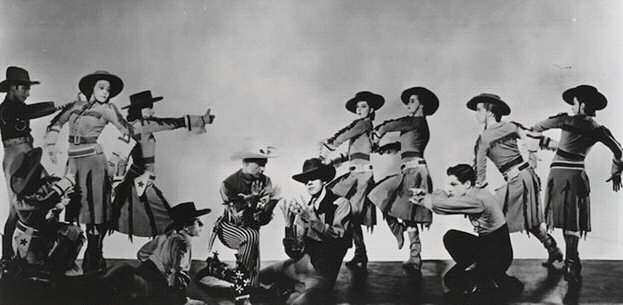
For the excerpt from the ballet suite, “Billy the Kid” the tone is quite different.
“From urban to rural, from New York jive to New Mexico twang, mixed with a bit of cowboy drawl and hot Mexican pepper,” said the conductor.
The ballet opens with a very grand, yet Western sound. Included in the score are many western cowboy songs in orchestral arrangement, still sounding dear to a western ear. 'Git Along Little Dogies', “Great Granddad”, 'Trouble for the Range Cook', 'Goodbye, Old Paint, I'm Leavin' Cheyenne', “The Chisholm Trail' all help tell Billy’s story through Copland’s western interpretations.
The ballet written in 1938 was choreographed by Eugene Loring for the Ballet Caravan. It premiered October 16, 1938, at Chicago’s Civic Opera House and it became an American classic.