
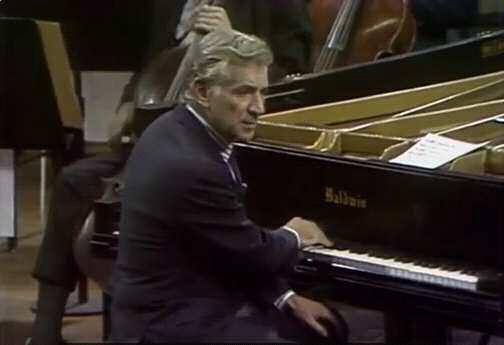
The opening program for the 15th season of the New York Philharmonic’s Young People’s Concert series was performed Feb. 13, 1972. The theme for this concert was “Liszt and the Devil”.
Bernstein opened with a brief discourse about how little we actually know about the compositions of Liszt. Without realizing it we have heard many of his piano pieces. They are either popular, easy-listening tunes like “Liebesträume”, the “Hungarian Rhapsodies”, or background music in cartoons. We might recognize these, but don’t know much about their composer.
This is even more puzzling because of the composer’s popularity in his day and his great influence over other composers, like Wagner and Debussy who are played frequently.
To show us why he felt the composer has not received his due attention, he used one of Liszt’s own compositions, the “Faust Symphony.” Bernstein described this as “one of the monumental works of the whole romantic movement.” He even compares Liszt to Faust, as a sort of Faustian character in his own life.
The story is based on a poem by Johann Wolfgang von Goethe, a German poet, in two parts. The first part was published in 1808, and the second part in 1832, which is when Liszt turned 20. Faust, Gretchen, and Mephistopheles are the three characters from Goethe’s poem and are the basis for the three movements of the symphony.
The centuries-old story about Faust is that he was a highly learned man. Nothing wrong with that. But, his knowledge was so vast during an age of superstition, that it was concluded he must have made a bargain with the devil, “his immortal soul in exchange for total knowledge and power.” Of course.
The audience is attentive as Bernstein explains who Faust is. Tiner, Photo YouTube.com The symphony is written to cover three themes: yearning, ideal love, and passion.
That Bernstein’s knowledge has depth can be easily seen as he leads the Philharmonic, and it is obvious he understands the story he is conducting. His performance is passionately physical and involved, not grandiose and expectant of worship.
This historic knowledge of composers and their compositions must affect the way his own pieces are presented, and his explanations certainly reveal that he hears elements the rest of us do not. The musicians, if you can see them, appear to be fervently involved in their own contribution to the symphony, and giving their best. Is it for their leader conductor, do they love Liszt, or is it devotion to their chosen profession?