
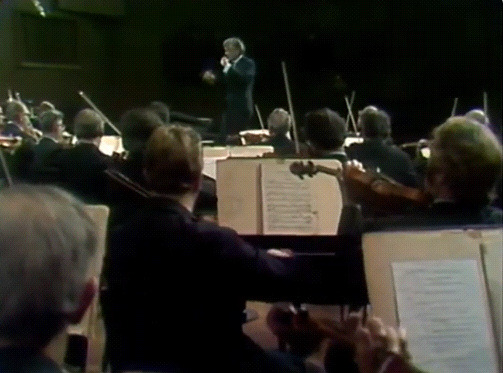
GRANTS,NM—Another brilliant presentation by the New York Philharmonic Orchestra under the conductor, Leonard Bernstein was originally presented on November 4, 1971. As it has been doing for several months, Cibola Arts Council shared this educational program with us on Friday May 23.
Arts Center Volunteer, C.L. Peterson, who scheduled the event, admires Bernstein and commented, “Bernstein is such a wonderful teacher, conductor, and musician.”
Harold C. Schonberg, chief Music Critic for the New York Times from 1960 to 1980 agrees. In his book, “The Great Conductors” Schonberg states about conductors, “He is of commanding presence, infinite dignity, fabulous memory, vast experience, high temperament and serene wisdom… He is many things: musician, administrator, executive, minister, psychologist, technician, philosopher and dispenser of wrath. Like many great men, he has come from humble stock; and, like many great men in the public eye, he is instinctively an actor. As such, he is an egoist. He has to be. Without infinite belief in himself and his capabilities, he is as nothing.”
Bernstein keeps proving this about himself with each performance. The Young People’s Concert series is aimed at a young audience of music students and their parents. We are also beneficiaries since the performances have been recorded for our education, enjoyment, and posterity.
The program was introduced with a tune familiar to most people regardless of age. We know it as the theme for “2001, A Space Odyssey.” But very few of us realized the grand sound of brass and percussion instruments is an excerpt from a composition by Strauss called “Thus Spake Zarathustra.”
Zarathustra was a Persian (Iranian) prophet of the sixth century B.C. His connection to Strauss is via the popular philosopher of his time, Frederic Nietzsche. Nietzsche wrote a book, “Thus Spake Zarathustra”. The philosophies in this book captivated and inspired Strauss musically, but the book isn’t about the prophet. Nietzsche used the prophet to speak for him, as a narrator.
Strauss’ composition, 'Thus Spake Zarathustra', is a musical tone poem about mortality and immortality, rebirth and transcendence.
“A tone poem, also known as a symphonic poem, is a single-movement orchestral piece that is written to evoke the tone of a poem, story, painting, place, or other extra-musical source. It is a piece of music for orchestra that represents a particular story, image, or mood. It is usually in a single continuous movement and illustrates or evokes the content of a poem, short story, novel, painting, landscape, or other (non-musical) source”. (hellomusictheory. com)
We all remember how the composition begins, with a few ascending notes in C. “Strauss builds his introduction on that rising motive, because it's supposed to depict a glorious sunrise, the equivalent of the prologue in Nietzsche's poem in which Zarathustra greets the morning sun on his mountain top.”
Next we hear the conflict of major and minor. Da Daa! “You see, those famous three notes are in C all right, but they are neither major nor minor. They could be either one. And now Strauss poses the first question, which is it? Major or minor?” You will know this when you hear it, but you probably didn’t know that was happening in the movie theme.
To continue with Bernstein’s introduction: “And then again come the same three notes, louder: And again the question, only this time the other way around: Minor or major? In other words, it's as if Strauss were saying 'Okay, that's the sun, the solar system, the universe, perfect and everlasting. But what’s my relation to it? If I'm part of it all, which I am, then why am I not also perfect and everlasting and immortal?' And that's the first question to be asked in this work, which is one long series of questions from start to finish. And the finish, as you'll see, instead of being an answer, will be the strangest and spookiest question of all.”
And so, the maestro continues to explain, and teach, the meaning and inspiration of Strauss’ composition. The piece, when the orchestra plays the half-hour composition, is as Bernstein says, full of musical questions and conflicts.
By now you must realize that attending these presentations, to hear for yourself, would be the greatest benefit. Bernstein explains all the compositions with ease and that is, of course, his great teaching skill. But words alone can’t teach music.
The orchestra plays this composition about a struggle over issues affected by time and man’s imperfection. It’s a very complex composition and performance. One can’t help but to have a degree of compassion for the man’s dilemma.
Bernstein and the Philharmonic do very well projecting and communicating the composer’s quandary.
In the end, Bernstein believes that having heard this tone poem will make us “wiser and better people than we were before.”
Maybe that is true because we have had the opportunity to be taught by a wonderful maestro.