
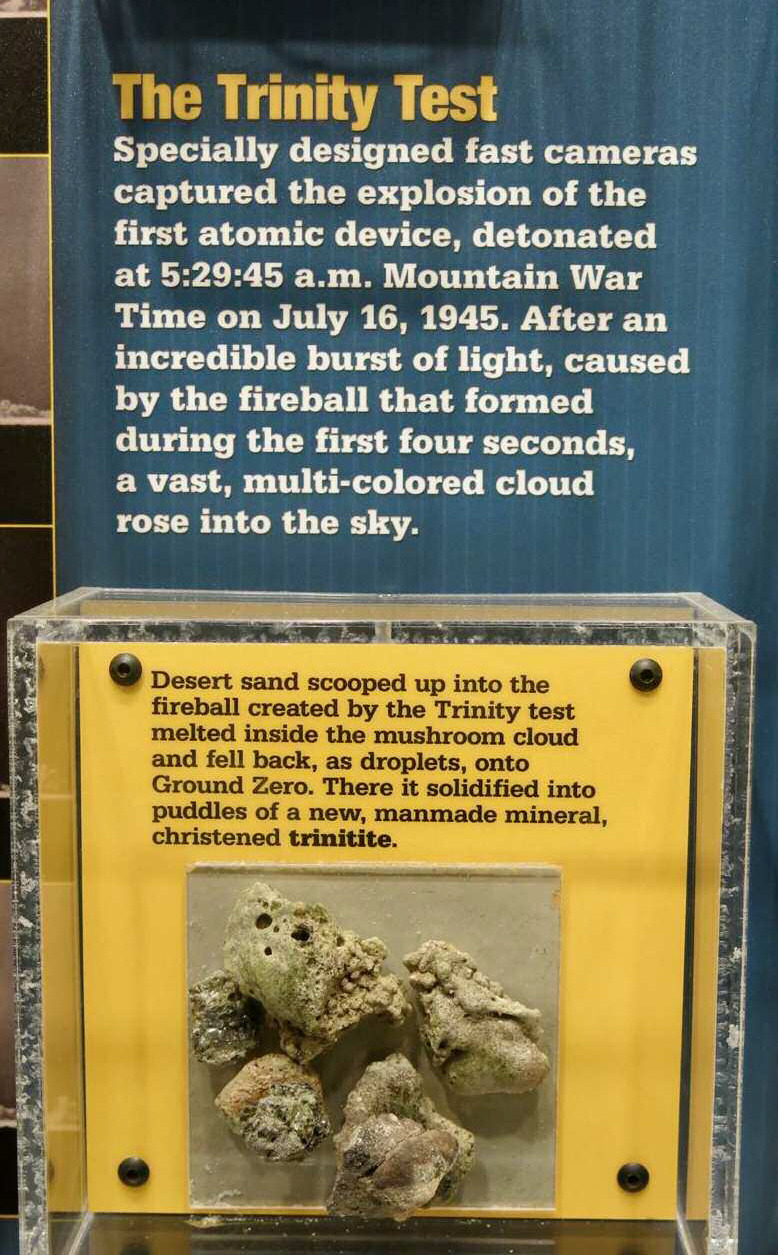
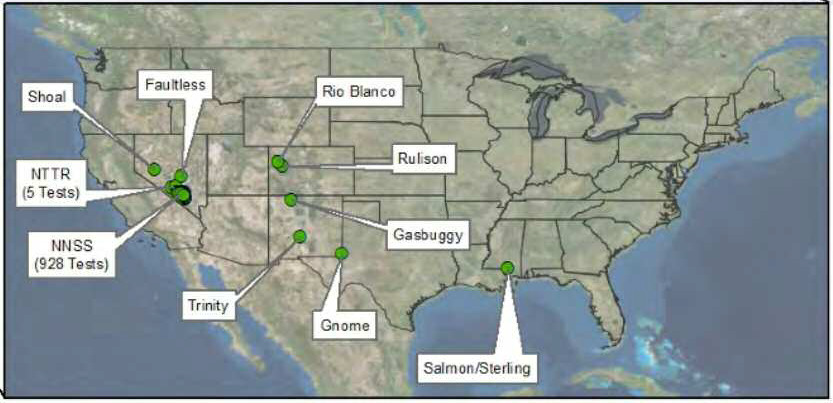
Beginning in 1945 with the Trinity Test in New Mexico, through July 17, 1962, the U.S. government conducted approximately 1,054 nuclear weapons tests, 24 of which were joint operations with the United Kingdom. The majority occurred at the Nevada Test Site, formerly Nevada Proving Ground, 65 miles north of Las Vegas.
Of those, 828 were underground tests and 100 were atmospheric, resulting in radioactive material being released into the atmosphere.
“During the Upshot-Knothole multi-shot experiment of 11 atmospheric nuclear tests conducted between March 17 and June 4, 1953, at the Nevada Test Site, 252 kilotons of nuclear fission products were emitted as radioactive fallout,” Mahlon E. Gates, manager of the Nevada Operations Office for the Department of Energy, told the House Subcommittee on Oversight and Investigations.
In other words, 11 of the 100 above-ground atomic tests contributed 555,564,900 pounds of radioactive fallout to the atmosphere.
It wasn’t until September 2002, 40 years after the aboveground tests ended, that the National Research Council in response to a congressional directive, convened a committee to assess recent scientific evidence associating radiation exposure with cancers or other human health effects. Their mission was to determine whether other groups of people or geographic areas should be covered under RECA, according to GAO.
The National Research Council report, published three years later, recommended that Congress establish a new, sciencebased process that would assess eligibility using a method called “probability of causation/assigned share,” a mathematical formula representing the fraction of a group of identical persons in whom a radiation-induced cancer would be expected to occur at some specified time after receiving a dose of radiation.
GAO said the report concluded that “the scientific evidence indicates that in most cases it is unlikely that exposure to radiation from fallout was a substantial contributing cause to developing cancer.”
Plaintiffs had begun filing lawsuits in the 1950s against the federal government under the Federal Tort Claims Act, alleging that it failed to warn them of the dangers of exposure to known radioactive hazards, Scott Szymendera, an analyst in Disability Policy at the Congressional Research Service, testified at the March 2021 RECA hearing.
Among the first downwinders to seek redress were a group of Utah sheepherders, he said. They alleged in 1956 that more than 4,000 of their sheep were killed as a result of exposure to radioactive fallout from the Upshot-Knothole tests.
The first two tests – the 24.4kiloton “Nancy” shot on March 24, 1953, and the 32.4-kiloton “Harry” shot on May 19, 1953 – contributed the greatest amounts of fallout to areas where sheep were known to be grazing, according to “the Knapp Report” on “Sheep Deaths in Utah and Nevada Following the 1953 Nuclear Tests,” (1979). Author Harold A. Knapp previously was a scientist with the Atomic Energy Commission Fallout Studies Branch.
At the time of the shots, 11,710 sheep were grazing in an area from 40 miles north to 160 miles east of the test site, Knapp said. Of those, 1,420 lambing ewes – female sheep pregnant during the time of the test shots – and 2,970 new lambs – born after in-utero exposure to radiation during the shots – died in the spring and summer of 1953.
Contrary to the National Research Council report, Knapp testified before Oversight and Investigations that exposure to radioactive fallout was, in fact, the primary cause of the sheep deaths.
On Aug. 7, 1980, the subcommittee released a damning report on the health effects of low-level radiation sustained as a result of the U.S. government’s nuclear weapons testing program. “The Forgotten Guinea Pigs” is based on information obtained during four hearings conducted between April and August 1979 in Utah, Nevada and Washington.
In a letter to the House Committee on Interstate and Foreign Commerce, Bob Eckhardt, chairman of the subcommittee, wrote that while the government was aware of the health hazards posed to the people living downwind from Nevada Test Site, it failed to provide adequate protection for the residents during its operation of the nuclear weapons testing program.
“At the very least, the government owed these people a responsibility to inform them of the exact time and place of each test and the necessary precautions that should have been taken to protect their health and safety. Absent such notification, and uninformed of the evidence held by the government which suggested that exposure to nuclear fallout was causing harmful effects, the residents of this area merely became guinea pigs in a deadly experiment,” Eckhardt said.
The government did, however, give advance notice to Southern Chemical Cotton Co. of Chattanooga, Tenn., and Eastman Kodak, according to “Under the Cloud,” by Richard L. Miller. (1986). The chemical company was the prime supplier of cotton film base to Kodak and was “very concerned with the problem of radioactive contamination.”
Miller wrote that in 1951, and occasionally thereafter, radioactive particles from Nevada had become mixed with the cotton in Tennessee and had subsequently ruined a substantial amount of film for their client.
“Subsequently, the AEC had agreed to tell Kodak of impending shots, no matter how secret,” he said. “Once the detonation had taken place, Southern Chemical would have about 12 hours before the air and water around Chattanooga became so radioactive it would preclude manufacture of the film. … it would take a week for the air to clear of any radioactivity, twice that long for the water.”
While Kodak and Southern Chemical were tipped off to the shots, “for the most part, the average American would be unaware of the composition or the special nature of the clouds drifting overhead,” Miller wrote. “And the spring of 1953 would prove to be the most radioactive to date.”
‘Suppression of data’ Regarding the ranchers who lost sheep during the Upshot-Knothole tests of 1953, Eckhardt wrote that despite evidence indicating a causal relationship between the sheep deaths and exposure to nuclear fallout, the subcommittee found that the sheep ranchers remained uncompensated “because of the government’s suppression and disregard of such data in the official investigation and reporting of the matter, and finally in the litigation of the case before the Utah District Court in 1956.”
Eckhardt wrote that scientific data presented to the subcommittee revealed that an unusual increase in leukemia deaths occurred in southwestern Utah for the years 19591960; additional leukemia “hot spots” were documented in Arizona and Utah for the years 19651970; and in Nevada for the years 1959-1963. There also was a twofold increase in thyroiditis and a fourfold increase in thyroid cancer in Utah between 1948 and 1962.
Upon determining the reason for the government’s failure to provide adequate protection to the downwind residents, the subcommittee concluded that a conflict within the authority to regulate nuclear energy existed in the Atomic Energy Commission such that the Commission’s decisions were weighted in favor of promoting the nuclear weapons testing program over controlling the safe production and use of nuclear energy, Eckhard wrote.
“Still further, the Subcommittee found that this conflict has continued to this day in the AEC’s successor agencies – the Department of Energy, the Department of Defense, and the Nuclear Regulatory Commission. As the primary responsibility and funding authority for radiation health research remains within these agencies, a bias, or at the very least, an appearance of a bias, to promote nuclear technology exists in the results of this research without a corresponding concern for health and safety,” he said.
The findings were being made available by the subcommittee, Eckhard wrote, “in recognition that we, as a nation, must accept the consequences of our governmental decisions and properly and promptly compensate the victims of our mistakes. Moreover, we must learn from events such as these so that we do not repeat past mistakes to the detriment of the health and welfare of future generations.”