
GRANTS, NEW MEXICO – A second showing of “Sleeping Monsters, Sacred Fires: Volcanos of New Mexico” on October 11, was as exciting and informative as the first time. The audience of volcano lovers was personally involved. They live amidst these sleeping monsters and love what volcanos have contributed to the landscape.
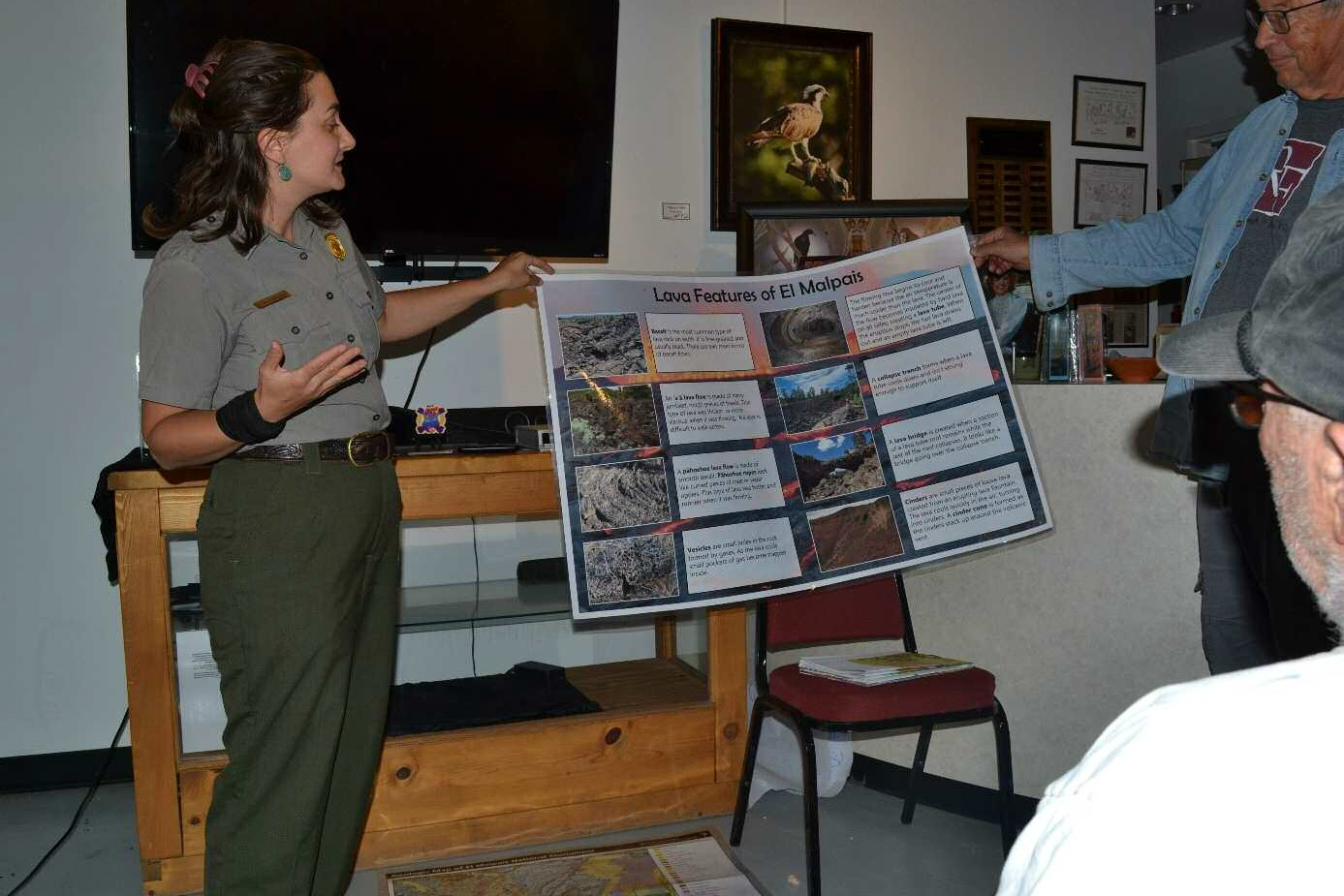
The group was also treated to a presentation and question/answer session by Carly Monnin, Park Ranger at El Malpais National Monument.
Our most obvious volcano, in the Grants area, is Mount Taylor. Monnin engaged the film attendees asking, “What makes it (Mount Taylor) special to you?
“I can, step outside my door and look upon it, and I have painted it,” commented Joan Sheski. “I'll go up there alone and spend hours just, maybe sketching, but just being with the trees.”
“I am envious. I have no artistic skills whatsoever, but my mother is a watercolorist,” Monnin contributed. “So y'all have built connections, relationships with the mountains around like you,” she added.
“I like to think of landscapes as people, with a sort of general impression,“ Monnin continued. “Under the surface it has multiple, multiple, multiple aspects, some of which are hiding in plain sight and are exposed to the surface, and some of them that are hiding far below, waiting to be discovered.”
“This is a geologic map of the Mount Taylor area, and as you can see, there are a lot of different colors there.” Monnin presented a map that has been researched by geologists who now volunteer at the Natural History Museum in Los Alamos.
Monnin continued to educate. “A geologic map shows you the layers that you are actually looking at, were you to uncover the soil.”
Looking at the map, it appears, to a non-geologist, to be a swirl of colors. Those colors, we are told, represent the depth of the layers that are unseen, but that lie beneath our very landscape.
“As you can see, there's an immense amount of diversity here because composite volcanoes like Mount Taylor create a huge diversity of types of rocks. That's why they're called composite or stratovolcanoes. It's because they create these strata. Not sedimentary strata like sandstone and mudstone, but layers and layers of volcanic material, some of which are highly viscous and resistant to flow,” Monnin added.
Ranger Monnin shared more details, “And so, they'll often explode, like Mount Saint Helens did in 1980. By contrast, non-viscous lava simply flows or oozes, sort of like molasses. And they'll build up these layers throughout millions of years or however long this volcano is active. This just gives you a taste of what's going on here.”
“All of these lava fields encompass 114,000 acres. That's how big El Malpais National Monument is,” continued Monnin. “That doesn't even count all of these cinder cones to the West on your way to El Morro, which are a bit older.
You can see there's a whole lot going on in here too. These are the Zuni mountains. There's a lot going on here because these are all due to uplift of a massive amount of material, some of which is from pre-Cambrian times, which is over a billion years old, just impossible for us to comprehend.”
“By contrast, the Mc-Cartys flow, was like 4000 years old. So human beings, particularly the Zuni and the Acoma people, were witnessing this. So not as much happening, as you can see, as in Mount Taylor. Why? Because from cinder cones and shield volcanoes down here in the (photo) Malpais there's mainly only one type of magma coming out and that's the non-viscous kind that is not resistant to flow. So, you only get basically one type of rock, which is basalt. And this just goes to show you the diversity within with just one type of rock.”
The park ranger brought a poster to illustrate some of the natural features that visitors can see at the monument. There are caves, in fact, one of the longest lava tube systems in the entire world.
“A dark line represented the lava tube that is almost 17 miles long. Some of it is broke (the lava tube) up in places, it is fragmented, and in some places the roof has collapsed creating a trench without a roof, so it’s no longer a cave. For that reason you probably couldn't walk the entire length of it inside because you would be blocked by rubble in so many places,” Monnin said.
The lava flows also contribute ecological value to their environment. The texture of the lava provides an opportunity for a diversity of life.
“Ecological diversity, or biodiversity, is the foundation of a healthy ecosystem. The more diversity there is, the healthier it is, the more resilient it is, the more empowered it is to withstand threats such as drought, which is becoming more prevalent with climate change, insect infestations or wildfire.”
Other natural features in lava tubes are moss gardens, bats, and insects that will feed on the mosses and the guano. You might also find cave crickets, larger arthropods, or possibly even birds growing, and a few mammals such as squirrels seeing what or who they can munch on.
Ranger Monnin continued to educate and fascinate the group about many more of the monument's features. You can find the film, “Sleeping Monsters, Sacred Fires: Volcanos Of New Mexico” on YouTube, and a plethora of information for your education at El Malpais National Monument (U.S. National Park Service), NPS.gov.