
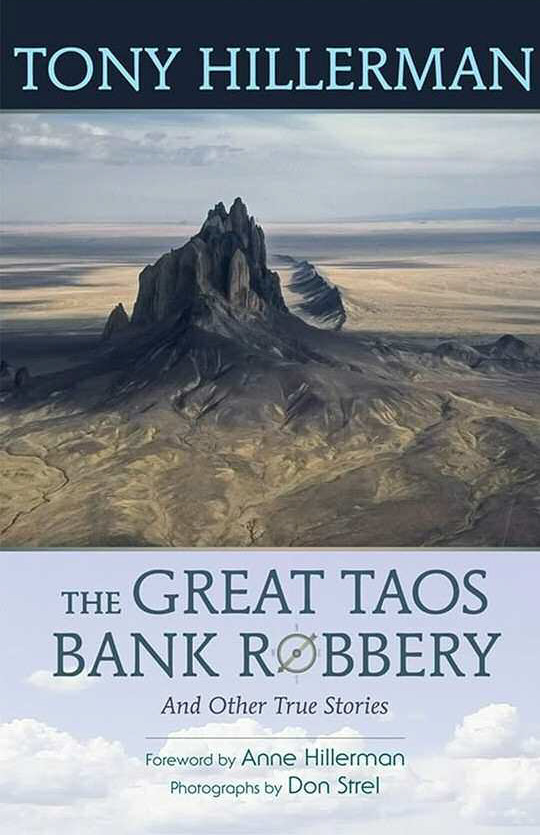

Title: “The Great Taos Bank Robbery and Other True Stories” Author: Anthony G. Hillerman Publisher: University of New Mexico Press, 1973 50th Anniversary Edition, UNM Press, 2023 ISBN: 978-0-8263-6545-3
“One glance at a book and you hear the voice of another person, perhaps someone dead for 1,000 years. To read is to voyage through time,” Carl Sagan.
This collection of 17 essays reflects how previous generations viewed life in the Land of Enchantment. These snapshots of history still resonate in the 21st century.
Tony Hillerman describes how the 1957 Taos bank robbery was reported (before it actually happened) to the Santa Fe newspaper, The New Mexican.
“If the reader can accept the fact that Taos managed a Great Flood [1935] without a river and with the very modest amount of water available in its arid climate, he is prepared to hear more about what happened on November 12, 1957,” cautioned the author.
“We All Fall Down” recounts the 1961 bubonic plague investigation near the village of Pecos. The disease, historically known as the Black Death, is caused by Yersinia pestis bacteria. This zoonotic bacteria is usually found in small mammals and their fleas, according to the World Health Organization. The disease has been detected in wild rodents and their fleas as far east as Central Kansas and Dallas, Texas.
The 1938 Catron County prairie dog die-off was the first record of plague in New Mexico. A Lincoln County man died of the disease in 2024. This was the first human case since 2021 and the first death since 2020.
“No organism has had more impact on the history of Western civilization. And none, with the possible exception of cholera, has killed more humans,” wrote Hillerman.
Cowboys, ranch life, and archeology are the focus of “Othello in Union County.” It traces the discovery of the skeletal remains of ancient mammals and human migration patterns. George McJunkin, born in east Texas, was the son of emancipated sharecroppers. McJunkin was the Crowfoot Ranch foreman when he and cowboy Tom Wylie first noted the bones of several prehistoric bison in Dead Horse Arroyo following the 1908 flash flood that destroyed most of the village of Folsom in northeastern New Mexico.
McJunkin died before the 1927 archeological dig which validated his claim that ancient hunters had harvested the giant bison in Dead Horse Arroyo. The Colorado Museum of Natural History excavated the site, which proved that humans had roamed North America more than forty thousand years ago.
The author’s interest in natural history is exemplified in “The Hunt for the Lost American,” which recounts the search for prehistoric artifacts near Albuquerque between the Rio Grande and the Rio Puerco rivers. Anthropologists now know that Folsom Man was neither the first nor the last of the Stone Age hunting people in America.
The tiny village of Las Trampas in northern New Mexico is a Spanish-Colonial settlement in Rio de las Trampas that was established in 1751. The Church of San Jose de Gracia, an adobe structure, was completed in 1780. The traditional Stations of the Cross were painted shortly after the Civil War by an itinerant artist from Sonora, Mexico. There were 34 families in Las Trampas fifty years ago but the young people don’t stay and the church and village will eventually disappear.
Hillerman describes the Four Corners Power Plant and Navajo Coal Mine in “The Very Heart of Our Country.” Fifty years ago the coal mine was one of the largest in the world.
“But there is also the stark, austere, everlasting beauty of the land,” wrote the author about the northwestern corner of the state.
The 1967 uprising at the Rio Arriba County courthouse, village of Tierra Amarilla, included a response by the National Guard. “Quijote Rio Arriba
County” explains the events that culminated on June 5. The goal was to force the federal government to prove in a court of law that it had legal ownership of the original Spanish land grants.
But the roots of the riot can be directly traced to 1848 when the Republic of Mexico ceded the territories of New Mexico and Northern California to the United States with the ratification of the Treaty of Guadalupe Hidalgo.
This included 33 million acres of Spanish land grants. By the turn of the century all but 1.9 million acres had vanished into national forests or public domain; and from the public domain through land frauds into the hands of cattle companies. The problem of swindled land grants still festers in the mountains of northern New Mexico, according to the author’s update.
“These essays were written a long time ago, when I was a forty-yearold grad student at the University of New Mexico,” wrote Hillerman in his Author’s Notes for the HarperCollins 2001 edition. SIDEBAR: Anthony Grove Hillerman (1925-2008), a native of Oklahoma, grew up on Native American lands. His journalism career included newspapers in Texas, Oklahoma, and New Mexico. This collection of short essays was the thesis for Hillerman’s Master’s Degree in Creative Writing, University of New Mexico, Albuquerque. He later earned a master’s degree in journalism, 1990, UNM Albuquerque, and served as chair of the UNM journalism department for twenty years.
His first novel, Blessing Way, was published in 1971. Hillerman wrote twenty-nine books including eighteen mysteries featuring Navajo police officers Jim Chee and Joe Leaphorn.
His 2001 memoir, Seldom Disappointed, garnered a Malice Domestic Lifetime Achievement Award and an Agatha Award. The Mystery Writers of America recognized Hillerman with two prestigious honors, the Edgar Allan Poe Award and the Grand Master Award. Hillerman was a recipient of the Grand Prix de Litterature Policiere.