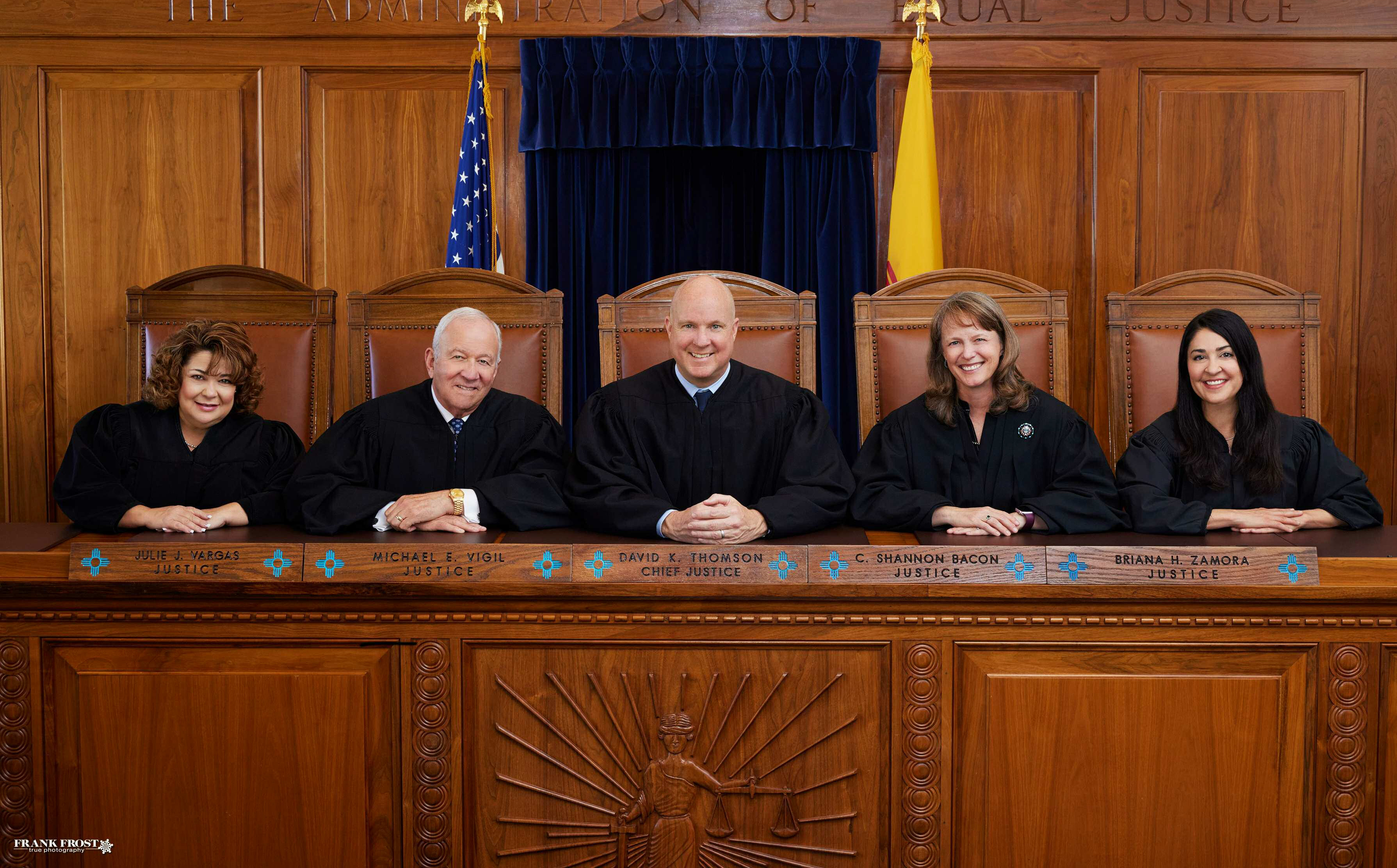
SANTA FE — In a direct response to a new federal executive order declaring English the official language of the United States, the New Mexico Supreme Court has reaffirmed the state judiciary’s constitutional commitment to providing language services for non-English speakers.
In an open letter issued this month, the state’s highest court emphasized that “without language access, individuals are at risk of wrongful conviction solely because of their language.” The letter, released by the New Mexico Administrative Office of the Courts, underscored that New Mexico’s legal framework—distinct among U.S. states—has long protected the rights of non-English speakers in the justice system.
“The New Mexico Judiciary is committed to upholding our Constitution and the fundamental right to fairness, equality, and due process,” the Court wrote.
The statement comes less than a month after President Donald Trump issued Executive Order 14224, which officially designates English as the language of the federal government. The order also revokes a 2000 directive (Executive Order 13166) that required federal agencies and federally funded programs to provide services to individuals with limited English proficiency (LEP).
While the federal order states that agencies may continue offering services in other languages at their discretion, it directs the U.S. Attorney General to rescind guidance associated with the previous language-access protections.
A Local Context with Deep Roots
New Mexico’s response reflects a broader tension between federal policy and the state’s multicultural heritage.
According to the New Mexico Supreme Court, approximately 27% of New Mexicans have limited English proficiency, and 25% speak Spanish at home. The state is also home to 23 federally recognized tribes, whose six major Indigenous language families—Keres, Tewa, Towa, Tiwa, Zuni, and Diné—remain active oral traditions.
“These languages are deeply embedded in our cultural fabric for thousands of years and still thriving today,” the Court stated. “The unique history and cultural composition of New Mexico is reflected in our laws, which ensure that no one is excluded from justice.”
Article VII, Section 3 of the New Mexico Constitution explicitly prohibits the exclusion of citizens from jury service based on an inability to speak English. The precedent dates back to Territory of New Mexico v. Romine (1881), one of the earliest legal opinions in the American West recognizing the importance of linguistic inclusion in the courts.
To that end, the New Mexico Judiciary provides interpreters for all aspects of jury duty, including selection, orientation, deliberation, and trial proceedings. It also offers scribes for jurors and selfrepresented litigants to complete legal documents, according to the Court’s Language Access Services Division (languageaccess. nmcourts.go v).
New Mexico’s stance is a constitutional one— rooted in its statehood history. When New Mexico was admitted to the Union in 1912, protections for Spanish-speaking citizens and Indigenous populations were central to negotiations with Congress. The state’s Constitution was crafted to reflect that, enshrining protections that continue to set it apart nationally.
While Executive Order 14224 does not explicitly mandate the elimination of multilingual services, it alters the federal government’s posture toward language access by rescinding the requirement that agencies accommodate LEP populations.
As courts across the country consider how to navigate the executive order’s implications, New Mexico’s highest court made its position clear.
“The New Mexico Judiciary stands firmly behind its duty to serve the public in all languages spoken by our people,” the Court concluded.
For more information about language services offered in New Mexico courts, visit languageaccess. nmcourts.gov.