


GRANTS, N.M. — The Radioactive and Hazardous Materials Committee of the New Mexico Legislature held a public hearing at New Mexico State University–Grants on July 11 to review the status of uranium mining across the state, with a focused discussion on proposed projects in Cibola County.
The hearing marked the first time in recent years that legislators gathered in person in Cibola to discuss uranium development—signaling the growing urgency and complexity of the issue for the region.
The committee, chaired by Senator Jeff Steinborn (D-Las Cruces), heard from state regulators, federal liaisons and tribal legal representatives in a daylong session inside Fidel Hall. While several topics were covered—including the San Juan Mine cleanup and uranium ore transportation—one presentation stood out for its depth and relevance to the Cibola community: a comprehensive update on the status of proposed uranium mining projects in New Mexico, delivered by David “D.J.” Ennis, Program Manager for the Mining Act Reclamation Program at the Energy, Minerals and Natural Resources Department (EMNRD).
Five Projects in Motion, Two on Mount Taylor
According to Ennis, five uranium projects are currently active or under review in New Mexico:
*La Jara Mesa Mine (Cibola County) – This proposed uranium mine is located northeast of Grants, within the Mount Taylor Ranger District, on a mix of U.S. Forest Service land and private property. The site lies within the boundaries of the Mount Taylor Traditional Cultural Property (TCP), a designation that acknowledges the mountain’s sacred importance to Indigenous nations including the Acoma, Laguna, Zuni, Hopi, and Navajo peoples.
Operated by Laramide Resources Ltd., the La Jara Mesa project is designed as a conventional underground mine with two lateral inclines providing access to uranium ore located above the water table. Because the ore body is in a “dry” geologic zone, the mine would not require dewatering—a process that typically involves pumping large volumes of groundwater to access ore. Instead, water use would be limited to surface operations, such as septic systems, worker showers, and dust control.
The project was initially proposed in 2009, but entered a prolonged hiatus beginning around 2012. Activity resumed in 2024, with Laramide working to update its Sampling and Analysis Plan, Baseline Data Report, and eventually submit a full Mining Operation and Reclamation Plan. The state’s Mining and Minerals Division (MMD) has not yet received the complete application.
Simultaneously, the U.S. Forest Service has resumed its federal permitting process, including tribal consultation under Section 106 of the National Historic Preservation Act and the resumption of the National Environmental Policy Act (NEPA) review.
A draft Environmental Impact Statement (EIS) was published in 2012, but the federal process is now being updated to reflect changes to the project and regulatory standards.
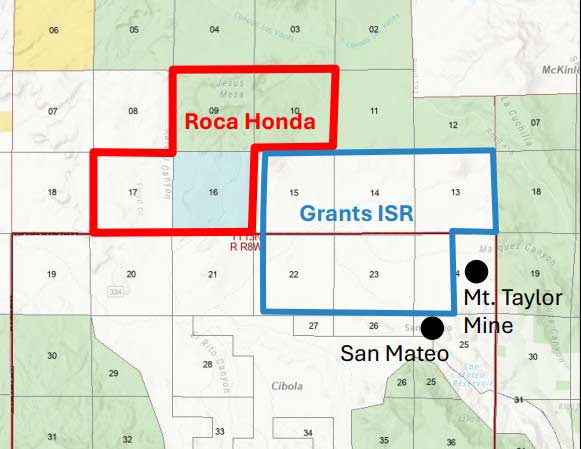
*Roca Honda Mine (McKinley County) – The Roca Honda project is a proposed conventional deep underground uranium mine located near the community of San Mateo, within the Mount Taylor Traditional Cultural Property (TCP).
The project is being developed by Energy Fuels Inc., one of the largest uranium producers in the United States.
Unlike La Jara Mesa, the uranium ore at Roca Honda lies below the water table. According to Ennis, this will require the construction of a vertical shaft approximately 2,000 feet deep to access the deposit.
Because the mine would intersect groundwater, it is classified as a “wet” mine, meaning extensive dewatering is necessary to keep the mine dry and operable.
Estimates indicate the mine would need to pump between 2,000 and 4,500 gallons of groundwater per minute during full operations. According to Ennis, the company Energy Fuels seeks to treat this water on-site and discharged through a pipeline system into the Rio San Jose, in accordance with federal and state water quality regulations.
Ennis explained the Clean Water Act governs this aspect of the project, alongside oversight from the New Mexico Environment Department (NMED).
According to Ennis, the project was first proposed in 2009 and a draft Environmental Impact Statement (EIS) was released by the U.S. Forest Service in 2012. Permitting activity slowed significantly between 2015 and 2024, but Energy Fuels has recently re-engaged with state and federal regulators.
Key permitting elements—such as the Mining Operation and Reclamation Plan, financial assurance, and updated tribal consultation—are still pending, according to Ennis.
*Cebolleta Uranium Exploration (Cibola County) - The Cebolleta project is an active uranium exploration program located north of Laguna Pueblo on private land within the historic Cebolleta Land Grant. The site lies within the Grants Mineral Belt, one of the most uranium- rich regions in the United States, which historically accounted for approximately 37% of all U.S. uranium production.
The project is currently being led by Premier American Uranium Inc., a Canadian mining company that recently merged with American Future Fuel Corporation, consolidating their uranium assets across New Mexico, Colorado, and Wyoming. The Cebolleta site was previously explored and mined in the mid-20th century, and the current effort is focused on confirming and expanding known deposits using modern drilling and geological assessment techniques.
As of 2024, Premier American Uranium reported an updated NI 43-101 compliant mineral resource estimate of 18.6 million pounds of uranium oxide (U3O8) in indicated resources and 4.9 million pounds in inferred resources, based on multiphase drilling and historical data. The company has now shifted from confirmation to resource expansion, targeting unexplored zones including the Jackpile extension, Sohio areas, and Piedra Lumbre prospect.
According to paperwork provided to the legislative committee, the project is located entirely on private land, it is not subject to federal permitting requirements under the National Environmental Policy Act (NEPA).
However, Ennis said the project must still obtain exploration permits from the New Mexico Mining and Minerals Division (MMD). Exploration permits were first issued in 2023 and subsequently renewed in 2024 and again recently in 2025.
The project does not yet have a mining permit, and drilling is being conducted solely for assessment and planning purposes.
Several legislators discussed a need for engaging the Cebolleta Land Grant, which remains active, with residents still living in and around it, about the mining initiative.
*Grants Precision In-Situ Recovery (ISR) (Cibola County) – The Grants Precision ISR Project is a proposed in-situ recovery uranium operation located near San Mateo, within the broader Grants Mineral Belt. This project is unique among the current uranium proposals in Cibola County due to its use of in-situ recovery (ISR) technology—a method of uranium extraction that differs significantly from conventional underground or open-pit mining.
Instead of removing rock, ISR involves injecting a solution of bicarbonate (HCO₃⁻) and oxygen into underground uranium-bearing rock formations through a wellfield system. This solution mobilizes the uranium, turning into a liquid-like form, which is then pumped back to the surface as uranium-rich water, where it is processed to extract uranium oxide (U₃O₈), commonly known as yellowcake.
Because ISR occurs entirely underground and does not involve surface excavation, it is often promoted as a lower-impact method of uranium production.
The Grants Precision ISR Project is being developed by Grants Energy, and it is regulated exclusively by the federal Nuclear Regulatory Commission (NRC).
The legislative committee was informed this site is exempt from the New Mexico Mining Act, which means it does not require a state mining permit.
Instead, environmental oversight is provided by the New Mexico Environment Department (NMED) and the NRC, which evaluate groundwater protection, waste handling, and radiation safety.
As of mid-2025, the project is in the early stages of the federal permitting process, with no final reviews completed as of July 11. The Grants ISR site has also been designated a FAST-41 “covered project”, giving it prioritized federal permitting coordination under President Trump’s executive orders aimed at accelerating domestic uranium development
Churchrock–Crownpoint In-Situ Recovery (ISR) (McKinley County) – The Churchrock–Crownpoint project is a proposed in-situ uranium recovery operation located in McKinley County, on a mix of private lands and Navajo allotments near the communities of Churchrock and Crownpoint.
The project is owned by Laramide Resources Ltd., a Canadian company with uranium holdings across the western United States, including the La Jara Mesa mine in Cibola County.
Like the Grants ISR project, this site uses in-situ recovery (ISR)—a technique in which bicarbonate and oxygen are injected into underground formations to dissolve uranium ore and turn it into a liquid-like form. The uranium-rich solution is then pumped to the surface and processed, reducing the need for surface disturbance.
The Churchrock and Crownpoint sites are permitted under a single federal license issued by the Nuclear Regulatory Commission (NRC).
As a result, the project is not regulated under the New Mexico Mining Act, and oversight instead falls to federal agencies and the New Mexico Environment Department for environmental and water quality permits.
Originally proposed in the 1980s and revised multiple times since, the ISR plan was granted a source materials license by the NRC, but development stalled for years due to opposition from the Navajo Nation, community organizers, and environmental groups.
In May 2025, the Churchrock–Crownpoint ISR project was added to the federal FAST-41 permitting program, a designation that prioritizes federal interagency coordination and expedites environmental reviews. Despite that status, the project still requires several additional permits and public engagement steps before construction or extraction can begin
What Does it Mean?
The La Jara Mesa and Roca Honda projects—both long-stalled—have resumed federal and state permitting processes in 2024 and are now subject to renewed environmental reviews, tribal consultations, and baseline data collection.
Ennis emphasized that while federal permitting can move independently, no uranium mine can operate in New Mexico without state approval.
State Asserts Authority Despite Federal Fast-Tracking
During the meeting, Ennis outlined the interplay between state and federal law.
While federal agencies— under recent executive orders from President Donald Trump—have moved to classify uranium mining as a national priority, Ennis reaffirmed that the New Mexico Mining Act still governs most aspects of hard rock mine approval in the state.
“The feds are going to do what the feds are going to do,” Ennis told the committee. “But if federal permitting is not on the same pace, the default becomes the state’s permitting process.”
Projects like La Jara Mesa and Roca Honda must still complete a full Mining Operation and Reclamation Plan, undergo environmental evaluations, and provide financial assurance for site reclamation.
In addition, water use and quality must be separately permitted through the New Mexico Environment Department.
Ennis added that failure to comply with state permitting could result in enforcement actions, including fines and—if necessary—the involvement of the New Mexico State Police to halt illegal activity.
Traditional Cultural Protections and Federal Designations
Mount Taylor has been a federally recognized Traditional Cultural Property (TCP) since 2014, a status that requires tribal consultation for any proposed land disturbance within its boundaries.
However, the TCP designation does not explicitly prohibit mining. Ennis acknowledged the uncertainty ahead.
“The intersection of the Mining Act and the TCP designation is a difficult question to answer,” he said. “I don’t know that we’ll know until we get to the end of the process.”
Some uranium projects on Mount Taylor, including La Jara Mesa, have been added to the federal FAST41 permitting program, which seeks to coordinate and expedite infrastructure development nationwide.
During the hearing, Senator Angel Charley (NM Senate District 30, D– Acoma Pueblo) reminded the committee that earlier this year, the Legislature passed Senate Memorial 14, which she sponsored to formally oppose new uranium mining near Mount Taylor.
The memorial passed on March 12, one day after the House adopted a similar measure, House Memorial 37, introduced by Representative Michelle Pauline Abeyta (NM House District 69, D–To’hajiilee).
“Mount Taylor is sacred to the Acoma people, to the Navajo, to Zuni, to Laguna, and to the Hopi,” Charley said. “It is a place of prayer, not a place for radioactive waste.”
Though non-binding, both memorials call on federal and state agencies to deny mining permits near the mountain and reform the General Mining Act of 1872 to require greater tribal consultation and environmental protection.
House Memorial 37 passed the New Mexico House of Representatives on March 11, 2025, by a vote of 39-23 with seven members excused and one absent.
Senate Memorial 14 passed the New Mexico State Senate on March 12, 2025, by a vote of 21-14 with four members absent and three excused.
The resolutions also instructed that copies be sent directly to the leaders of Cibola, specifically: the Grants City Council, the Milan Board of Trustees, and the Cibola County Commission, emphasizing that the state’s stance should be heard locally.
Counties Can Weigh In— Formally
Near the end of the meeting, DJ Ennis responded to a question about the role of counties in the permitting process.
He clarified that while county commissions do not have authority to approve or deny mining permits, they can pass resolutions stating their position on uranium mining.
“It’s not regulatory,” Ennis said, “but it becomes part of the record.”
Ennis explained that public comments are taken seriously when considering applications for the opening or closure of mines.