

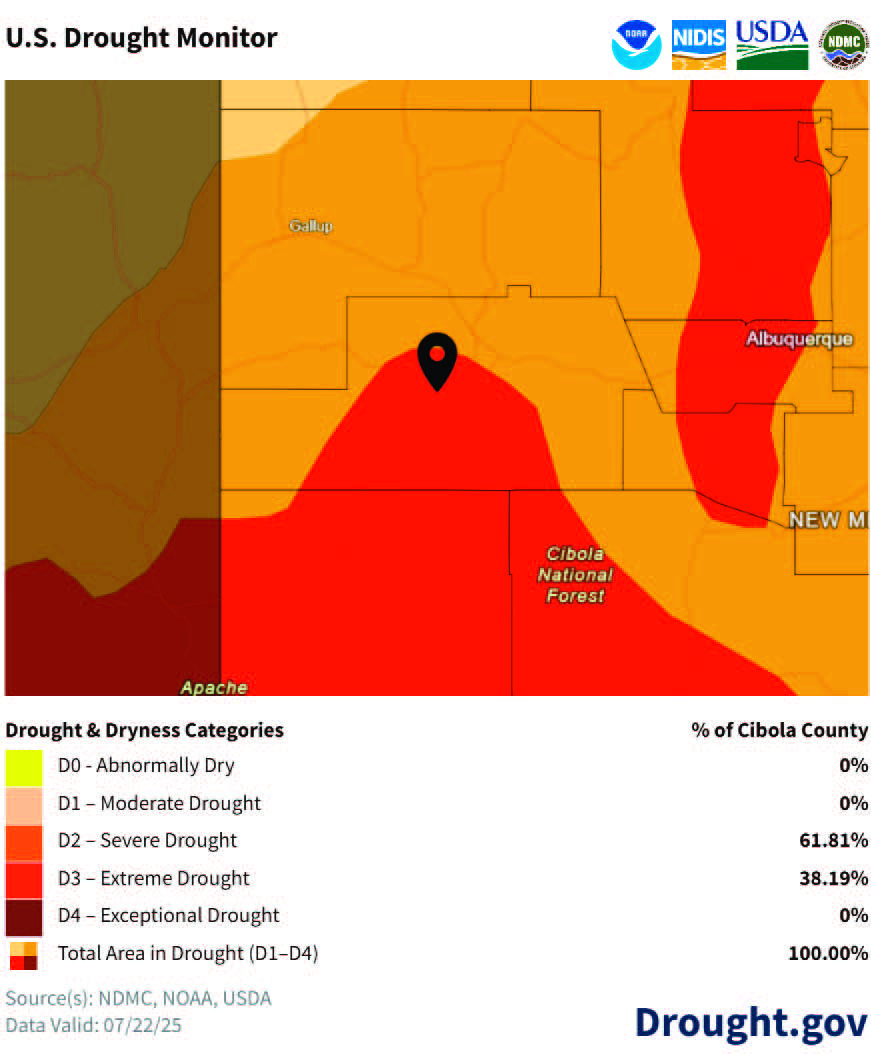
CIBOLA COUNTY, N.M. — While scattered rainfall briefly touched parts of Cibola County this month, the drought remains unchanged: 100 percent of the population— an estimated 27,213 residents—remains affected, according to the latest figures from the U.S. Drought Monitor and the National Integrated Drought Information System.
As of July 25, 61.81 percent of Cibola County is experiencing Severe Drought (D2) conditions, with the remaining 38.19 percent in Extreme Drought (D3). There has been no change in drought category from the previous week or month, marking a steady, prolonged stretch of dryness that continues to challenge land managers, fire crews, and agricultural producers across the region.
The drought’s toll on agriculture remains considerable. According to USDA estimates, 448 acres of hay and 30 acres of haylage are currently in drought conditions, along with 10,281 cattle and 3,026 sheep. These figures underscore the vulnerability of both livestock and forage in the face of sustained dryness.
A Dry 2025
Despite June ranking as the 31st wettest June in 131 years—coming in 0.36 inches above normal— the year overall remains dry. From January through June, Cibola County is experiencing its 43rd driest year on record, down 1.24 inches from the historical average.
Bluewater Lake, the county’s largest reservoir, offers a vivid illustration of these patterns.
After peaking in early spring at over 10,000 acre-feet, the lake's volume has steadily declined, measuring just 6,418 acrefeet as of July 28, based on U.S. Geological Survey data. This drawdown reflects a combination of evaporation, downstream demand, and the region’s ongoing drought.
The Zuni/Bluewater River Basin’s Rice Park SNOTEL station reported negligible remaining snowpack this season, which was capped by a dismal 0.3 inches of snow water equivalent earlier in the year—far below average and insufficient to recharge reservoirs or support long-term soil moisture.
Local Blazes and Regional Risks
Recent wildfires—including the Porter Ranch Fire, which burned over 50 acres south of San Rafael on July 28—have demonstrated how even small ignition events can escalate rapidly under these conditions. The blaze was quickly contained by fire crews, with Cibola County Manager Kate Fletcher thanking all of the fire crews for their rapid response to the incident which prevented further fire growth Fires at higher elevations and more remote areas, including the Drop Off Fire on Mount Taylor, the Bluffs Fire in the Zuni Mountains, and Rainbow Springs Fire in Cibola’s West, have each contributed to regional fire activity; all of these fires were successfully contained.
Local agencies remain on high alert. The New Mexico State Forestry Division, Cibola County Fire, and federal partners have coordinated response to multiple incidents this month, aided by favorable nighttime humidity and water drops. Still, weather forecasts show sustained fire danger, with humidity levels dipping as low as 11 percent and winds reaching up to 14 mph in affected areas.
Across New Mexico, over 92 percent of the state remains in drought, with nearly one-third in Extreme Drought or worse, according to the Office of the State Engineer’s July 8 monitoring report. These conditions continue to place stress on both fire suppression capacity and long-term water resilience.
A Call for Vigilance
Cibola County remains under Stage II fire restrictions, including bans on campfires, charcoal use, and smoking in open areas. These restrictions will remain in place through at least September 30, unless lifted sooner.
As the drought persists, local officials urge residents to remain cautious, avoid outdoor burning, and report any signs of smoke. Drought conditions may not always be visible day to day—but their effects on fire behavior, farming, and water storage continue to mount.
More information and resources are available at drought.gov and fire.airnow.gov.